|
Iberia
(Georgian — იბერია, Latin: Iberia or Iberi and
Greek: Ἰβηρία)
also known as Iveria (Georgian: ივერია) was a name given by the ancient
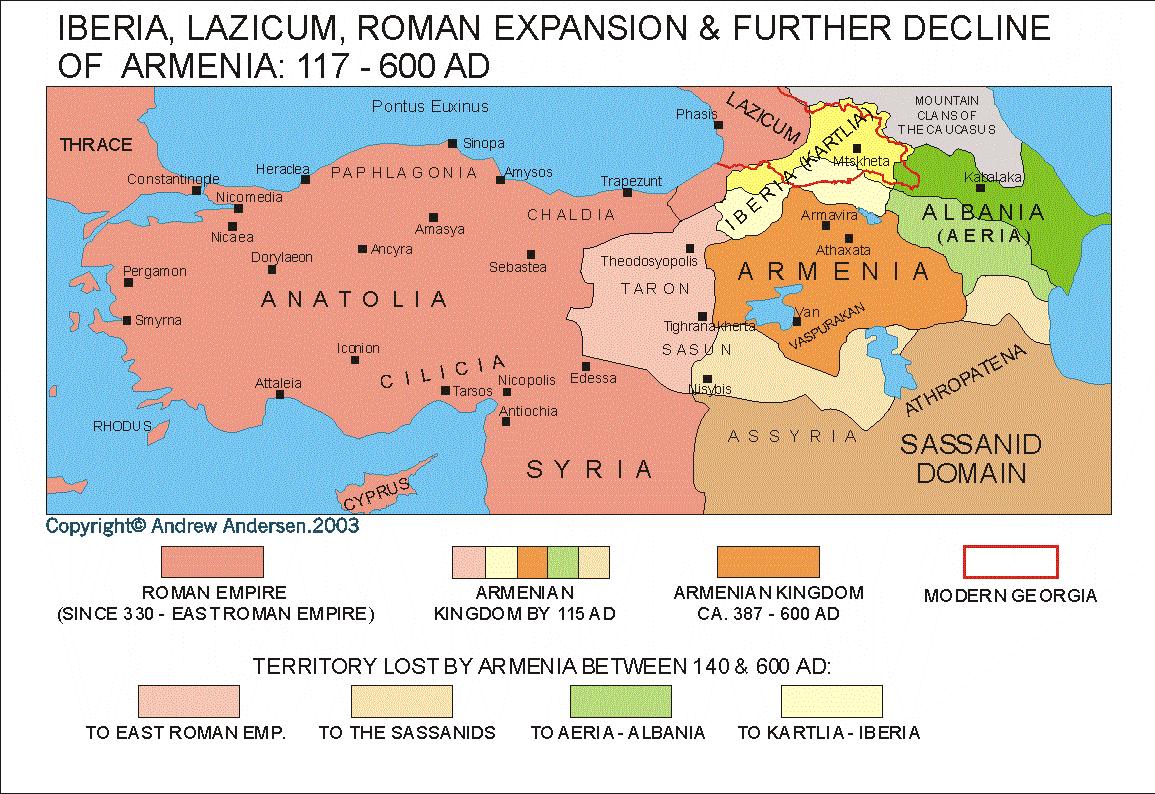
Greeks and Romans to the ancient Georgian kingdom of Kartli (4th century
BC-5th century AD) corresponding roughly to the eastern and southern parts of
the present day Georgia.
The term “Caucasian Iberia” (or Eastern Iberia) is used to distinguish it
from the Iberian Peninsula, where the present day states of Spain, Andorra
and Portugal
are located. The Caucasian Iberians provided a basis for later Georgian
statehood and formed a core of the present day Georgian people (or
Kartvelians).
EARLIEST HISTORY
The area was inhabited in earliest times by several related tribes,
collectively called Iberians (the Eastern Iberians)
by ancient authors. Locals called their
country Kartli after a mythic chief, Kartlos.
The Moschi mentioned by various classic historians, and their possible
descendants, the Saspers (who were mentioned by Herodotus), may have played a
crucial role in the consolidation of the tribes inhabiting the area. The
Moschi had moved slowly to the northeast forming settlements as they
migrated. The chief town of these was Mtskheta, the future capital of the
Iberian kingdom. The Mtskheta tribe was later ruled by a chief locally known
as Mamasakhlisi (“the father of the
household” in Georgian).
The medieval Georgian source Moktsevai
Kartlisai (“Conversion of Kartli”) speak also about Azo and his people,
who came from Arian-Kartli - the initial home of the proto-Iberians, which
had been under Achaemenid rule until the fall of the Persian Empire - to
settle on the site where Mtskheta was to be founded. Another Georgian
chronicle Kartlis Tskhovreba
(“History of Kartli”) claims Azo to be an officer of Alexander’s armies, who
massacred a local ruling family and conquered the area, until being defeated
at the end of the 4th century, BC, by Prince Pharnavaz, who was a local chief
at that time.
Pharnavaz I and His
Descendants
Pharnavaz, victorious in power struggle, became the first King of Iberia (ca.
302 - 237 BC). Driving back an invasion, he subjugated the neighbouring
areas, including significant part of the western Georgian state of Colchis (locally known as Egrisi), and seems to have
secured recognition of the newly founded state by the Seleucids of Syria.
Pharnavaz then focused on social projects, including the construction of the
citadel in the capital, the Armaztsikhe, and erection of an idol of a god
named Armazi. He also reformed the Georgian written language, and created a
new system of administration subdividing the country into several counties
called saeristavos. His successors
managed to gain control over the mountainous passes of the Caucasus Range
with Daryal (also known as the Iberian Gates) being the most important of
them.
The period following this time of prosperity was marked with incessant
warfare though. Iberia
was forced to defend itself against numerous invasions. As a result, the country
lost some of its southern provinces to Armenia, and the Colchian lands
seceded to form separate princedoms (sceptuchoi). At the end of the 2nd
century BC, the Pharnavazid king Farnadjom was dethroned by his own subjects
and the crown given to an Armenian prince Arshak who ascended the Iberian
throne in 93 BC, establishing the Arshakid dynasty.
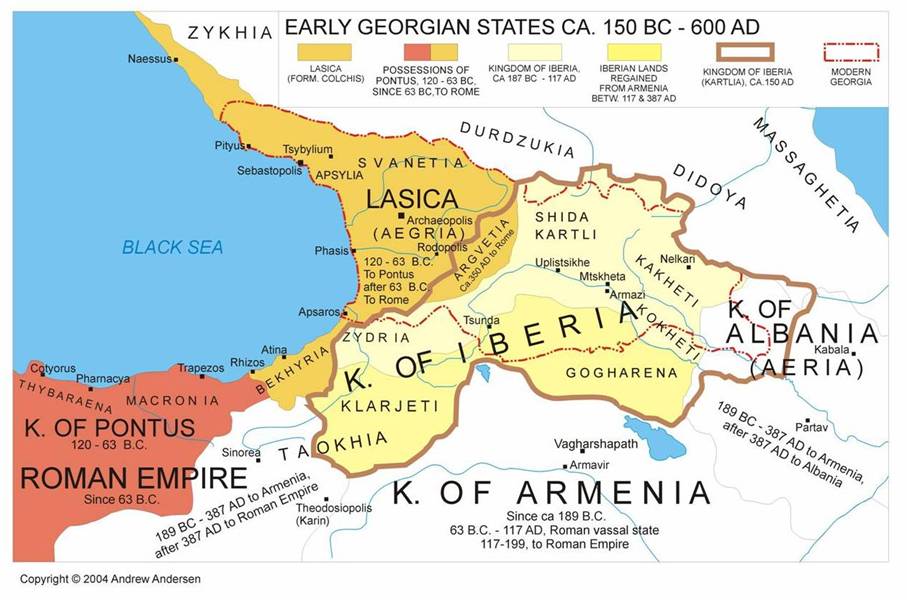
ROMAN PERIOD
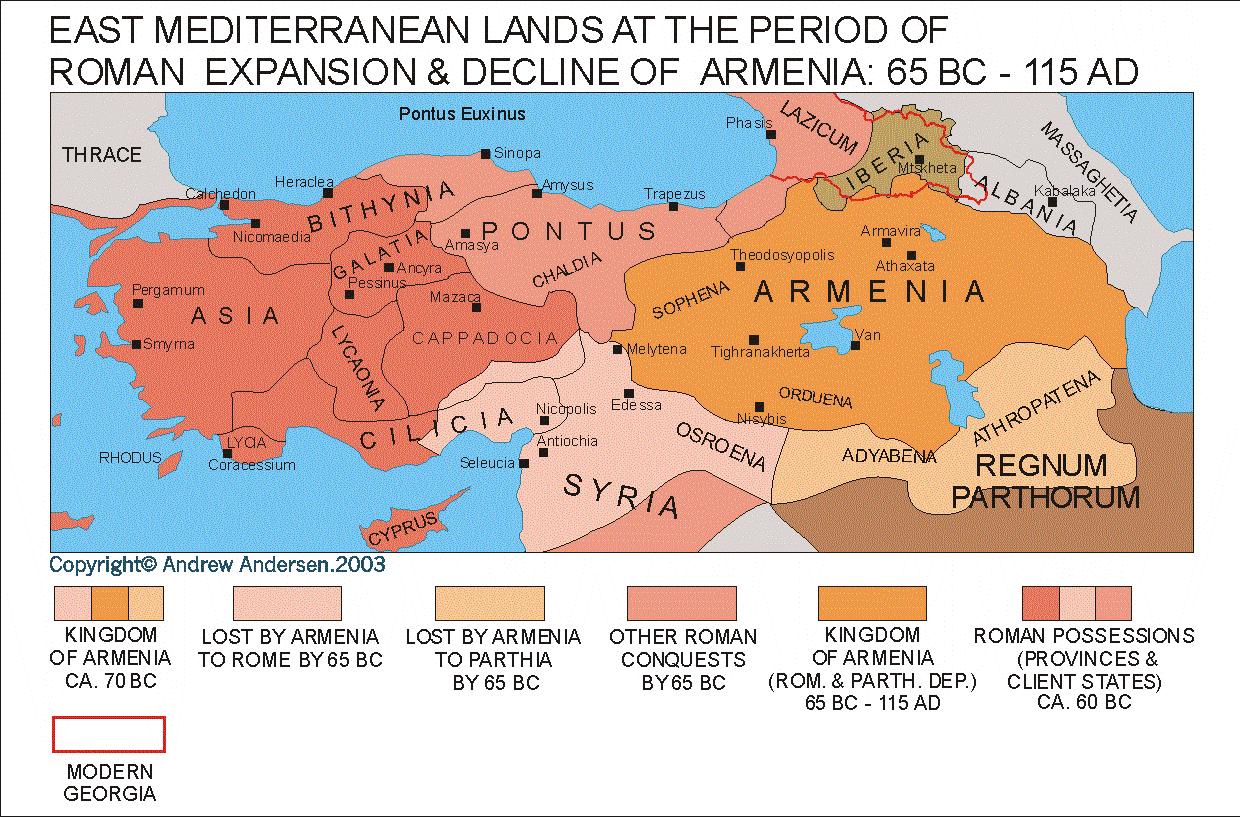
This close association with Armenia
brought upon the country an invasion (65 BC) by the Roman general Pompey, who
was then at war with both Mithradates VI of Pontus,
and Tigran II of Armenia.
However, Rome failed to establish its
permanent power over Iberia.
Nineteen years later, the Romans again marched into Iberia (36
BC) forcing King Pharnavaz II to join their campaign against Caucasian
Albania.
While another Georgian kingdom of Colchis was turned into a Roman province, Iberia
accepted Roman Imperial protection. A stone inscription discovered at
Mtskheta speaks of the first-century ruler Mihdrat I (A.D. 58-106) as
"the friend of the Caesars" and “the King of Roman-loving
Iberians." It was at that period when Emperor Vespasian fortified the
ancient Mtskheta site of Arzami for the Iberian kings in 75 A.D.
|