|
|
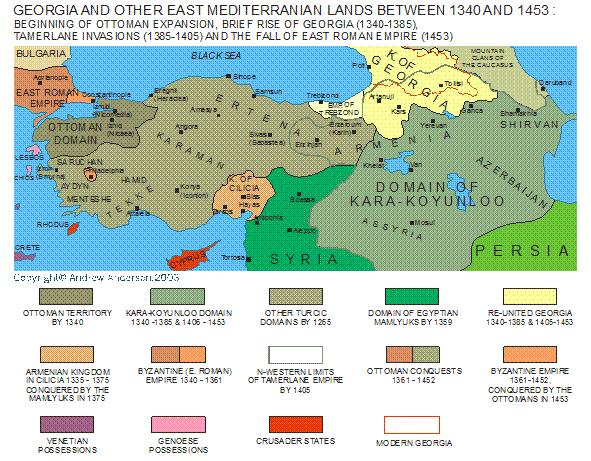
The invasions of Transcaucasia
by the Mongols from A.D. 1220 onwards brought the Golden Age of Georgia to an
abrupt end. The country was reduced to vassalage under the Mongol Il-khans of
the line of Hulagu Khan. In the fourteenth century, there were signs of a
national revival. The onslaughts of Tamerlane created great havoc in Georgia's
economic and cultural life, from which the kingdom never fully recovered. The
countryside was strewn with the ruins of churches, castles and towns, the
people fled to the hills, and once busy roads were overgrown with grass and
bushes.
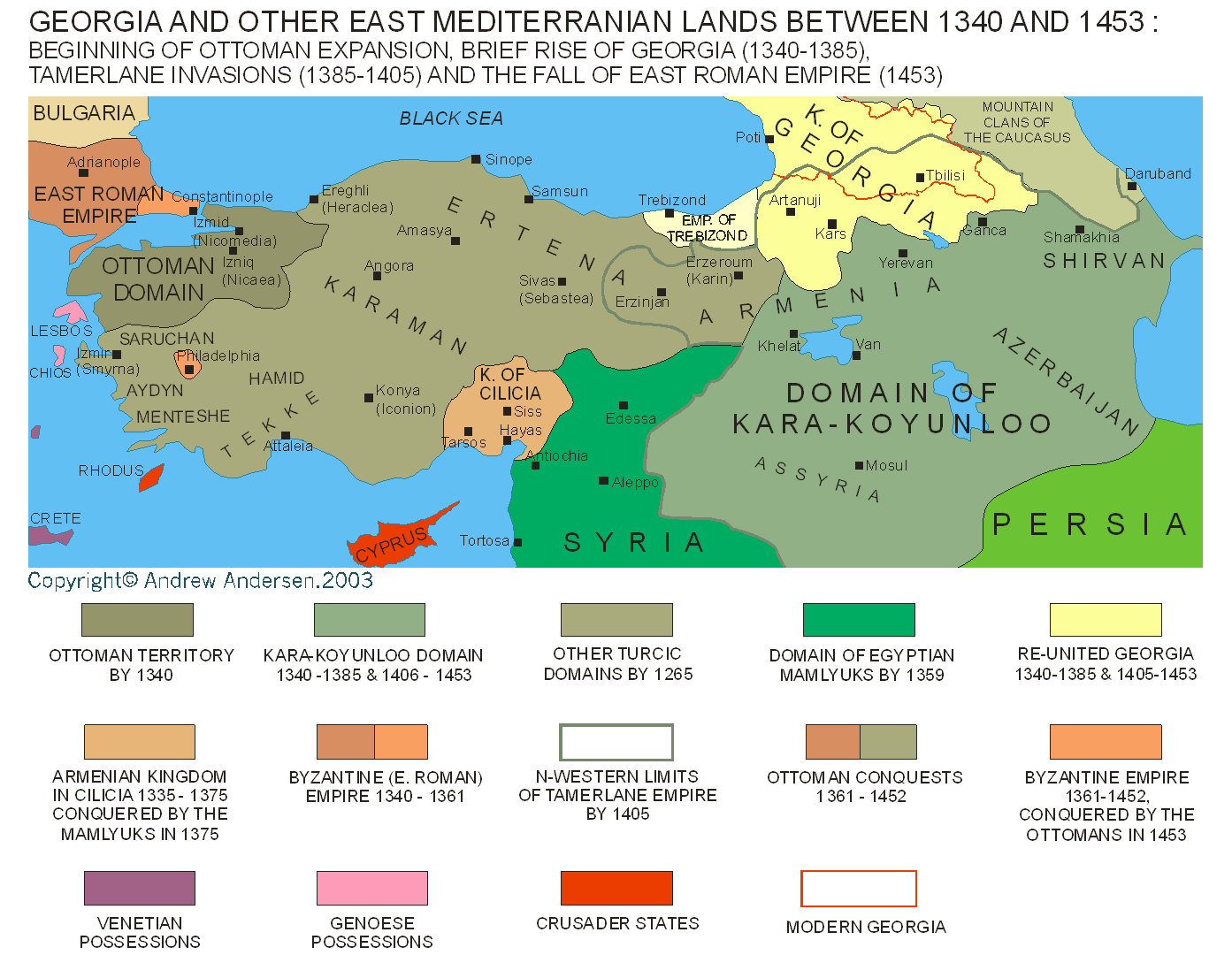
The last king of united Georgia was
Alexander I (1412-43), under whose sons the realm split up into squabbling
princedoms. The disintegration of the monarchy was further aggravated by the
fall of Constantinople to the Ottoman Turks in 1453, and the resulting
isolation of Georgia
from Western Christendom. The Black Sea became a Turkish lake, and the land
routes from the Caucasus to the Mediterranean and the West through Anatolia
and Syria
were all in enemy hands.
|
Click
on the map for better resolution
|
|
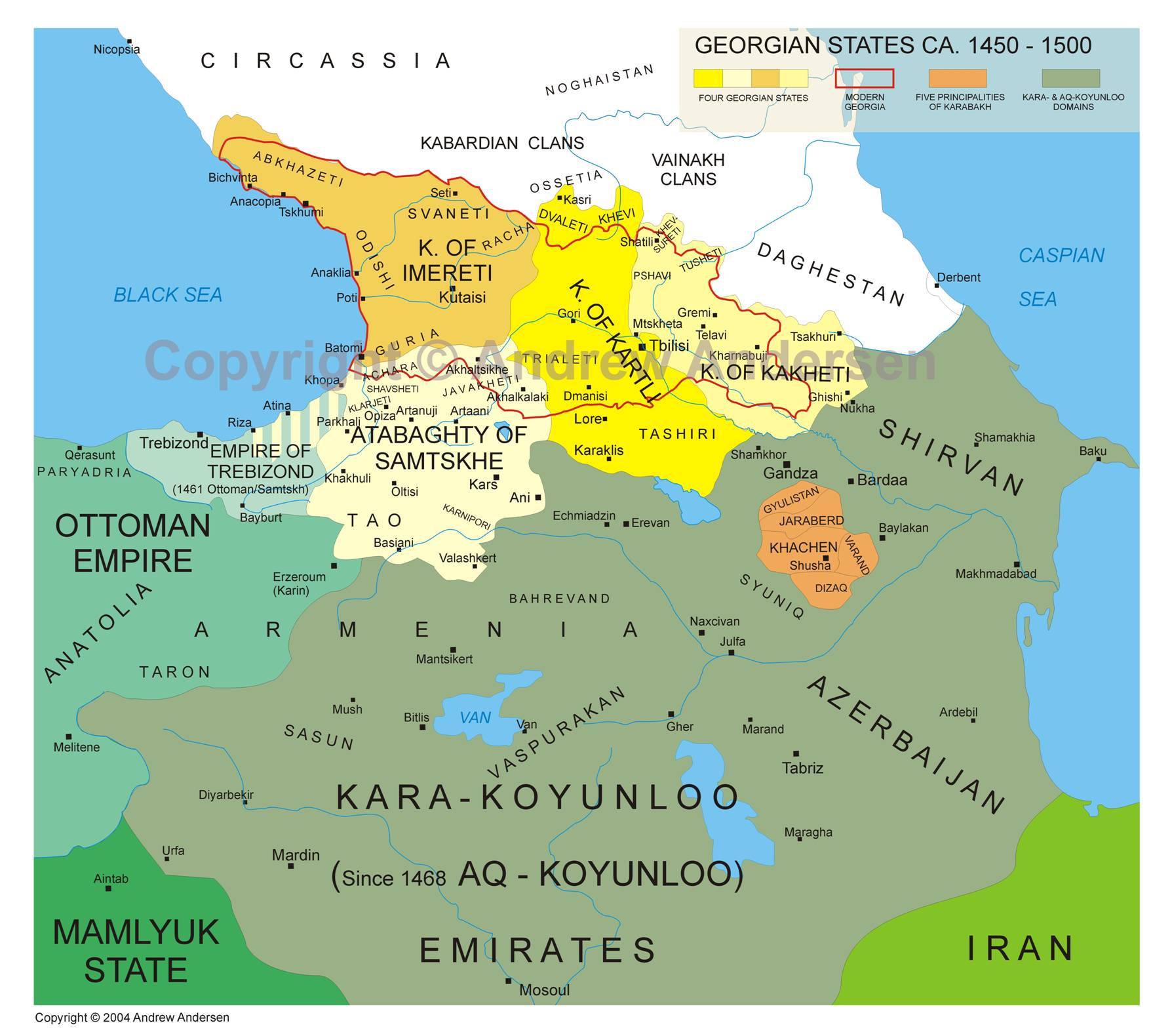
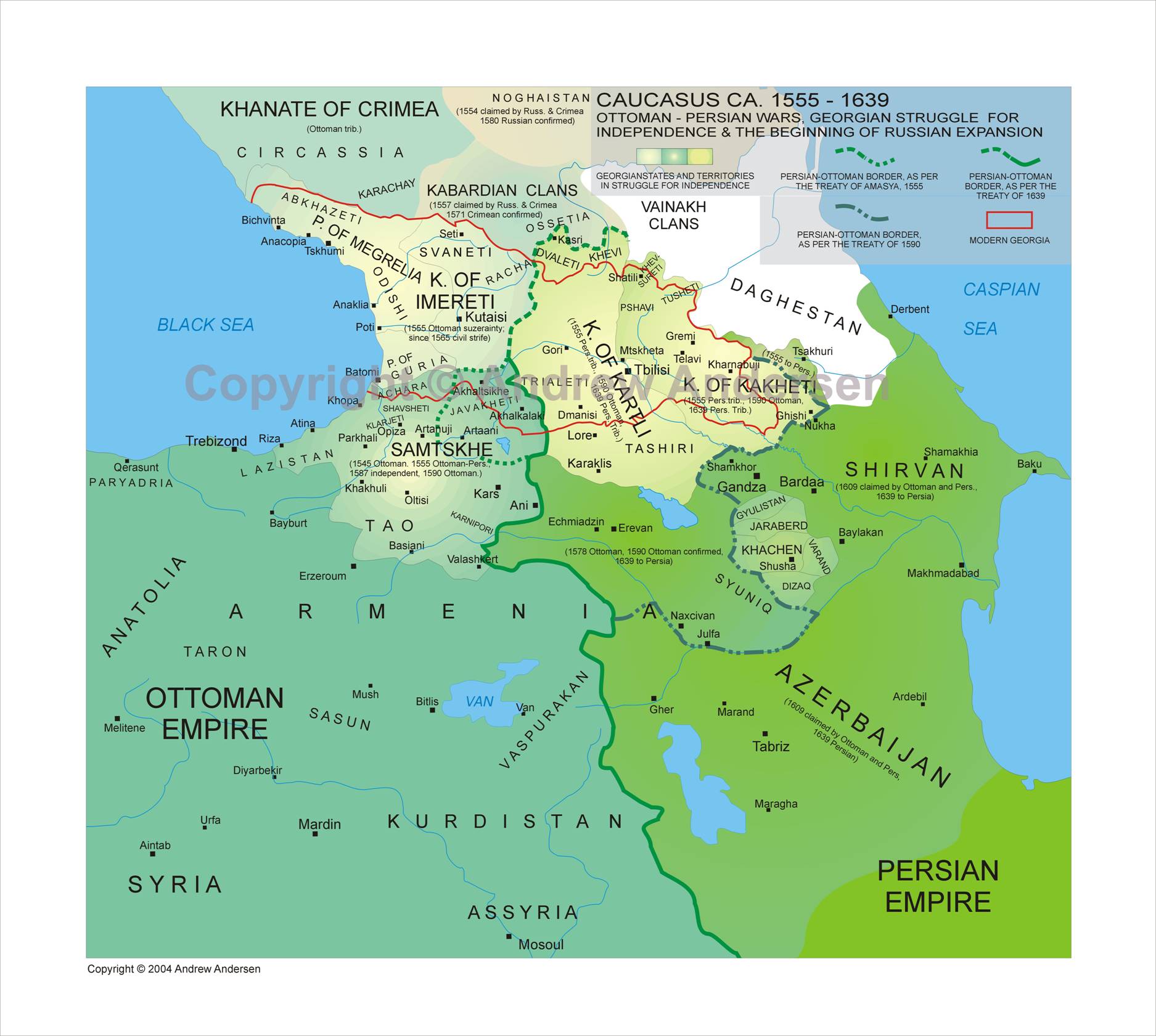
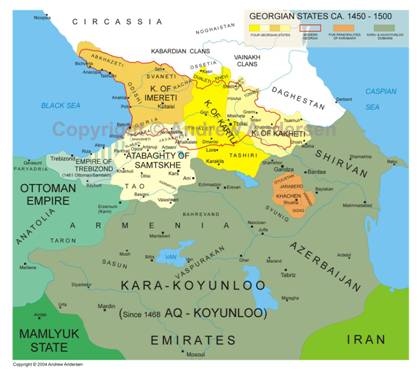
The Bagratid royal family was now divided
into three branches. The senior line ruled at Tbilisi
over the kingdom of Kartli; a second ruled over Western Georgia or
Imereti--'the land on the far side'; a third possessed Kakheti, Georgia's
most easterly province. Five princely families took advantage of this
break-down of the central monarchy to set themselves up as independent
dynasts on their own. These were the Jaqelis of Samtskhe in the south-west;
the Dadianis of Mingrelia, which comprised a large part of ancient Colchis;
the Gurielis in Guria, on the Black Sea immediately south of Mingrelia; the
Sharvashidzes in Abkhazia, on Georgia's
north-western Black Sea fringe; and the Gelovanis in highland Svaneti among
the peaks of the Caucasus range.
|
Click
on the map for better resolution
|
|
Ottoman
Turkey and Safavi Persia
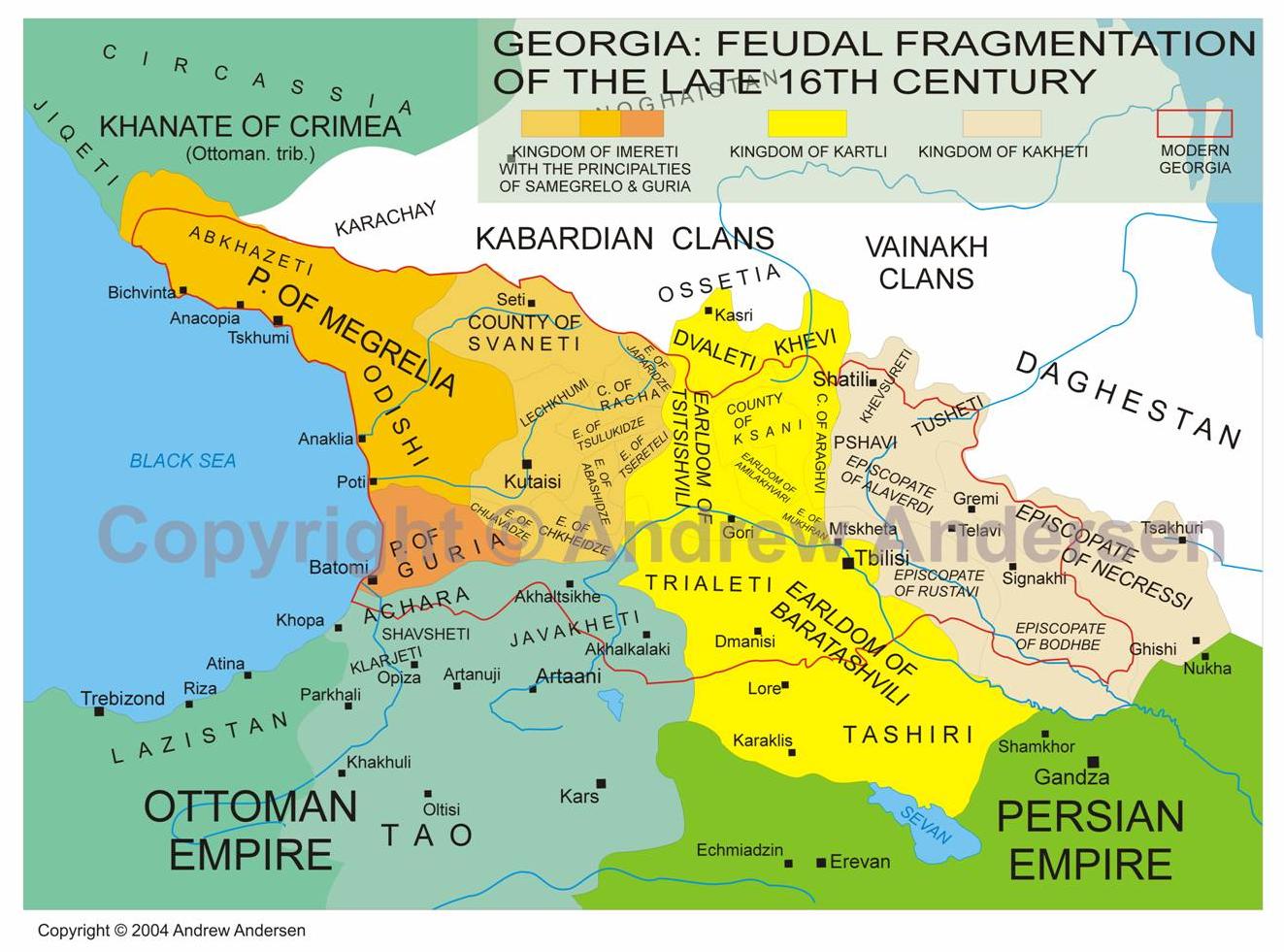
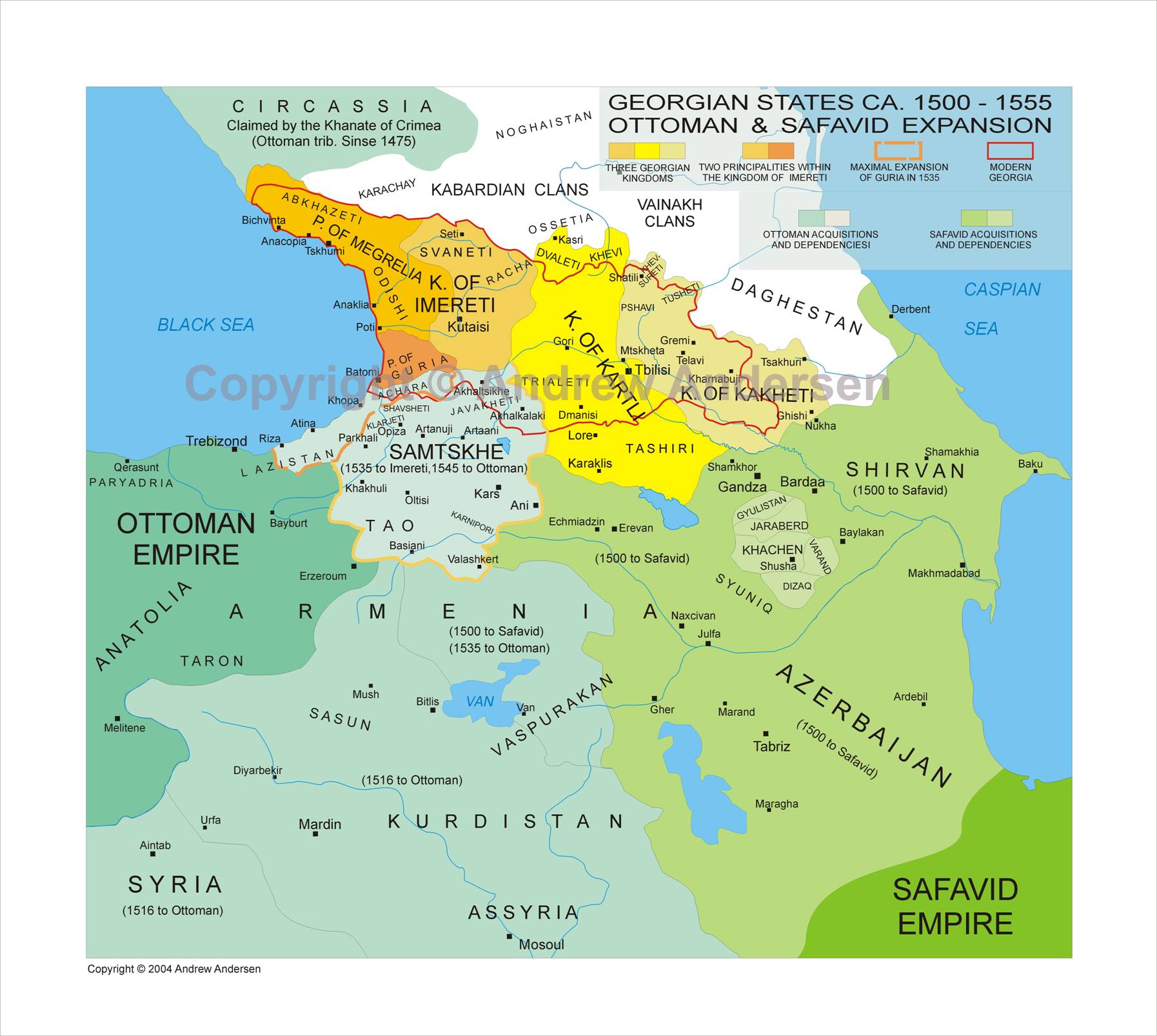
This political fragmentation rendered Georgia powerless to resist the designs of
Ottoman Turkey and Safavi Persia,
who now vied for control over Caucasia. In
1510 the Turks invaded Imereti and sacked the capital, Kutaisi. Not long afterwards, Shah Ismail
Safavi of Iran
invaded Kartli--a foretaste of many onslaughts which the land was to suffer
at the hands of this dynasty of Persian rulers.
From the north, the Grand Princes of
Muscovy had already begun their drive towards the Caspian
Sea and the North Caucasian steppe. In 1492, King Alexander of
Kakheti sent an embassy of friendship to Ivan III of Moscow. After Kazan
and Astrakhan
had fallen to Ivan the Terrible in 1552 and 1556 respectively, the Tsar sent
King Levan of Kakheti a Cossack bodyguard and took him under Russian
protection. Threats and protests from the Shah of Persia soon led to the
Cossacks being withdrawn. However, the Grebensky and Terek Cossack
settlements in the North Caucasian steppe became an important factor in
Caucasian politics. In 1594, Tsar Fedor Ivanovich sent an army to seize the
strategic fortress of Tarku in Daghestan, capital of the dynasty of the
Shamkhals. This, and subsequent expeditions, ended in disaster for the
Russians. However, a further Russian advance into Caucasia
was only a matter of time and opportunity.
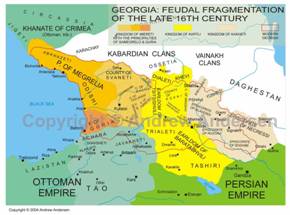
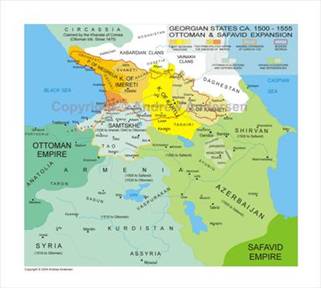
During the closing decades of the sixteenth
century, a period of anarchy in Persia
enabled the Ottoman Turks to overrun the whole of Transcaucasia
and Persian Azerbaijan. Their triumph was short-lived. The Safavi dynasty in Persia
soon rose to new heights of power under the brilliant and ruthless Shah
'Abbas I ( 1587-1629). The expulsion of the Turks from Eastern Georgia by
Shah 'Abbas was followed by a reign of terror instituted by the Shah with a
view to eliminating the more vigorous Georgian princes, and turning the land
into a Persian province. Many thousands of the Christian population were
deported to distant regions of Iran, where their descendants
live to this day. The Dowager Queen of Kakheti, Ketevan, was given the choice
of abandoning the Christian faith and entering the Shah's harem, or of a
cruel martyrdom. She chose the latter fate, and is numbered among the saints
of the Georgian
Church.
It was only with the arrival in Tbilisi of
Khusrau-Mirza, an illegitimate, renegade scion of the Bagratid royal line,
that the country's wounds began to heal. King Rostom, as Khusrau was styled
within Georgia,
was an elderly politician with an excellent knowledge of diplomacy and
considerable influence at the Persian court. Himself a Muslim, Rostom took to
wife the daughter of a leading Georgian aristocrat, and was married according
to both Christian and Muslim rites. The patriotic extremists, of course,
regarded Rostom as a traitor and resented his introduction of Persian
ways--'luxury and high living, dissipation and unchastity, dishonesty, love
of pleasure, baths and unseemly attire, lute and flute players', the historian
Prince Vakhushti disapprovingly termed them. However, Rostom pursued
undeterred his policy of conciliation. 'Everywhere', as the French traveller
Chardin records, 'he reestablished peace and order, and governed with much
clemency and justice.' 16
|
Click
on the maps for better resolution
|
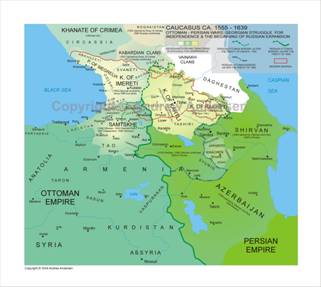
|
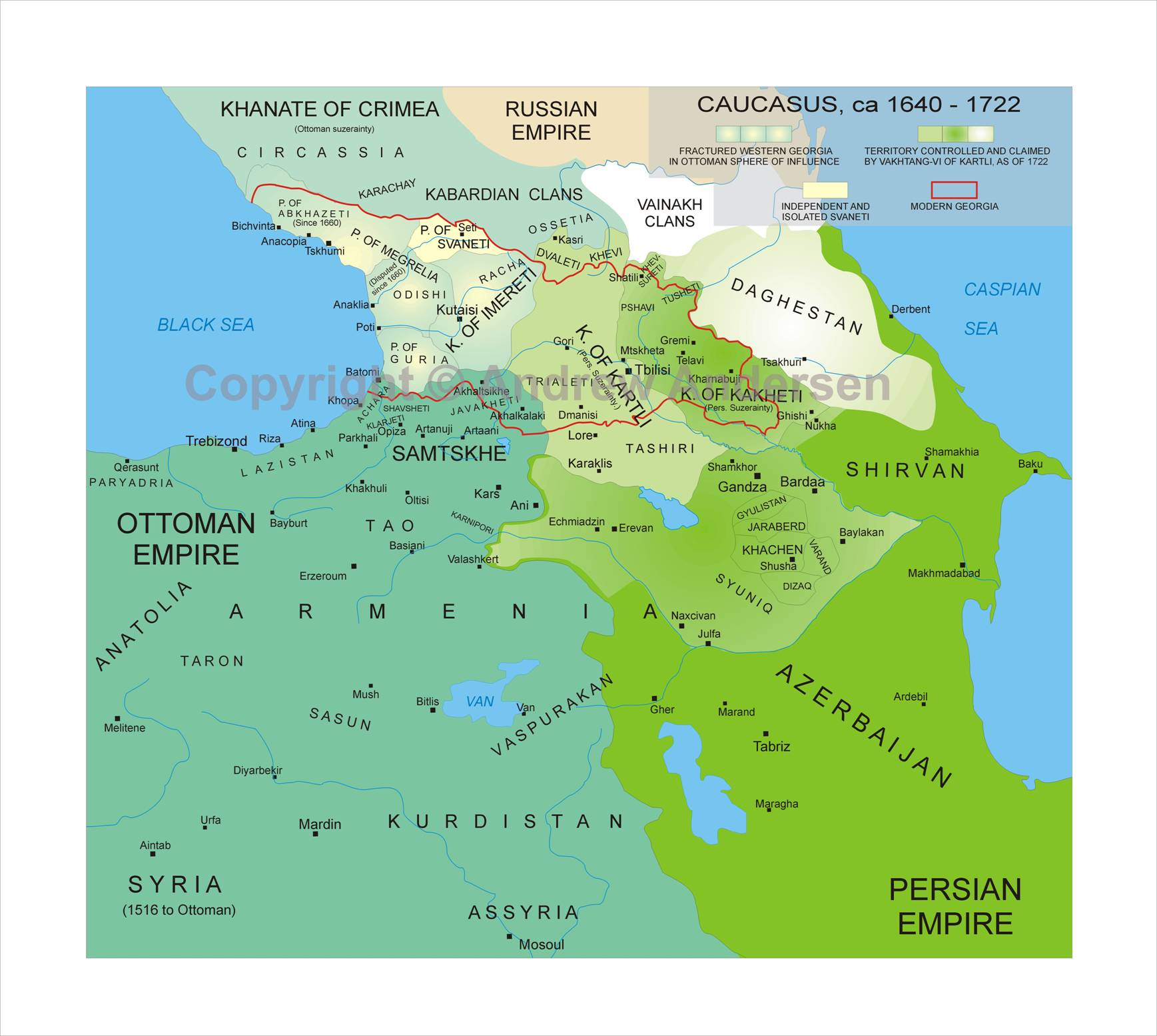
While the Persians were establishing their
rule over Eastern Georgia, the Turks dominated Imereti and the minor
principalities of Western Georgia. Without
actually annexing these regions, they maintained a loose suzerainty over
them. From time to time, they would stage an invasion to dethrone some
disobedient prince and remind the people of the nearness of Ottoman power.
Otherwise they left the people of Imereti, Mingrelia and Guria very much to
their own devices, apart from levying a frequent tribute of male and female
Georgian slaves, who were highly prized in Turkey. Being mostly engaged in
civil wars among themselves, these minor kings and princes of Western Georgia
presented little danger to Turkey's
eastern frontiers.
Rapprochement with Russia
During the reign of King Rostom ( 1632-58) and
his immediate successors, the Russian court avoided becoming embroiled in
military intervention in the Caucasus. At
the Kremlin, Tsar Alexis had plenty to occupy him in the way of tumult,
religious schism, and wars with his European neighbours. Russia was also loth to relinquish the
flourishing trade which she carried on with Persia
via the Caspian Sea. This did not mean that Russia lost
interest in Georgian affairs. Peaceful penetration was intense. The Dadian or
reigning prince of Mingrelia and the King of Imereti, both within the Turkish
zone of influence, were taken under nominal Russian suzerainty. Several
embassies were exchanged with King Teimuraz I of Kakheti, son of the martyred
Queen Ketevan, who visited Moscow
to appeal for Russian aid against the Persians. Community of faith led the
Russians, as the great Orthodox power in the East, to lend a sympathetic ear
to the pleas of the Georgians, while the latter, like the Balkan Slavs,
looked confidently to Christian Muscovy as a certain deliverer from the
Muslim yoke.
The consequences of this touching but
misguided confidence were seen most clearly during the reign of King Vakhtang
VI of Kartli, who governed at Tbilisi as regent from 1703 until 1711, and
then as king, with interruptions, until 1723. Vakhtang was one of the most
gifted monarchs Georgia
has produced; as patron of the arts and sciences, he may be compared with the
Renaissance princes of Italy.
He codified the laws, set up a commission to edit the national chronicles,
installed a printing press at Tbilisi, built
palaces, restored churches, dug canals for irrigation purposes, and generally
improved Georgia's
economic and social position. In 1721, the Caucasus
was suddenly affected by an international crisis. The Afghans of Qandahar had
revolted against the King of Persia, Shah Sultan Husayn, and marched on Isfahan from the east.
From the north, Peter the Great of Russia cast covetous eyes on Persia's Caspian provinces and sent messengers
to Tbilisi to
rally the Georgians to his banner. King Vakhtang VI, whom the Shah had
coerced into abjuring Christianity and embracing Islam, responded with
alacrity to the Tsar's overtures. When the Shah sent to him for military
help, Vakhtang refused, with the result that Isfahan fell to the Afghans in 1722 after a
protracted siege in which scores of thousands perished from hunger and
wounds. Seeing Persia
in chaos, the Turks invaded from the west in 1723, Occupying Tbilisi. The
Ottoman sultan threatened war if the Russians sent help to the Georgians or
entered the Turkish occupation zone. Driven from his capital, Vakhtang soon
lost all hope of effective Russian support: 'While Peter plans to succour
Paul, Paul is being skinned.' Eventually, the Russians offered Vakhtang and
his followers asylum; the Georgian king died in exile at Astrakhan in 1737.
|
Click
on the map for better resolution
|
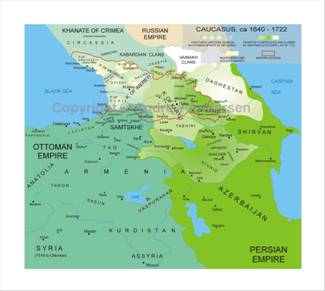
|
This setback curtailed Russian influence in
Georgia
for many years. The next serious rapprochement took place during the reign of
Erekle II (1744-98), a remarkable man who played in his youth a leading role
in the campaigns of the Persian conqueror Nadir Shah, whom he accompanied on
his expedition to India
between 1737 and 1740. Nadir rewarded him in 1744 with the throne of Kakheti,
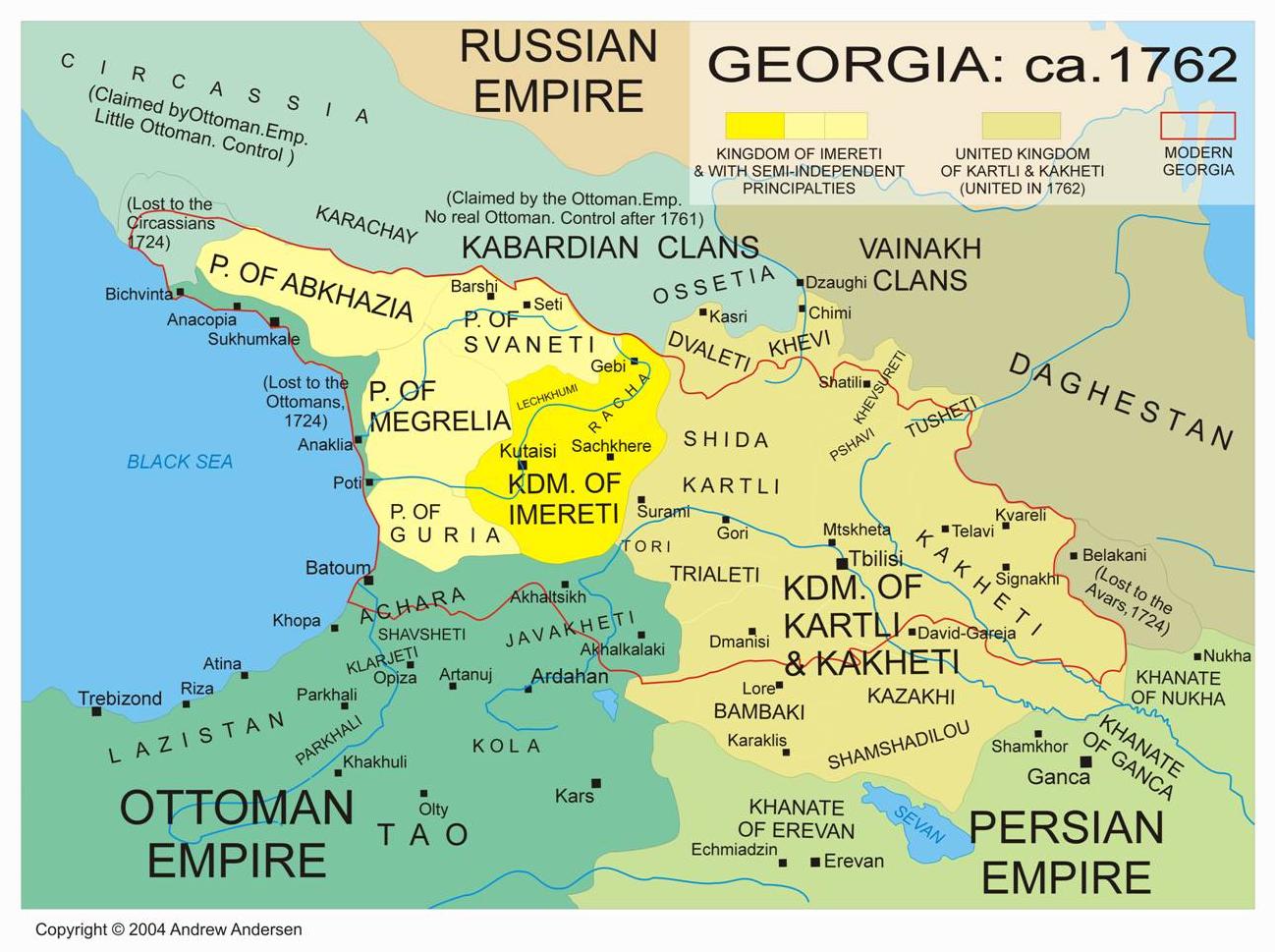
while his father, Teimuraz II, became King of Kartli. In 1762, Teimuraz II
died while on a diplomatic mission to the court of St. Petersburg. Erekle now
combined Kartli and Kakheti into one East Georgian kingdom. 'Nervous, brittle
and intelligent in his small tumbling world,' to use W. E. D. Allen's graphic
phrase, the king 'felt out this way and that for the bricks of some
stability.' 17
He strove to enlist the support of European powers, and to attract
Western scientists and technicians to give his country the benefit of the
latest military and industrial techniques. His vigilance in the care of his
people knew no bounds. On campaign, he would sit up at night watching for the
enemy, while in time of peace, he spent his life in transacting business of
state or in religious exercises, and devoted but a few hours to sleep.
Collapse
of the monarchy
The great scourge which afflicted Georgia during
Erekle's reign was the insecurity which resulted from raids by Muslim
tribesmen of Daghestan, the Lezghis. These marauders were egged on by their
Turkish co-religionists just over the border. Georgian peasants could not
work at any distance from their dwellings for fear of attack by these
ruthless mountaineers, who pounced on their victims in the fields, or dragged
them from their huts to sell to the Turks and Persians. It has been reckoned
that these raids, together with the various local wars which took place in Georgia,
reduced the population by as much as a half during the eighteenth century. By
1800, the combined population of Eastern and Western
Georgia had sunk to less than half a million.
This state of affairs had a paralysing
effect on the development of industry. When Erekle tried to start an iron
foundry in the Borchalo district, he had to close it down owing to the
onslaughts of the Lezghis. Caravans of merchants were constantly being
waylaid and robbed. The economic situation was also adversely affected by
hostility between the Armenian moneyed class and the improvident Georgian
gentry. There was a steady outflow of much-needed capital from Georgia as the wealthier Armenian merchants
left Tbilisi and Gori to make their
headquarters in Moscow or Astrakhan.
In 1768, war broke out between Russia and Turkey. Catherine the Great
decided to stage a military diversion against the Ottoman Empire's frontier
provinces in the Caucasus. She sent to Georgia an
expeditionary force, commanded by a swashbuckling German adventurer named
Count von Todtleben. In conjunction with Erekle II and the King of Imereti,
Solomon I, the Russians scored a few successes over the Turks. However,
Todtleben quarrelled with the Georgian rulers, whom he despised as ignorant orientals,
and left them to bear the brunt of the fighting themselves. Relations between
Georgia and Russia
were subjected to great strain.
|
Click
on the map for better resolution
|
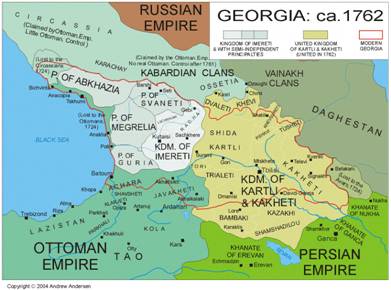
|
The
Russians take over
The estrangement between the courts of Tbilisi and St.
Petersburg was eventually patched up, thanks largely
to the vision of Catherine's favourite, Prince Gregory Potemkin. The empress
and her lover were aware of the important role which the Christian Georgians
might be made to play in furthering Russian designs to partition Persia and the Ottoman
Empire. The Georgians on their side entertained high hopes of
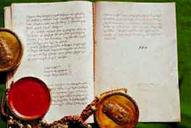
Russian military and economic aid. In 1783, a treaty between Russia and the Georgian kingdom of Kartlo-Kakheti
was signed at Georgievsk.
|
|
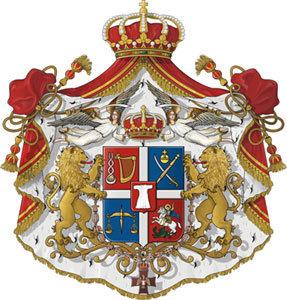
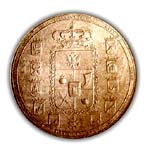
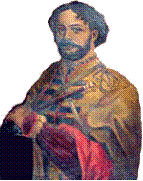
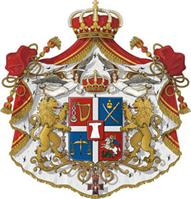
King Erekle
(left) Royal Arms (right) and the
Treaty of Georgievsk (Below)
|
|
In signing the Treaty of Georgievsk, Erekle
undertook to renounce all dependence on Persia or any other power but Russia;
he and his posterity were solemnly confirmed forever in possession of all
territories under their sway; the kings of Georgia, on succeeding to the
throne, would request and receive from St. Petersburg their insignia of
investiture; Erekle was to conduct negotiations with foreign powers only
after securing the approval of the Russian authorities; the empress and her
heirs were pledged to treat Georgia's foes as those of Russia; there was to
be no interference in the internal affairs of Georgia; the Georgian
Catholicos-Patriarch was given the eighth place among the Russian prelates,
and made a member of the Holy Synod; the Georgian nobility were to have the
same prerogatives as the Russian aristocracy; special facilities were to be
afforded to Russian traders in Georgia and to Georgian merchants in Russia.
The treaty was to remain in force permanently, and any modification was to be
made only by the voluntary consent of both parties. Four additional articles
were appended to the treaty. These provided among other things for the
stationing in Georgia of
two battalions of Russian infantry with four cannon, and the eventual
recovery by force of arms of Georgia's
ancient territories now in the hands of the Ottoman Turks. In making these
grandiose promises, Catherine and Potemkin overreached themselves. The only
line of direct communication between Georgia
and Russia was the
precarious military road over the main Caucasus
range via the Daryal pass, a route infested by hostile tribes. The Turks and
their allies, the Muslim warriors of Circassia and Daghestan, were still
entrenched in large areas of North Caucasia.
When Catherine's second Turkish war broke out in 1787, it was decided,
despite frantic protests from the Georgians, that
the Russian expeditionary force should be withdrawn, and the Georgians left
to their own devices.
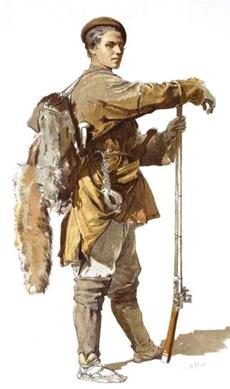 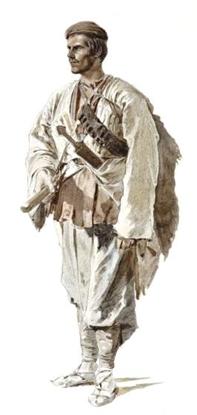
Georgian soldiers of the late 18th
century
The dire consequence of this decision was
seen a few years later, when a new dynasty, that of the Qajars, seized power
in Persia.
The head of this royal house, the eunuch Agha Muhammad Khan, resolved to turn
Georgia once more into a province of Persia. In vain did Erekle send appeal
after appeal to the Empress Catherine at St. Petersburg. The Russians, confronted
with the French Revolution and the resulting wars and upheavals in Europe, had other problems to occupy their minds. In
1795, Agha Muhammad and his savage hordes swooped down on Tbilisi. King Erekle, in spite of his
seventyfive years, took part in the furious battle which raged before the
gates of the city. The Georgians fought like lions at bay, but were decimated
and had to give way at last before the overwhelming numbers of the foe. The
king narrowly escaped capture, while Tbilisi
was sacked and burned by the triumphant Persians. To quote a contemporary,
Sir John Malcolm:
'The conquerors entered Teflis: a scene of
carnage and rapine ensued pleasing to one who desired to make this city an
example for such as dared to contemn his authority. The Mahomedan historian
of Aga Mohamed Khan, after describing the barbarous and horrid excesses,
observes, "that on this glorious occasion the valiant warriors of Persia gave to the unbelievers of Georgia a
specimen of what they were to expect on the day of judgement". It is not
easy to calculate the number who perished. Bigotry inflamed the brutal rage
of the soldier. The churches were levelled to the ground; every priest was
put to death. Youth and beauty were alone spared for slavery. Fifteen
thousand captives were led into bondage; and the army marched back laden with
spoil.' 18
The destruction of his capital city was a
death blow to Erekle's dream of establishing, with Russian protection, a
strong and united Georgian kingdom, into which Imereti and the lost provinces
under Turkish rule would all eventually be drawn. The old king died early in
1798.
The next three years were a time of muddle
and confusion. Georgian affairs were subjected to the imponderable whims of
Tsar Paul I, the crazy autocrat of Russia, who had succeeded his
mother Catherine in 1796. At Tbilisi
little more than nominal power was exercised by Erekle's son, King Giorgi
XII. This invalid monarch was beset by the intrigues of his stepmother, the
Dowager Queen Darejan, whose aim was to deprive Giorgi of the throne in
favour of one of her own numerous progeny. The king thus lived in constant
fear of being deposed or even murdered by his half-brothers, or of seeing yet
another Persian army invading his kingdom. In these circumstances, Giorgi was
forced to the conclusion that something more than a formal Russian
protectorate was needed to ensure the kingdom's survival. In September 1799,
he sent an embassy to St. Petersburg with
instructions to surrender the realm of Eastern Georgia
into the care of Tsar Paul--'not under his protection, but into his full
authority' --provided only that the royal dignity should be preserved for
ever in the Georgian royal family of the Bagratids. He was asking, that is to
say, for a status comparable to that of native rajahs under the British
empire in India, or that enjoyed by many sheikhs, amirs and sultans during
the French and British dominion over the Near and Middle East.
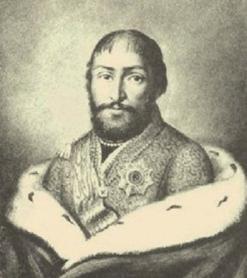
King Giorgi
XII of Georgia
But even this modest remnant of autonomy
was to be denied to the Georgian kings and their subjects. Tsar Paul, it is
true, at first promised to guarantee certain privileges to King Giorgi and
the Georgian royal family. However, in November 1800, the emperor wrote to
the Russian general in command on the Caucasian front: 'The weakening of the
king's health gives ground for expecting his decease; you are therefore
immediately to despatch, as soon as this occurs, a proclamation in Our name
that until Our consent is received no action should be taken even to nominate
an heir to the Georgian throne.' 19 The
following month, Paul signed a manifesto declaring the kingdom of
Kartlo-Kakheti annexed to the Russian crown.
Neither Tsar Paul nor King Giorgi were
fated to see these measures put into effect. On 28 December 1800, before his
emissaries had returned from St.
Petersburg, Giorgi XII died. The commandant of
Russian troops in Tbilisi
set up a temporary administration, but on 15 January 1801, Giorgi's eldest
son, Prince David, declared himself Regent of Georgia. Before the succession
problem could be finally settled, Tsar Paul was himself assassinated in St. Petersburg during
the night of 11-12 March 1801.
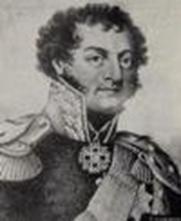
David Bagrationi,
the last independent ruler of Georgia before the Russian annexation
The Georgian question confronted the new emperor,
Alexander I, with something of a dilemma. His more liberal advisers urged him
to repudiate his despotic father's policy of unilateral annexation which, as
they justly reminded him, contravened the Russo-Georgian treaty of 1783. In
their view, the perpetration of so flagrant a wrong against the Georgian
royal house would be a blot on the emperor's honour. The difficulty was that
the Georgians themselves were bitterly divided on the succession to the
throne. At Tbilisi, the Dowager Queen Darejan
incited her own sons to open revolt against the Prince-Regent David, her
stepson; one of Darejan's sons, Alexander Batonishvili, even fled the country
and offered his services to the new Shah of Persia, Fath-'Ali, successor of
the eunuch Agha Muhammad who had ravaged Georgia only five years
previously. This violent discord within the Bagratid house was adroitly
utilized by some of Tsar Alexander's less scrupulous intimates, who focused
his attention on the rich mineral resources of Georgia, on the country's vital
military position as a springboard for invasion of the Middle East, and
strongly urged him not to miss this unique opportunity of joining the land to
the Russian empire.
After much high-minded vacillation,
Alexander decided to throw scruples to the winds. A manifesto couched in
grandiose terms was drawn up, announcing Eastern Georgia's
annexation, and repudiating any suggestion of self-interest on the Russian
side. The Tsar cited the defenceless state of Georgia, the menace of civil war,
the unanimous appeals which had been received from the Christian population
for protection against the Persians and Turks. Alexander undertook to turn
over the country's entire revenues to its own use, and to preserve the rights
and prerogatives of all classes of the community, except, of course, those of
the dethroned royal house. Each social order would have the opportunity of
taking an oath of allegiance to the emperor. This manifesto was published in Moscow on 12 September
1801, three days before Alexander's coronation. For over two hundred years,
the Tsars of Russia had styled themselves 'Lords of the Iberian land and the
Georgian kings'. Now this honorific title had become reality with a
vengeance; having entered voluntarily into the bear's embrace, the kings of
Georgia now found the breath hugged out of them altogether.
Following the abolition of the Bagratid
monarchy of Kartlo-Kakheti in Eastern Georgia, the liquidation of the branch
of the dynasty ruling in Western Georgia was
only a matter of time. King Solomon II of Imereti defended his independence
as long as he was able. Taken under Russian suzerainty in 1804, Solomon later
revolted and was deposed and captured by armed force in 1810. The smaller
independent principalities of Western Georgia
were gradually absorbed into the administrative framework of the Caucasian
Viceroyalty. Guria was taken over in 1829, Mingrelia in 1857, Svaneti in 1858
and Abkhazia in 1864.
The decision of Tsars Paul and Alexander to
destroy the independence of a vassal monarchy which they were pledged to
maintain was morally indefensible, and was also to prove highly inexpedient
in the longer term. Nevertheless, it is certain that Georgia in
1801 was in no position to stand on her own feet. With a population of only
500,000 or less, there was no prospect of a resurrection of the old
pan-Georgian monarchy of David the Builder and Queen Tamar. With the royal
family of Kartlo-Kakheti convulsed by dynastic feuds and Western
Georgia perpetually agitated by civil strife, the disintegration
of the state had reached an advanced stage. The raids of the Lezghian
tribesmen and the depredations of the Persians and Turks rendered it
impossible to build up a viable national economy. Some form of close
association with Russia
--though not necessarily outright annexation--was clearly essential for the
sake of corporate physical survival. The Russia of Alexander I was not, by
Western standards, a liberal or a progressive state. But it was a European
power, with a European administration of sorts. Russian occupation turned the
eyes of the Georgians away from Muslim Asia and gave them a window on to Europe, with all the opportunities which that implied,
while the population of their country, surrounded by a ring of Russian
bayonets, increased eight-fold in a century and a half.
|
|