|
|
GEORGIA UNDER THE TSARS:
RESISTANCE, REVOLT, PACIFICATION: 1801-32
The liquidation of the old order--Prince Tsitsianov--Death of a general--Subjugation of Western
Georgia--KingSolomon II and Napoleon Bonaparte--The
revolt of 1812--Suppression of the Georgian Church--Economic progress and
literary contacts--The conspiracy of 1832
The
liquidation of the old order
WHEN TSAR ALEXANDER I published his
manifesto of 12 September 1801, declaring the East Georgian kingdom of Kartlo-Kakheti irrevocably joined to the Russian empire,
he also made public the outline of a new system of administration for the
country. The land was now divided into five districts or uezdy
on the Russian model, three in Kartli and two in Kakheti, with administrative centres at Tbilisi, Gori, Dusheti, Telavi and Sighnaghi. With the Georgian royal family removed from
power, the commander-in-chief on Russia's
Caucasian front was now supreme head of the central government at Tbilisi by virtue of proconsular powers conferred on him by the Tsar.
Authority on the spot was vested in a council of Russian and Georgian
officials headed by the commander in chief's deputy, who received the title
of pravitel or administrator of Georgia.
The administration was divided into four branches or 'expeditions'--the
executive, the financial, and the criminal and civil judiciaries. Each branch
was to be headed by a Russian official set over four Georgian committee
members. Corresponding local administrations were to be set up in the country
districts under Russian kapitan-ispravniki
or district officers. The mountain clans of the Pshavs,
Khevsurs and Tush, as
well as the Tatar nomads dwelling in the southern borderlands, continued to
be governed by Georgian mouravs or prefects.
For civil litigation, the code of King Vakhtang VI
remained in force, while criminal cases were to be judged according to
Russian law.
The high-handed way in which Alexander had
suppressed the independence of Kartlo-Kakheti did
not pass without protest. The late King Giorgi's
second son, Ioane, who had come to St. Petersburg, tried to
organize a nation-wide petition to be submitted to the emperor, urging him at
least to maintain the royal title in the Bagratid
line in accordance with the treaty of 1783 and subsequent Russian pledges. Ioane's correspondence was seized by the Russian
authorities, and his efforts frustrated. The Georgian envoys who had been
sent to St. Petersburg by King Giorgi to negotiate an extension of Russian suzerainty
over Georgia
protested vigorously at the fashion in which the Russians had devoured their
country, without any pretence of negotiation, and without even notifying the
Georgian delegation of what was afoot. A number of petitions were received
from Georgia,
urging the claims of the Prince-Regent David or of his uncle, Prince Yulon, to be retained as titular head of the Georgian
administration. It appears also that representatives of Western powers
expressed, albeit discreetly, their misgivings at the way in which Georgia's
absorption had been effected. But the Tsar stuck to his decision, and refused
to make any concession to the Georgians' national pride and susceptibilities.
On 12 April 1802, the Russian
commander-in-chief in the Caucasus, General Karl Knorring,
published in Tbilisi
the imperial proclamation of September 1801, confirming Tsar Paul's earlier
decree, and affirming Kartlo-Kakheti to be an
integral part of the Russian dominions. The general then administered to the
princes and notables of Georgia
the oath of allegiance to the Tsar. The effect was somewhat marred by the
presence of armed Russian guards around the audience hall, making it clear
that any attempt to avoid due compliance would provoke reprisals. A few
Georgians who voiced disapproval were taken into custody. This made a poor
impression on Russia's
new subjects, deemed to have placed themselves voluntarily under the Tsar's
benevolent protection.
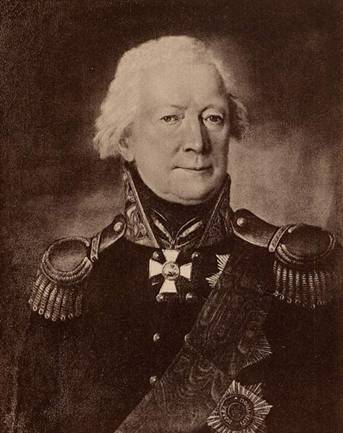
General Karl Knorring
The new Russian administration was set up
in Tbilisi in
May 1802. The administrator of Georgia was a certain Kovalensky, who had served as Russian envoy at the
Georgian court during the reign of the late King Giorgi
XII. This Kovalensky had already made himself obnoxious to the Georgians by his haughty manner
and bullying demeanour. They were not reassured to see him back among them,
invested with all the authority of the Russian state.
During these first two years of Russian
rule, the internal situation in Eastern Georgia
left much to be desired. Russian authority was confined to only a small part
of Transcaucasia, namely the area centred on Tbilisi, measuring about one hundred and
ninety miles long by one hundred and forty miles wide. This bridgehead of
Russian power was ringed about by Persian khans, Turkish pashas, wild
mountaineers, and unsubdued Georgian princelings, most of them hostile to Russia. Marauding parties of Lezghis on their agile steeds roamed the countryside,
defying the less mobile Russian garrisons. The Ossetes who dominated the Daryal
Pass, Russia's only supply line over the Caucasus
range, held up travellers and convoys. Trade was virtually at a standstill,
while the peasantry scarcely ventured out to plough the fields.
The widow of King Erekle
II, the redoubtable Dowager Queen Darejan,
continued to intrigue in favour of her eldest son, Prince Yulon,
whom she wished to see installed as king under the Russian aegis. The nobles
and people, while affirming their desire to remain under Russian protection,
continually agitated for a prince of their own. The Russian authorities
interpreted this natural aspiration as insurrection, and made a number of
arrests. Seeing scant improvement in the state of the country, the Georgians
lost faith in the Russian government and its local representatives.
Prince Tsitsianov
The chief administrator in Tbilisi, Kovalensky, was not the man to restore general
confidence. He was busy enriching himself by disreputable speculations in the
bazaar, and allotting key positions in the government to his relatives and
friends. The Georgian councillors whose appointment
was provided for in the manifesto of September 1801, were never nominated.
Corruption and abuse went unchecked. Official documents of the time show that
rape and acts of violence were commonly committed by Russian officials and
soldiery. Prince Tsitsianov, who later succeeded Knorring as commander-in-chief, alludes in one of his
reports to the 'crying abuses of authority committed by the former
administrator of Georgia',
which had 'gone beyond the Georgian people's limits of patience'. Even the
official Russian historian of the Caucasus,
A. P. Berzhe, remarks that 'Kovalensky
and Company did not remove, but aggravated the abuses from which the Georgian
people so grievously suffered. . . . Disappointed hope for improvement turned
into ill-will, discontent, and impotent resentment, in fact the very impulses
from which derive rebellion and revolt against supreme authority.'20
Rumours of Kovalensky's
nefarious activities soon reached St.
Petersburg. It was reported to the Tsar by one of
his trusted advisers, Count Kochubey, that Knorring and Kovalensky 'were
committing great exactions; that they were maintaining discord among the
peoples of the country in order to be able to pillage them with more ease;
and all kinds of similar horrors'.
It can hardly be said that Tsar Alexander
was much of a liberal in his dealings with his Georgian subjects. But he was
determined at least to keep up appearances, and saw how much Georgia needed a governor with courage and
integrity, and some direct knowledge of local conditions and of the mentality
and culture of Russia's
new citizens.
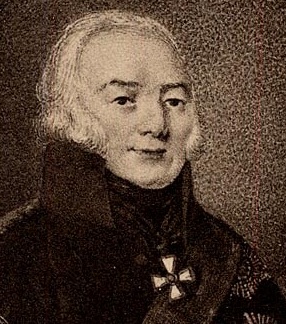
Prince Pavel
Dmitrievich Tsitsianov (Pavle Tsitsishvili)
Fortunately, so it seemed, the ideal man
was to hand in the person of Prince P. D. Tsitsianov,
a scion of the Georgian noble family of Tsitsishvili.
Tsitsianov was an officer with a distinguished
record in the Russian Army; he had been a disciple of the illustrious
Suvorov. He was also a distant relative of the widow of King Giorgi XII of Georgia, Queen Mariam,
who had been a Princess Tsitsishvili. In September
1802, Alexander appointed Tsitsianov
commander-in-chief on the Caucasian Line, with viceregal
powers over Georgia.
He was instructed to introduce order and prosperity into the country, and to
show the Georgian people that 'it would never have cause to repent of having
entrusted its destiny to Russia'.
The Tsar further empowered him to take immediate steps to persuade--if
necessary by physical force--the former Georgian royal family to settle in Russia,
and thus put an end to all agitation for the Bagratid
dynasty to be retored.
Arriving at Tbilisi on 1 February 1803, Tsitsianov's first care was to pack off the remaining
members of the old royal family. The former Prince-Regent David and his
uncle, Prince Vakhtang, left Tbilisi under escort later in February.
There remained the Dowager Queen Darejan, widow of Erekle II, and the widow of the late King Giorgi XII, Queen Mariam, with
her seven children. In April, Tsitsianov heard that
Queen Mariam was planning to flee to the mountain
strongholds of Khevsureti with the aid of loyal
clansmen from the hills. He therefore gave orders that the queen and her
children should be sent off into exile in Russia under guard the very next
morning. To impart an air of ceremony to the proceedings, it was decided that
Major-General Lazarev, commander of Russian troops
in Tbilisi,
should proceed in full uniform to the queen's residence, with a military band
and two companies of infantry, and prevail upon her to take her departure
forthwith.
Death
of a general
Of the ensuing tragedy there are several
contemporary accounts, based on the reports of eye-witnesses. 21 Arriving
at Queen Mariam's mansion, Lazarev
found her in her private apartment, seated on a couch, and surrounded by her
seven sleeping children. The general strode brusquely up to the queen and
said, through his interpreter: 'Get up, it is time
to be off.'
The queen calmly replied: 'Why this hurry to get up? Can you not see my children
peacefully asleep round about me? If I wake them up abruptly it might be
harmful to them. Who has given you so peremptory an order?'
The general replied that his orders were
from Prince Tsitsianov himself.
' Tsitsianov--that mad dog!' Queen Mariam
cried out.
At this, Lazarev
bent down to drag her forcibly to her feet. The queen was holding on her
knees a pillow, beneath which she held concealed the dagger which had
belonged to her late husband, King Giorgi. As quick
as lightning, she drew the dagger and stabbed Lazarev
through the body with such force that the tip of the weapon emerged through
his left side. Mariam pulled the dagger from the
gaping wound and threw it in the face of her prostrate tormentor, saying: 'So
dies anyone who dares add dishonour to my
misfortune!'
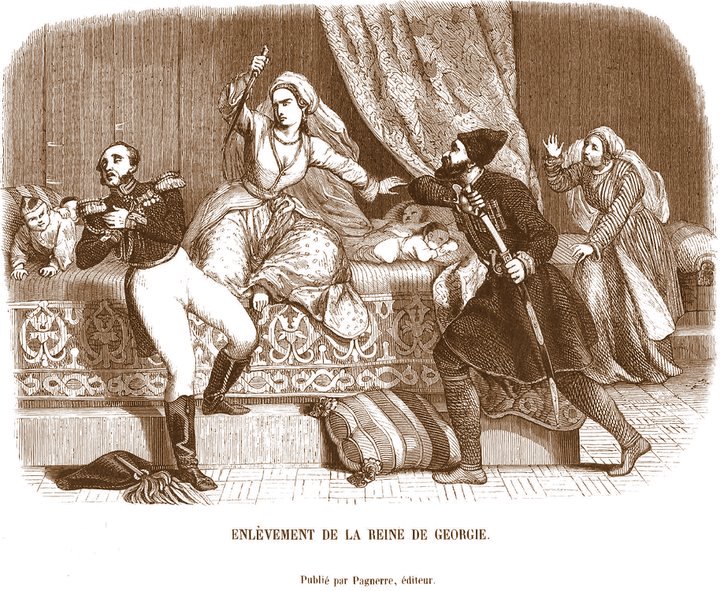
At Lazarev's
expiring cry, his interpreter drew his sword and hacked at the queen's left
arm. Soldiers rushed in and beat at the queen with their rifle butts. They
dragged her from the house all covered in blood, and hurled her with her
children into a carriage. Escorted by a heavy guard of armed horsemen, the
party left Tbilisi along the military road
leading to Russia over the
Daryal
Pass. Everywhere the queen's
carriage was surrounded by devoted Georgians, who wept as they struggled to
bid farewell to the family of their late sovereign. These loyal
manifestations were repulsed by the Russian soldiery.
When one of the children cried out that he was thirsty, a bystander brought
up a jug of water, which the Russian escort hurled to the ground. On arrival
in Russia, Queen Mariam was imprisoned for seven years in a convent at Voronezh. She lived to a
great age, and eventually died at Moscow
in 1850. She was interred at Tbilisi
with regal honours.
The Queen Dowager Darejan--'that
Hydra', as Tsitsianov delicately termed her--held
out until the October of 1803, when she too was bundled off to Russia.
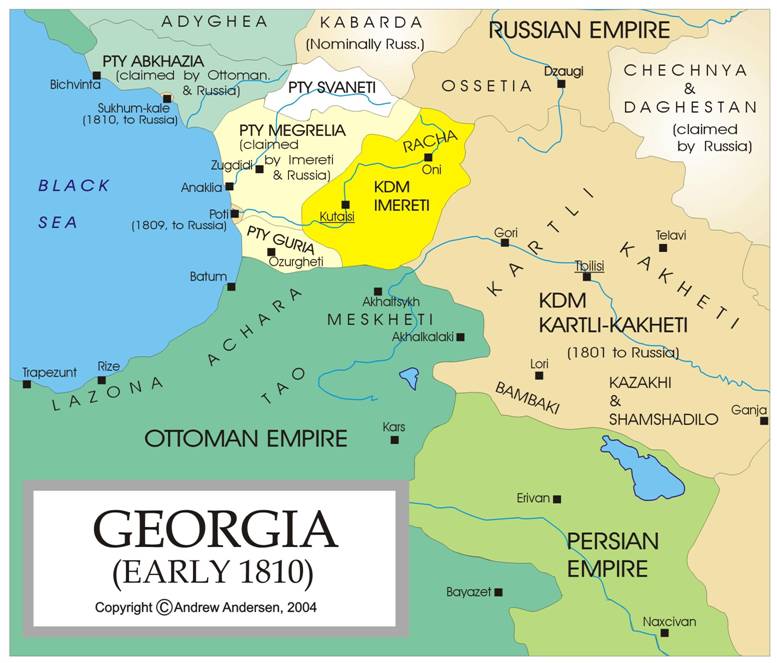
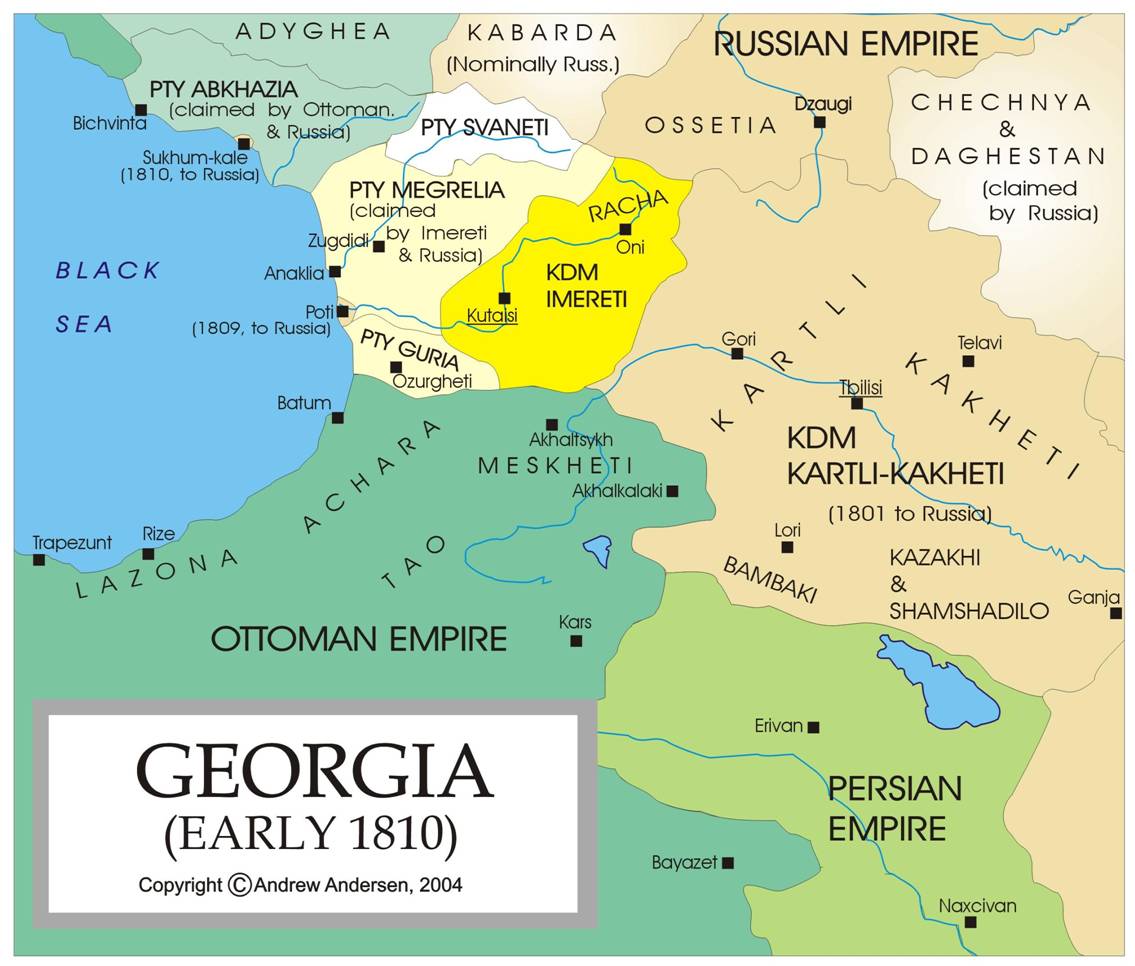
Click on the map for better
resolution
Subjugation of Western
Georgia
Having eliminated these obstacles, Tsitsianov rapidly extended Russia's
grasp on Transcaucasia. He saw the urgency
of securing as rapidly as possible the entire area between the Black Sea and the Caspian. From his headquarters in Tbilisi, he turned his
attention westwards to Imereti. Western
Georgia was at this time torn by a feud between King Solomon II
of Imereti and his nominal vassal, the
semi-independent prince-regent or Dadian Grigol of Mingrelia. One of Grigol Dadian's predecessors
had sworn fealty to the Tsar of Russia as long ago as 1638. Now, in 1803, his
country was taken under direct Russian suzerainty. In contrast to the
situation in Eastern Georgia, the local
administration was left to the princely house, which retained control under
nominal Russian supervision until the dignity of Dadian
was finally abolished in 1867. With his principal vassal and foe now under
Russian protection, King Solomon of Imereti felt it
wise to feign submission. His dominions also were in 1804 placed beneath the
imperial aegis, under guarantees similar to those given to the Dadian. However, Solomon remained at heart bitterly opposed
to his foreign overlords, and his court at Kutaisi was a hot-bed of anti-Russian
intrigue.
Eastwards of Tbilisi,
Georgia's internal
security was still threatened by the warlike Lezghian
tribesmen of Daghestan, and by the independent
Muslim khans of Ganja, Shekki
and Baku,
allies and nominally vassals of the Shah of Persia. Tsitsianov
sent several expeditions against the Lezghis, with
only partial success. His bravest lieutenant, General Gulyakov,
was killed in one of the bloodthirsty engagements which took place. In his
dealings with the Muslim potentates of Daghestan, Tsitsianov did not mince words. 'Shameless sultan with
the soul of a Persian--so you still dare to write to me! Yours is the soul of
a dog and the understanding of an ass, yet you think to deceive me with your
specious phrases. Know that until you become a loyal vassal of my Emperor I
shall only long to wash my boots in your blood.' 22 With
language of this kind, backed by cold steel, Tsitsianov
eventually abated the Lezghian menace and improved Georgia's
internal security.
On 3 January 1804, Prince Tsitsianov took the important trading centre and fortress
of Ganja by storm. Its ruler, Javat
Khan, had been a bitter enemy of the Georgian kings, and had helped Agha Muhammad Khan Qajar to
invade Georgia and sack Tbilisi in 1795. Javat was now slain on his own battlements. The town was
renamed Elizavetpol, in honour of the Empress
Elizabeth, consort of Alexander I. (It is the presentday
Kirovabad.)
This success enhanced Russian prestige to such an extent that for the time
being, to use the historian Dubrovin's metaphor,
the rulers of neighbouring, khanates took on a demeanour of lamb-like
meekness. 23
During the reign of King Erekle II, the rulers of both Ganja
and the chief city of Armenia, Erivan, had been vassals of the Georgian crown. Having
subjugated Ganja, Tsitsianov
judged the moment ripe for an expedition to Erivan.
He learnt also that the Persians were massing a large army in Azerbaijan to the south, in preparation for an
onslaught on the Russian dominions in the Caucasus.
Determined to nip this in the bud, Tsitsianov
marched against Erivan in June 1804,
defeated a Persian force under the Crown Prince, ' Abbas
Mirza, and laid siege to the city. A wet autumn,
supply difficulties, and skirmishing attacks by the Persian light cavalry,
ultimately forced Tsitsianov to raise the siege and
retire to Tbilisi.
A contributory cause of this fiasco was a
mass uprising which broke out along the Georgian military highway over the Caucasus range, on which the Russians depended for all
reinforcements and supplies. This was the first of several spontaneous mass revolts
against Russian rule. Its unmistakably popular character distinguished it
from earlier movements of protest headed by the Georgian royal house and
landed aristocracy.
The immediate reason for the outbreak was
the severity of the Russian commandants in the Daryal Pass and Ananuri
sectors. The Ossete mountaineers and the villagers
of Mtiuleti were forced to toil without payment on
the roads and were mercilessly flogged, some dying from their injuries.
Others perished from cold in clearing away snow drifts. The peasants broke
into revolt and killed the town commandant of Ananuri.
The insurgents were joined by contingents of the Khevsurs
and other mountain clans. They received encouraging messages from Prince Yulon, who still hoped to win the Georgian throne, and
from the Shah of Persia. The rebels defeated a regiment of Don Cossacks sent
from the North Caucasian Line, cut communications between Georgia and Russia,
and menaced the town of Gori. The onset of autumn and
the arrival of Russian reinforcements strengthened Tsitsianov's
hand. The insurgents were no match for regular troops, and the revolt was
brought under control. Reprisals followed and whole families were shut up in Gori castle and left to perish of hunger and cold.
Despite these difficulties, Tsitsianov did his best
to put the social and economic life of Georgia on a sound footing. It
had been one of the conditions of the various pacts concluded between Russia and Georgia that the Georgian
aristocracy and squirearchy should be confirmed in
their traditional privileges, and placed on the same footing as the Russian
nobility. Feudalism as practised in Georgia
was by no means identical with the Russian system of serf proprietorship,
which had reached the high point
of its development during the reign of Catherine the Great, and was in many
ways indistinguishable from outright slavery. However, Tsitsianov
did the best he could to regularise relationships between the Georgian nobles
and their vassals, though many grievances and misunderstandings arose under
the new dispensation.
Tsitsianov was well aware of
the urgency of improving trade and communications, with a view to feeding the
Russian garrisons off the land and clothing them from local resources,
increasing the customs and excise revenues, and generally making the country
self-supporting. The town bourgeoisie were afforded special protection, with
inducements to expand their operations. For some years to come, however, the
occupation of Georgia
entailed a substantial drain on the central Russian treasury. In 1811, for
instance, a million silver rubles had to be sent to
pay the troops and civil servants stationed in the country.
Education and public amenities were not
neglected. Prince Tsitsianov founded a school in Tbilisi for sons of the
aristocracy. Special scholarships, notably in medicine, were founded to
enable some students to continue their studies at Moscow University.
The Georgian printing press which had functioned in Tbilisi until Agha
Muhammad Khan destroyed it was now reinstalled. A State-owned apothecary's
shop was opened, as well as a botanical garden, since famous throughout Russia.
In 1804, a mint was opened in Tbilisi, at
which a distinctive Georgian silver and copper coinage was struck until 1834,
when the standard Russian coinage was given exclusive currency in Georgia.
Public buildings constructed on European lines began to make their appearance
in the Georgian capital, while the citizens were encouraged to rebuild those
quarters of the town which had been completely laid waste by the Persians in
1795.
With his Georgian ancestry, Tsitsianov fully realized the dangers inherent in
over-hasty russification of Georgia's administrative and
judicial system. He recommended that the transition from the old oral system
of administering justice to the bureaucratic formalism characteristic of
Russian official procedure should be brought about by gradual stages. He
thought that it would be best to retain the Georgian language as the medium
for transacting local official business. However, Tsitsianov
set his face firmly against any concession to Georgian national sentiment.
Loyalty to the Russian Tsar and his own personal ambition overrode any regard
which he might have had for Georgia's
glorious past and for her ancient dynasty, the Bagratids.
Thus when Count Kochubey, Alexander's
liberal-minded minister of the interior, wrote in 1804 to ask whether one of
the Georgian royal princes might not after all be set up as a vassal ruler in
Georgia
under Russian supervision, Tsitsianov at once stifled
the project. 24
The successes won by Tsitsianov
and the rapid expansion of Russian influence throughout Transcaucasia were a
source of extreme concern to the Ottoman Porte and to the Shah of Persia, as
well as to the East India Company and the British Foreign Office. The Shah
was at this time in the enviable position of having rival French and British
missions in Tehran
vying for his favour. In 1805, profiting by Russia's
heavy commitments in the struggle against Napoleon in Europe,
the Persian crown prince, ' Abbas Mirza,
invaded the Karabagh and menaced Elizavetpol. The Russians stood firm, until finally the
Shah's forces retired discouraged and without engaging battle.
Prince Tsitsianov
now judged the time ripe to extend Russia's
dominions to the shores of the Caspian Sea
south of the Caucasian range. In January 1806, he marched on Baku. The khan who
governed that place as a nominal vassal of the Persian shah feigned
submission, and undertook to hand over the keys of the city. As Tsitsianov rode out to meet the khan and his followers,
the Persians opened fire and shot him down on the spot. The artillery of the
citadel started up a bombardment, and the demoralized and leaderless Russians
withdrew. So ended the brief but eventful viceroyalty of this determined
proconsul, a renegade to his own people, but a man who, in serving Russia, dealt many a crushing blow to Georgia's
traditional enemies.
The decade which followed Tsitsianov's death was less spectacular than these first
few years, in which Russian power had spread so rapidly through Transcaucasia. Tsitsianov's
successors were less talented than he. The element of surprise which had
enabled the Russians to overcome the petty Caucasian states one by one was
now lost; the Persian shah and the Turkish sultan were on the alert, and
neither the British nor the French could view with approval this Russian
wedge being driven down towards Mesopotamia and the Levant on the one side,
and towards the Persian Gulf and the Indian Ocean on the other. Furthermore,
the Napoleonic wars imposed an immense strain on Russia's
resources, and prevented the deployment of large forces in remote Caucasia. Nor can one overlook the deterioration of
relations between the native Georgian population and the occupying power,
resulting from the exactions of the military commanders and the corrupt ways
of Tsarist officialdom.
'Up to 1812,' wrote a staff officer serving
at that time in the Russian Army of the Caucasus,
'the Georgians, organized as irregular troops, had served in our ranks
virtually as volunteers. A disastrous expedition against Akhaltsikhe,
in which they felt themselves to have been sacrificed and abandoned, the
resulting misfortunes, combined with requisitions and extortions, drove them
to revolt. Rebellion was stifled in blood; but its spirit lived on. Only an
entirely new approach can reawaken the fidelity which an odious system has
almost extinguished.' 25
Under Tsitsianov's
successors, the war against Persia
and Turkey
continued with varying success and great ferocity. On the Persian front, Derbent and Baku were at
last annexed in 1806, though a second attack on Erivan
in 1808 ended in another costly failure. In Western Georgia, the Russians
kept up their pressure on the Turks, from whom they took the Black Sea port of Poti in 1909, Sukhum-Kaleh
on the coast of Abkhazia in 1810, and the strategic town of Akhalkalaki ('New Town') in south-western Georgia
in 1811.
King
Solomon II and Napoleon Bonaparte
The remaining independent princes of Western Georgia hastened to accept Russian suzerainty.
In 1809, Safar Bey Sharvashidze,
the Lord of Abkhazia, was received under Russian protection and confirmed in
his principality. Prince Mamia Gurieli,
ruler of Guria, was taken under the Russian aegis
in 1811, receiving insignia of investiture from the Tsar. Only King Solomon
II of Imereti held out to the bitter end.
Encircled by Russian troops, the king
strenuously resisted an demands for submission, in
spite of the fact that he had earlier, under pressure, sworn fealty to the
Tsar. In 1810, the Russians despatched an ultimatum to Solomon, demanding
that he hand over the heir to his throne and other Imeretian
notables as hostages, and reside permanently under Russian surveillance in
his capital at Kutaisi.
Solomon refused, and was declared to have forfeited his throne. Hounded by
Russian troops and by Georgian princes hostile to
him, he sought refuge in the hills, but was soon captured and escorted to Tbilisi. A few weeks
later, Solomon staged a dramatic escape from Russian custody, and took refuge
with the Turkish pasha at the frontier city of Akhaltsikhe.
Inspired by this daring feat, the people of Imereti
rose against the Russian invaders. Ten fierce engagements were fought between
the Russian forces and the guerillas of Imereti. Famine and plague broke out, and some 30,000
people perished, while hundreds of peasant families sought refuge in Eastern Georgia. Eventually the patriots were crushed
by armed force. A Russian administration was set up in Kutaisi, the country placed under martial
law.
King Solomon now applied for help to the
Shah of Persia, to the Sultan of Turkey, and to Napoleon Bonaparte himself.
To the Emperor of the French, Solomon wrote in 1811 that the Muscovite Tsar
had unjustly and illegally stripped him of his royal estate, and that it
behoved Napoleon, as supreme head of Christendom, to 'take cognizance of the
act of pitiless brigandage' which the Russians had committed against him.
'May Your Majesty add to your glorious titles that
of Emperor of Asia! But may you deign to liberate me, together with a million
Christian souls, from the yoke of the pitiless emperor of Moscow, either by
your lofty mediation, or else by the might of your all-powerful arm, and set
me beneath the protective shadow of your guardianship!" 26 Napoleon
himself was, of course, quite a connoisseur of 'pitiless brigandage'.
However, this eloquent plea, which reached him shortly before he set out on
his ill-fated campaign to Moscow, provided him with encouraging evidence of
the unsettled condition of Russia's Transcaucasian
provinces. But as things turned out, Napoleon could not save even his own
Grand Army from virtual annihilation, let alone a princeling
down in the distant Caucasus. Without
regaining power, Solomon died in exile in 1815, and was buried in the
cathedral of Saint Gregory of Nyssa in Trebizond.
The elimination of King Solomon did not
bring civil strife in Georgia
to an end. No sooner was Western Georgia
outwardly pacified than fresh troubles broke out in Kartli
and Kakheti. Ten years of Russian occupation had
greatly changed the attitude of a people who, a decade before, had welcomed
the Russians as deliverers from the infidel Persians and Turks. Called upon
to furnish transport, fodder and supplies to the Russian Army at artificially
low rates, and regarded by their new masters as mere serfs, the Georgian
peasantry looked back wistfully to the bad old days. Under the Georgian
kings, though invaded and ravaged by Lezghis,
Persians and Turks, their country had at least been their own. Now it was
simply an insignificant province, engulfed in a vast, alien empire, whose
rulers seemed lacking in sympathy for this cultivated, Christian nation which
had voluntarily placed itself under the protection of its northern neighbour.
In their yearning for independence, the
Georgians were encouraged by the dauntless personality of Prince Alexander Bagration, son of their great king Erekle
II. Alexander, who had sought refuge with the Shah of Persia, was described
by a contemporary British traveller as 'a prince whose bold independence of
spirit still resists all terms of amity with Russia'. 'It was impossible to
look on this intrepid prince, however wild and obdurate, without interest;
without that sort of pity and admiration, with which a man might view the
royal lion hunted from his hereditary wastes, yet still returning to hover
near, and roar in proud loneliness his ceaseless threatenings
to the human strangers who had disturbed his reign.' 27
The
revolt of 1812
In 1812, the Persians won some military
successes against the Russians in the Karabagh
region. When they heard of the Russian setback, the peasants of Kakheti broke into revolt. They wiped out the garrison of
Sighnaghi and blockaded Telavi,
the capital town of Kakheti. The insurgents
proclaimed as king the young Bagratid
prince, Grigol, son of Prince Ioane,
and grandson of the late King Giorgi XII. In answer
to an ultimatum addressed to them by the Russian commanderin-chief,
Marquis Philip Paulucci, the rebels replied:
'We know how few we are compared with the
Russians, and have no hope of beating them. We wish rather that they would
exterminate us. We sought the protection of the Russian Tsar, God gave it to
us, but the injustices and cruelty of his servants have driven us to despair.
We suffered long! And now, when the Lord has sent us this terrible famine,
when we ourselves are eating roots and grass, you violently seize food and forage
from us! We have been expelled from our homes. Our storerooms and cellars
have been plundered, our stocks of wine uncovered, drunk up and wantonly
polluted by the gorged soldiery. Finally our wives and daughters have been
defiled before our eyes. How can our lives be dear to us after such ignominy?
We are guilty before God and the Russian Tsar of steeping our hands in
Christian blood, but God knows that we never plotted to betray the Russians.
We were driven to this by violence, and have resolved to die on the spot. We
have no hope of pardon, for who will reveal our condition to the emperor? Do
we not remember that when we called on the Tsar's name, our rulers would
answer: God is on high, the emperor far away.' 28
The rebellion spread like wildfire. Even
the Russian authorities in Tbilisi
felt themselves menaced. Prince Alexander Bagration
arrived in Daghestan from Persia to mobilize the Lezghis,
those inveterate foes of both Georgia
and Russia.
But Russian reinforcements were hurried to the scene. The rebels lacked
cohesion, discipline, supplies. In October 1812, the Russians defeated
Alexander and his motley horde at Sighnaghi. A few
days later, the daring Russian commander, Kotlyarevsky,
crossed the River Araxes and defeated the main Persian Army at Aslanduz, leaving 10,000 of the enemy dead upon the field
of battle.
Neither the Russians nor their Persian and
Turkish adversaries were in a fit state to continue the struggle. Peace with
the Ottoman Empire had already been concluded at Bucarest
in May 1812,whereby the Russians handed back to the
Turks the Black Sea port of Poti and the strategic
town of Akhalkalaki.
More favourable to Russia
were the terms of the Treaty of Gulistan, concluded
between Tsar Alexander I and Fath'Ali Shah of
Persia in 1813, largely through the mediation of the British ambassador to Persia,
Sir Gore Ouseley. By this instrument, Russia was confirmed in possession of Eastern
and Western Georgia, Daghestan, and the Muslim
khanates of Karabagh, Ganja,
Shekki, Shirvan, Derbent, Baku
and Kuba.
Suppression
of the Georgian
Church
An event which caused the greatest
resentment throughout Georgia,
and contributed still further to the deterioration of Russo-Georgian relations,
was the suppression in 1811 of the independent Georgian Church.
It will be recalled that the Russo-Georgian treaty of 1783 had guaranteed to
the Patriarch of Georgia the eighth place among the prelates of Russia
and a seat in the Russian Holy Synod. Now, having abolished both the Georgian
monarchies, the Russians found that the Church was becoming a focus for
Georgian national solidarity. With that same scant regard for treaty rights
which it had shown even earlier, the Russian government now sent the CatholicosPatriarch Antoni II
into enforced retirement at St. Petersburg,
replacing him by a representative of the Russian Church,
the Metropolitan Varlaam, who was given the title
of Exarch of Georgia. This complete suppression of
a national Church by the government of a friendly Christian power must be
without parallel in the modern annals of civilized nations.
Himself a Georgian of
noble birth, Varlaam failed to show himself
sufficiently obedient to the will of his Russian masters. He was soon replaced
by a Russian cleric, Theophilact Rusanov, a man
quite alien to Georgian ways. Theophilact regarded
his flock as ignorant barbarians, and did his utmost to replace the Georgian
liturgy with Slavonic forms of worship. In spite of the Russian bayonets which
he had at his disposal, Theophilact encountered
strong opposition throughout Georgia.
In 1820, the Russians arrested the Archbishops of Gelati
and Kutaisi, the principal ecclesiastical
leaders of Western Georgia. Archbishop Dositheus of Kutaisi,
stabbed and maltreated by Russian Cossacks, died soon afterwards. Spontaneous
uprisings followed these Russian outrages. The insurgents planned to restore
the monarchy of Imereti. The upland district of Ratcha was the scene of bitter fighting. The movement
also spread into Guria and Mingrelia.
An outbreak of civil war in Abkhazia in 1821 further aggravated the
situation. The general unrest was not quelled until 1822.
The Russian proconsul in Georgia between 1816 and 1827 was
General A. P. Ermolov, one of the heroes of the
Napoleonic wars. Ermolov, who had taken part in the
battles of Austerlitz, Borodino
and many others, was a man of unsurpassed courage, spartan
in his habits, and adored by his troops. He declared a war to the death
against the Muslim tribesmen of Daghestan and North
Caucasia, and his campaigns, conducted on the good old plan with fire and
sword, the devastation of crops, the sacking of villages, the massacre of men
and the ravishing of women, gave them a lesson which they doubtless
appreciated to the full. Another Russian general said of Ermolov
that 'he was at least as cruel as the natives themselves'. He himself
declared:
'I desire that the terror of my name should
guard our frontiers more potently than chains of fortresses, that my word
should be for the natives a law more inevitable than death. Condescension in
the eyes of Asiatics is a sign of weakness, and out
of pure humanity I am inexorably severe. One execution saves hundreds of
Russians from destruction, and thousands of Mussulmans
from treason.' 29
Ermolov's administration
resulted in improved public security within Georgia. A police force was
founded in Tbilisi.
Bands of marauding Lezghis dared no longer carry
off villagers into slavery or raid trading caravans. Military and post roads
were built, benefiting trade and communications. Ermolov
had some of the Tbilisi
streets paved, and roofed over the bazaar. The erection of European public
buildings helped to modernize the city's appearance. Similar improvements
were undertaken in Kutaisi,
the old capital of Imereti, until now a decayed and
insignificant township.
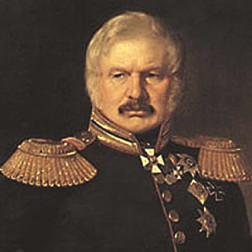
General Alexei Petrovich
Ermolov
Economic progress and literary contacts
Now that Russia
controlled a stretch of territory extending from the Black
Sea to the Caspian, commerce began to revive. Odessa
in southern Russia
was linked by sea with the little port of Redut-Kaleh
in Mingrelia. By this route, manufactured goods
from Russian cities and Western Europe could be transported via Tbilisi to Baku on the
Caspian, or into Persia
overland via Tabriz.
Tsar Alexander's edict of 1821 granted to Russian and foreign concerns
operating in Georgia
special customs concessions and other privileges for a space of ten years. Tbilisi merchants began to establish connexions with Marseilles, Trieste, and Germany, and to re-export European wares to Persia
on a substantial scale. In 1825, Georgian and Armenian traders made purchases
totalling over a million rubles at the Leipzig fair; in 1828,
the figure exceeded four million. The demand for European manufactured goods
was stimulated by the presence in Georgia of a large number of
Russian officers and civilian functionaries, with their families. In 1830, an
official of the finance department reported from Tbilisi that trade was in the most
flourishing condition. British, French and Swiss commercial houses showed
interest in this growing market.
Imports of Western manufactured goods,
however, far outweighed Georgian exports of raw materials. In 1824, for
instance, the Acting French Consul in Tbilisi reported that although Georgia
produced timber, cotton, saffron, madder, wax, honey, silk and tobacco, there
was little attempt as yet to market these commodities on a large scale. By
Western commercial standards, Georgia
could not furnish a worthwhile cargo of goods for export at any one time,
while acts of piracy by the Circassians and
Abkhazians on Black Sea shipping made sea
trade hazardous. 30
General Ermolov
did his best to remedy these difficulties. The French Consul, the Chevalier
de Gamba, was granted a concession in Imereti to exploit the country's vast timber resources,
and to start up cotton plantations. Five hundred families of Swabian peasants from Württemberg arrived in Georgia
in 1818. They were encouraged to set up model farmsteads near Tbilisi and elsewhere.
They set an admirable example of diligence, thrift and sobriety, which
contrasted with the fecklessness of the local inhabitants. But they remained
aloof from the population at large, with whom they had nothing in common.
They were respected rather than liked, and their influence on the general
life and history of Georgia
was small. Other branches of industry encouraged by Ermolov
were the cultivation of silk in Kakheti, and the
production of wine, for which that same province had always been famed. It
would, however, be wrong to imagine that Russia
benefited financially at this period from her colonization of Georgia.
In 1825, her total revenue derived from the country amounted to 580,000 rubles, which did not even pay for the maintenance of the
local Russian garrisons and administration.
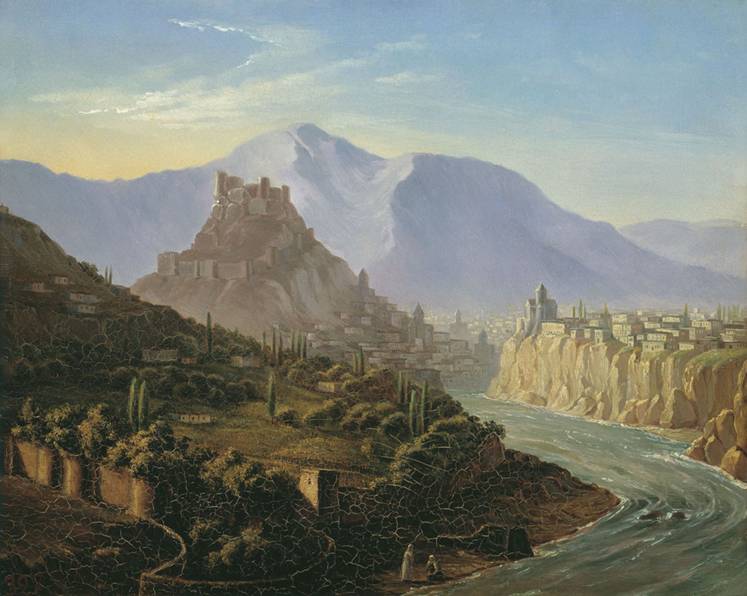
Tbilisi in the early 19th
century (picture by Mikhail Lermontov / 1837)
During the 1820's, the influence of the
Russian Finance Minister, Count Kankrin, and the
agitation of the Moscow manufacturers led to the triumph of protectionism in
Russia generally and the abandonment of any attempt to promote free trade
with foreign countries. Tariff walls and similar devices were imposed
increasingly for the encouragement of budding home industries. Accordingly,
on the expiration of the tenyear customs franchise
granted for Georgia by the edict of 1821, this was not renewed; merchandise
entering Transcaucasia was subject now to the same high dues as were levied
at Russia's other frontiers. Since no large-scale local factories existed,
this return to protectionism simply impoverished the Tbilisi merchants and hampered the growth
of Georgian trade. European goods soon began to reach Persia via Trebizond and Erzurum
in Turkey,
without passing through Russian territory at all. This put a stop for the
time being to any increase in Georgia's
importance as a stage in the international trade route between Europe and the East.
In the meantime, a series of spectacular
events had brought Ermolov's Caucasian viceroyalty
to an untimely close. Early in December 1825, news was brought to St. Petersburg of the death of Tsar Alexander I at Taganrog. Immediately, a
nationwide crisis arose over the succession to the imperial throne. The
reason for this was that the Grand Duke Constantine, who was governing Poland,
had in 1822 formally renounced the succession to the Russian throne in favour
of his younger brother Nicholas, though this had been kept a closely guarded
state secret. For a time, neither Nicholas nor Constantine would accept the
imperial succession, until finally Nicholas was prevailed upon to do so.
Clandestine revolutionary societies had for
some years been active among the younger, liberal-minded officers of the
Russian army. Many of the conspirators belonged to the foremost princely
families in the land. The unsettled state of public opinion now provided them
with what they deemed a propitious moment for their projected coup. On 26
December 1825, when called upon to take the oath of allegiance to the new
emperor, Nicholas I, 2,000 soldiers of the Guard formed up outside the Senate
building in St. Petersburg, shouting for 'Constantine and Constitution (konstitutsiya)' which latter many of the soldiers
took for the name of the Grand Duke Constantine's wife. The military governor
of St. Petersburg
was killed while parleying with the mutineers. Finally, loyal troops were
brought up and two volleys of grapeshot cleared the square. 31 The
resulting investigation revealed that the conspiracy had wide ramifications
throughout Russia.
Five of the ringleaders were hanged, and many others exiled to Siberia or
sent to serve in the ranks of the army of the Caucasus.
Among the many distinguished individuals whose names were mentioned in the
course of the enquiry was General Ermolov. In the
absence of specific evidence against him, he was left at his post, though
under a cloud.
Ermolov was soon under
fire from another quarter. In spite of the Treaty of Gulistan,
which they had signed under duress in 1813, the Persians had never reconciled
themselves to the loss of their Caucasian possessions. In 1825, Ermolov's troops occupied Gokcha,
a small and barren frontier district northeast of Erivan in Armenia. This precipitated a
crisis. Encouraged by garbled reports of the Decembrist uprising, the
Persians decided on an offensive. They were spurred on to action by Prince
Alexander Bagration, the exiled Georgian royal
prince, whose hatred of Russia
overbore any reluctance to subject his native land once more to the horrors
of war. In 1826, the Persian Army launched a surprise attack on Georgia and
the Karabagh. Pambak, Shuragel and Borchalo were
overrun, Elizavetpol (Ganja)
captured. Tbilisi
itself was menaced.
Ermolov reacted with what
can only be termed masterly inactivity. To the urgings of Tsar Nicholas he
responded with pleas for reinforcements. The fire seemed to have gone out of
the veteran warrior.
It was not long before the dashing General Paskevich arrived to take command in the field. Ermolov was relieved of his post. Paskevich
soon routed the Persians completely. The cities of Erivan, Tabriz
and Ardebil
fell to his victorious army. In February 1828, the Russo-Persian Treaty of Turkmanchai was signed, establishing Russia's frontier on the River
Araxes, where it has ever since remained fixed. 32
The treaty of Turkmanchai
eliminated Persia
as a factor in Caucasian politics. The warlike tribes of Daghestan
were cut off from direct contact with their co-religionists in the Islamic
world outside the borders of the Russian Empire. In future, the Muslims of
the Caucasus were to look to the Turks alone
for support. But the successes won by such commanders as Paskevich
meant that the Ottoman Empire, once a mighty world power, was fighting a
losing battle to hold the passes giving access to the inner homeland of Anatolia. During the century following the Caspian
campaign of Peter the Great, the main chain of the Caucasus
mountains had lost its old importance as an impregnable bastion
shielding the Middle Eastern lands against invasion from the north. Caucasia
had become a base from which Russian political and military power could be
directed westward across Anatolia towards the Mediterranean, southward across
Persia towards the Indian
Ocean, and eastward across the Caspian into the heart of Central
Asia. 33
The conclusion of peace with Persia
set Paskevich free to concentrate on Turkish
affairs. A general war between Russia and the Ottoman Porte was
in prospect. The main Russian objectives were the expulsion of the Turks from
the Black Sea coast, and in particular from the ports of Anapa,
Poti and Batumi; the reconquest
of the former Georgian province of Samtskhe, which
had for centuries now been governed by the Turco-Georgian
pashas of Akhaltsikhe; and the establishment of a
satisfactory frontier which would round off Russia's Transcaucasian
dominions and be defensible against Turkish incursions.
The campaign opened in May 1828, with the
surrender of the Turkish garrison in Anapa to a
combined expedition of the Russian fleet and troops from the Caucasian Line.
Relieved of anxiety on the score of his communications with Russia, Paskevich
then marched on the famous fortress of Kars,
which he captured by storm in June. The next month, the Georgian towns of Khertvisi and Akhalkalaki fell
to the Russians, as well as the port
of Poti.
The key city of Akhaltsikhe
was captured in August, while the Turks in Ardahan
surrendered without fighting. With autumn coming on, Paskevich
suspended operations and retired into winter quarters. He left garrisons in
the captured Turkish strongholds, and withdrew with the bulk of his weary
forces into bases within Georgia.
During the winter, Paskevich visited his imperial
master in St. Petersburg, and impressed upon
him the potentialities of an all-out offensive in Asia Minor.
The general proposed first to conquer Erzurum
and overrun the Armenian highlands; next, to launch a combined operation
against Trebizond, with the support of the Russian Navy; and thirdly, to
advance into the heart of Anatolia by way of Sivas.
Two untoward events delayed the campaign of
1829. On 11 February, the Russian mission to Tehran, headed by the playwright Griboedov, was hacked to pieces by a frenzied mob of
fanatical Persians. Only a display of unwonted moderation by the Russians
prevented a fresh outbreak of war with Iran. This moment, too, was
chosen by the Turks to launch a counter-offensive in the course of which they
reoccupied Ardahan and laid siege to the Russians
who manned the citadel of Akhaltsikhe. At the
beginning of June, Paskevich resumed the offensive.
His brilliant strategy and forceful leadership soon reduced the Turks to a
state of demoralization. Within a month, the Russians were before the great
Turkish fortress of Erzurum, which the Ottoman seraskier
made haste to surrender together with the remnants of his army, one hundred
and fifty fortress guns, and vast stores. The conclusion of the Treaty of
Adrianople in September 1829, forestalled the complete execution of Paskevich's ambitious plan. The terms of this treaty,
dictated by wider issues of European politics, were relatively moderate in
regard to the Ottoman Porte's Caucasian dominions. The Russians gained the
strongholds of Adsquri, Akhalkalaki
and Akhaltsikhe. But the provinces of Erzurum, Bayazid and Kars reverted to the Turks, who also regained Batumi and parts of Guria. The Russians received the ports of Poti and Anapa. The loss of Anapa cut off the Turks from direct access to Circassia, over which the Porte formally renounced all
claim to suzerainty.
These spectacular campaigns had the effect
of making Georgia
an important focus of international affairs. Intellectual life began to
revive as Tbilisi
became more and more of a cosmopolitan centre. There were frequent contacts
between the Georgian aristocracy and visitors from the outside world, both
Russians and travellers from Western Europe.
The first Georgian newspaper, Sakartvelos
gazeti or The Georgian Gazette, was
published between 1819 and 1822. The Russian-language Tiflisskie
vedomosti or Tiflis News started to appear
in 1828, with a supplement in Georgian. Associated with this venture was the
Georgian publicist Solomon Dodashvili, otherwise
known as Dodaev-Magarsky ( 1805-36),
who had attended the University of St. Petersburg and was now a teacher at the government
school in Tbilisi.
Also prominent in the intellectual life of Georgia was Prince Alexander Chavchavadze ( 1787-1846),
father-in-law of the Russian dramatist Griboedov. Chavchavadze's house in Tbilisi was a meeting place for the cream
of Georgian and Russian society. He won renown as a lyric poet, as did Prince
Grigol Orbeliani ( 1800-83), both of them being high-ranking officers in
the Russian Army.
After the abortive Decembrist conspiracy of
1825, the Caucasus was used by the Tsar as a milder alternative to Siberia for political offenders. Many of the exiled
Decembrists served in the ranks of Paskevich's
army. Several of these were poets and novelists of distinction, who found the
hospitable atmosphere of Georgia
highly congenial. The prevailing cult of Byronism in Russia encouraged a mood of romantic
enthusiasm for the snow-capped peaks of the Caucasus,
and their valiant, picturesque denizens. As the Russian critic Belinsky observed, 'The Caucasus seems to have been fated
to become the cradle of our poetic talents, the inspiration and mentor of
their muses, their poetic homeland.' In one of his lyrics, Griboedov describes the charm of Kakheti,
'where the Alazani meanders, indolence and coolness
breathe, where in the gardens they collect the tribute of the purple grape.'
He started work on a romantic tragedy to be entitled Georgian Night,
based on a theme from national legend. The great Pushkin was in Georgia
in 1829. He was royally feted in Tbilisi,
and wrote several lyrics on Georgian subjects. His travel journal, A
Journey to Erzurum, gives an account of his visit to the marchlands of Turkey
in the train of the victorious Paskevich; it
contains glimpses of Georgian life, music, poetry and scenic beauty. Some of
the brilliant inspiration of the great romantic M. Yu. Lermontov came to him
from Georgia.
The poems Mtsyri and Demon have a
Georgian setting, while his ballad Tamara presents a lurid if
historically false image of the great queen. In another of his poetic works,
Lermontov sketches a portrait of a drowsy Georgian countryman, recumbent in
the shade of a plane tree, languidly sipping the mellow wine of Kakheti.
But neither the Russian romantic cult of
the Caucasus, nor the hospitable welcome extended by Tbilisi society to Russian officers and
poets, could efface the deep-seated antagonism which the experience of a
generation of Russian rule had implanted in the Georgian nation. There were
observers who saw with concern the effect which foreign misrule was having on
the Georgian population. One eyewitness, Colonel Rottiers,
a Belgian in the Russian service, went so far as to recommend that Russian
officials be removed altogether from service in Georgia. 'The Georgians,' he
wrote, 'would submit to a governor from among their own nation. They would be
happy to see punished, or at least recalled, the officials of whom they have
had the most to complain. They ask for an administrative system which extends
beyond questions of criminal, civil and commercial law, and would like to
have laws based as far as possible on the code of their ancient kings. It is
wrong to despise as barbarians a people whose aspirations testify at once to
their love of abstract justice, and to so pronounced
a sense of nationality. . . . They desire, finally, to be eligible according
to merit to posts which up to now have been bestowed by favour alone, and,
furthermore, they would like themselves to elect their municipal magistrates,
their mouravs or justices of the peace.
"But," you may say, "these folk are as good as demanding a
constitution!" And why not? Those who have seen them at close quarters
deem them ripe for this privilege. When it is a question of bestowing liberty
on a nation, that is the crucial point at issue.' 34
The conspiracy of 1832
The moral climate of the 1820's was
conducive to romantic nationalism and to movements of revolt against imperial
systems. Throughout Europe, the ideals
typified by the Holy Alliance and the policies of Metternich and the Russian
autocrats were being called in question by thinking men. The activities of
the Carbonari in Naples,
the liberation movement in Greece,
the abortive Decembrist rising in Russia,
the Paris revolution of 1830 and the general
insurrection in Poland,
were all symptoms of a general malaise.
The Georgians had not forgotten their
chivalrous days of old, and the general mood of romantic effervescence found
response in their hearts. There were also material causes of grievance. Even
the higher aristocracy were discontented, especially as the Russian
administration had curtailed the landlords' feudal jurisdiction over their
peasants and ousted them from participation in local government, as well as questioning
the titles of nobility of some of the leading princely families. Continual
wars had bled the country white. The Russian writer
Griboedov commented in 1828 that 'the recent
invasion by the Persians, avenged by Count PaskevichErivansky
with so much glory for Russia, and the triumphs which he is now winning in
the Turkish pashaliks, have cost the Transcaucasian provinces enormous sacrifices, above all Georgia,
which has borne a war burden of exceptional magnitude. It is safe to say that
from the year 1826 up to the present time she has suffered in the aggregate
heavier losses in cereal crops, pack animals and beasts of burden, drovers,
etc., than the most flourishing Russian province could have sustained.' 35 The
prevailing mood was aptly summed up in a quatrain by Prince Ioane Bagration, son of the
last king of Kartlo-Kakheti, Giorgi
XII:
The Scythians [i.e., Russians] have taken
from us the entire land, and not even a single serf have they given to us.
Not satisfied with Kartli and Kakheti,
they have added to them even Imereti. We have grown
poor in misfortune, and have no advocate to whom to turn. We ask justice from
above; we shall see how God decrees!
A striking portrayal of the results of a
generation of Russian rule over Georgia
is contained in the report submitted by two Russian senators, Counts Kutaysov and Mechnikov, who
carried out an official inspection of Georgia in 1829-30. The state of
affairs displayed in this document resembles that so effectively pilloried in
Gogol's comedy, Revizor, or The Inspector-General.
'Not in a single government chancellery in Transcaucasia is there a shadow of that order in the
forms and procedure of transacting business which is prescribed by law. In
some chancelleries, this is because of their defective organization; in
others, because of the incapacity and lack of experience of the officials
posted for service there, and the complete absence of personnel capable of
efficient work. . . . The quantity of unresolved lawsuits turned out to be
beyond calculation. They had piled up, not because they were submitted in
great quantities, but because no efforts were made to bring them to a prompt
settlement.'
According to these two senators, Russian
officials were volunteering to serve in Georgia
simply in order to benefit by the advancement in rank automatically granted
as an incentive to undertake a tour of duty in the Caucasus.
On arrival there, they spent their period of service in wandering idly from
one department to another, and waiting impatiently for the moment to return
home. Arbitrary caprice rather than observance of official regulations
governed the administration of justice. Thus, the Governor of Tbilisi, P. D. Zavaleysky, and his colleagues, had deprived some
proprietors of their lands, and granted these to others, just as they saw
fit. 'In Imereti', the senators went on, 'we found
abuses of power and acts of extortion.' The main culprits were the head of
the local administration, State Councillor Perekrestov,
and his colleagues. The senators removed these persons from office and
committed them for trial. The general muddle was further aggravated by the
right which the Russian commanders-inchief at
Tbilisi had arrogated to themselves of acting as supreme judges of appeal,
and sometimes forcing local tribunals to give verdicts against the canons of
Russian law, in which nobody therefore had any faith. 'Although certain
provinces have been joined to Russia
for about thirty years,' the senators continued, 'the administration in Transcaucasia still bears the stamp of the
irresponsible, capricious and vague methods of government practised by the
former rulers of this country.' This applied particularly to the basis of
land tenure and the system of serfdom. 'Some peasants exercise rights of
ownership over other peasants, as if they were themselves members of the
gentry class. . . . The princes there possess nobles as their vassals, and
dispose of their persons as well as of their property.' The dues and services
rendered by the peasants to their proprietors were innumerable, and not
defined by any law. The lot of the farmers was rendered intolerable by the
behaviour of Russian quartermasters. When grain and other supplies needed for
the troops were commandeered, often at artificially low prices, payment was
frequently withheld and embezzled by the military commanders themselves.
There were even cases where the authorities acted as receivers of stolen
property, and protected the thieves from prosecution by the rightful owners.
Senators Kutaysov
and Mechnikov went on to underline the backward
state of the social services and public amenities in Georgia. There were no charitable
foundations, orphanages, almshouses, homes for incurables, or lunatic asylums.
One small, wretched hospital served the needs of the entire population.
Public hygiene and the study of tropical diseases demanded urgent attention.
The towns were still dirty and squalid in appearance. There were no regular
travel facilities or posting stations. The income of the Georgian Exarchate
was not being spent, as it should have been, in keeping the churches under
its authority in good repair. The churches in both Eastern
Georgia and Imereti were in a wretched
and dilapidated condition. Some of these, which the senators recognized as
possessing outstanding architectural merit and historical interest, were
literally falling down; others had holes in the roof, through which rain
poured down upon the worshippers. The senators concluded by informing the
emperor that they had uncovered in the administration of Transcaucasia
abuses, malpractices and oppression of the people, and had endeavoured to put
an end to these once for all. They hoped that the state of Georgia would swiftly take a turn
for the better. 36 This
hope, as it turned out, was a trifle premature.
It was natural, given these conditions, that the Georgians should have yearned for the
removal of Russian dominance and the return of the house of Bagration. The senior members of the Georgian royal
family were by now dead, or else for the most part resigned to exclusion from
power. An exception was Prince Alexander Bagration,
who was still living among the Persians, and ever on
the alert for a chance of action against the hated Russians. Within Russia,
the spirit of Georgian nationalism was kept alive principally by Okropir Bagration, a younger
son of King Giorgi XII and the heroic Queen Mariam, and also by his cousin, Prince Dimitri, son of Yulon. Okropir and Dimitri used to
hold gatherings of Georgian students at Moscow
and St. Petersburg,
and attempted to inspire them with patriotic feeling. A secret society was
formed in Tbilisi
to work for the re-establishment of an independent kingdom under Bagratid rule. Okropir himself
visited Georgia
in 1830, and held talks with the principal conspirators, who included members
of the princely houses of Orbeliani and Eristavi, as well as the publicist Solomon Dodashvili. They hoped to enlist the support of Western
Georgian nationalists who had been active in the revolt in Imereti in 1820. The young Constantine Sharvashidze, a scion of the ruling house of Abkhazia,
was also believed sympathetic.
The Georgian conspirators of 1830-32 were
not liberal republicans, but rather monarchists and nationalists. Their
projected plan of action was melodramatic rather than practical. It was
proposed to invite Baron Rosen, who had succeeded Paskevich
as commander-in-chief in Georgia, and other members of the garrison and
administration, to a grand ball in Tbilisi.
At a given signal, they would all be assassinated. The conspirators would
then seize the Daryal
Pass to prevent reinforcements from
arriving from Russia.
Prince Alexander Bagration would return from Persia to be proclaimed king of Georgia.
Plans for seizing the arsenal and barracks were drawn up, as was the
composition of a provisional government.
This rather wild project proved
unacceptable to the more moderate members of the group. Many of the Georgian
nobles had, after all, friends or relatives by marriage among the Russian
residents. The publicist Dodashvili quitted the
conspiracy altogether, while the patriot and poet Alexander Chavchavadze refused to support a scheme which depended
on the support of Prince Alexander Bagration and
his infidel Persians, the murderers of his son-in-law Griboedov.
These waverers refrained, however, from disclosing
their knowledge to the Russian authorities.
The ball at which the Russian officers were
to be assassinated was scheduled for 20 November 1832, the day of the meeting
of Georgian princes and nobles at Tbilisi
for the election of deputies to the Provincial Assembly of the Nobility. This
session was unexpectedly postponed, first to 9 December.,
then to 20 December.
Early in December, the whole affair was
revealed to the authorities by one of the conspirators, who turned 'King's
Evidence'. Extensive arrests were made. Commissions of enquiry were set up at
Tbilisi and in St. Petersburg. Although ten of the accused
were sentenced to death, they were all reprieved. Some of them were deported
for a few years to provincial centres in Russia, or enrolled in the ranks
of the Russian Army. The writer Dodashvili, already
a consumptive, was posted to Vyatka, the
harsh climate of which place soon brought him to the
grave.
The Emperor Nicholas was perturbed by the
well-founded grievances revealed by the commissions of enquiry, and ordered a
thorough investigation into the causes of discontent. Most of the conspirators
were later allowed to resume their official careers, and one of them, Prince Grigol Orbeliani, rose to be
Governor of Tbilisi. The failure of the plot of 1830-32 marks the end of an
epoch in Georgian history. All hope for a restoration of the Bagratid dynasty was now lost. The Georgian aristocracy
came more and more to identify their own interests with those of the Russian
autocratic régime. Georgia sank gradually into a
mood of torpid acquiescence, until the economic and intellectual revival which
occurred during the viceroyalty of Prince Vorontsov,
between 1845 and 1854, paved the way for a fresh upsurge of national
consciousness.
Click here
to continue
___________________________________________________________________________________________________
20. See
Russian sources cited in D. M. Lang, The Last Years of the Georgian
Monarchy, p. 254.
21. We
follow the version given by Colonel B. E. A. Rottiers,
in his Itinéraire de Tiflis à
Constantinople, Brussels
1829, pp. 73-83.
22. J.F.
Baddeley, The Russian Conquest of the Caucasus,
London 1908,
p. 68.
23. Cited
in D. M. Lang, The Last Years of the Georgian Monarchy, p. 257.
24. D.
M. Lang, The Last Years of the Georgian Monarchy, p. 259.
25. Rotfiers, Itiéraire
de Tiflis à Constantinople, pp. 94-95.
26. French
diplomatic archives, Quai d'Orsay, Paris,
as quoted in M. Lang, The Last Years of the Georgian Monarchy, pp. 263-65.
27. Sir
Robert Ker Porter, Travels in Georgia,
Persia, etc., Vol. II,
London 1821-22,
p. 521.
28. D.
M. Lang, The Last Years of the Georgian Monarchy, pp. 267-68.
29. Quoted
in Baddeley, The Russian Conquest of the Caucasm, p. 97.
30. Archives
of the French Ministry of Foreign Affairs, Quai d'Orsay, Paris,
Correspondance Commerdale,
Tiflis, Vol. I,
pp. 107-8.
31. See
Sir Bernard Pares, A History of Russia, revised edition, London 1947,
p. 365; D. M. Lang, "The Decembrist Conspiracy through British
Eyes", in American Slavic and East European Review, Vol. VIII,
No. 4, December 1949, pp. 262-74.
32. D.
M. Lang, "Griboedov's Last Years in
Persia", in American Slavic and East European Review, Vol. VII,
No. 4, December 1948, pp. 317-39.
33. W.E.
D. Allen and P. Muratoff, Caucasian
Battlefields: A History of the Wars on the Turco-Caucadan
Border, 1928-1921, Cambridge
1953, p. 21.
34. Rottiers, Itinéraire
de Tifiis à Constantinople,
p. 95.
35. Text
in D. M. Lang, The Last Years of the Georgian Monarchy, pp. 275-76.
36. See
the text of the report in the Akty or
Collected Documents of the Caucasian Archaeographical
Commission (in Russian), Vol. VIII, Tbilisi
1881, pp. 1-13.
|
|