|
|
TOWARDS
GEORGIAN
INDEPENDENCE:
1917-18
Abdication of Nicholas II--Kerensky and the
Georgian SocialDemocrats--Economic change and social revolution--Restoration
of the Georgian Church--Disintegration of Russia's Caucasian Front--Short
rations and Bolshevik broadsheets--The Bolsheviks seize power--The
Transcaucasian Commissariat--The Turkish menace--Brest-Litovsk repudiated--An
ephemeral federation-Germany takes a hand--Birth of the Georgian Republic
Abdication
of Nicholas II
THE STRESSES of World War I precipitated
the Russian political débâcle which many observers had long predicted. In
March 1917, when the revolution ultimately took place, the fall of Tsardom
was comparatively effortless. Bread riots in Petrograd
were followed by a mutiny of the garrison there. The Duma refused to obey the
Tsar's orders any longer. A provisional government was formed on 14 March,
and Nicholas gave in and abdicated without a struggle.
When the news of the revolution reached Georgia,
the fabric of authority crumbled and collapsed. In Tbilisi and elsewhere, the police vanished
from their posts and administrative offices closed down. Bands of
revolutionaries appeared from their hiding places. Mass meetings were held in
the principal towns, at which fierce mountaineers and grimy workers
fraternized and congratulated one another on the achievement of their
longed-for freedom. The once formidable viceroy, Grand Duke Nikolai
Nikolaevich, haggard, with bloodshot eyes and trembling hands, declared to
the local representative of the British fatherland. To the Georgian
Social-Democrats Zhordania and Noe Ramishvili, the grand duke expressed the
hope that he might himself be granted a seat in the Constituent Assembly
which would be called upon to decide the future organization of the Russian
state. However, this was not to be. Nikolai Nikolaevich was very soon
relieved of his post by the new Petrograd government, and politely escorted
to Tbilisi
railway station by squads of cheering soldiers waving red banners and singing
the Internationale.
Aware of the urgency of establishing some
form of authority in Transcaucasia, the Provisional Government in Petrograd
formed a special committee, consisting in the main of Caucasian members of
the Duma, to exercise civil power in Georgia,
Armenia and Azerbaijan.
The chairman of this committee, the so-called Ozakom, was B. A. Kharlamov. At
the outset its only Georgian member was Prince Kita Abashidze.
Kerensky
and the Georgian Social-Democrats
Representations by the Tbilisi
socialists later brought about the co-option of Akaki Chkhenkeli, the
Georgian SocialDemocrat, who also acted as the Petrograd Soviet's Commissar
for Caucasia and on the Turkish military
front. The Ozakom has been described as 'a collective Viceroy, only much
weaker and without the prestige which the representatives of the Tsars had
enjoyed'. 92
One of the sources of weakness of the Kerensky government in Russia
was incessant rivalry between the administration and the Soviets, both of
which regarded themselves as the true repositories of revolutionary power. A
similar dualism existed in Transcaucasia.
Everywhere selfappointed revolutionary bodies sprang up, ready to assume
various functions of government. Among these we may mention the executive
committees of the cities of Tbilisi and Kutaisi, which represented a wide
range of social groups and classes, and normally obeyed the directives of the
Ozakom, and the Tbilisi Soviet of Workers' Deputies ( Chairman, Noe
Zhordania), in which the Georgian Mensheviks had a decisive majority and to
which as time went on deputies of the soldiers and peasants also adhered.
Economic
change and social revolution
As during the 1905 revolution, the Georgian
revolutionary organizations behaved during the trying circumstances of 1917
with moderation and public spirit. They lent their influence to keeping the
peace, preventing inter-communal strife, and bringing about social and
economic reforms in the midst of the war conditions and general upheaval. The
leading Georgian SocialDemocrats renounced for the time being the extremist
slogans of Bolshevik class war and came out on the side of national unity.
'The present revolution,' Zhordania
declared on 18 March 1917, 'is not the affair of some one class; the
proletariat and the bourgeoisie are together directing the affairs of the
revolution. . . . We must walk together with those forces which participate
in the movement of the revolution and organize the Republic with our forces
in common.' 93
The March revolution brought again into the
forefront all the old social and economic problems which the Tsarist
government had failed to tackle. First and foremost was the agrarian problem.
This, obviously, could not be settled overnight. Accordingly, peasants and
landowners in many parts of Georgia adopted an interim solution, whereby
share-cropping peasants settled on a landowner's estates simply ceased
handing over the master's share of the crop, the so-called gala,
amounting to between one-quarter and one-half of the total. Having no one to
cultivate them on their behalf, the nobility found their domains slipping
from their grasp, while the peasants were now endowed with both their own
former small-holdings and those portions of their former lord's estates which
they had formerly cultivated as share-croppers. Access to communal woodlands
and pastures, monopolized by the landed proprietors under the terms of the
liberation decrees of 1864 onwards, reverted to the peasantry. Plantations,
forests and vineyards owned by members of the former Russian imperial family
were confiscated and nationalized. Small farms belonging to the lesser
squirearchy, a numerous category in Georgian rural society, were relatively
little affected.
Restoration
of the Georgian
Church
Another burning question also swept into
the forefront--that of the autocephaly or independent status of the Georgian
Orthodox Church. As soon as news of the March revolution reached Tbilisi, the Georgian
bishops invaded the headquarters of the Russian exarchate and ejected the
Russian chief bishop and his staff. Georgians were appointed to take their
places and administer the property and estates of the Georgian Church.
The Ozakom was asked to give official sanction to the restoration of the
Georgian patriarchate, abolished by Russia in 1811. However, this
question was simply shelved until the eventual convention of the all-Russian
Constituent Assembly. This did not deter the Georgians from going ahead with
the reorganization of their old national Church. Bishop Kyrion was elected
Catholicos-Patriarch of All Georgia, taking the title of Kyrion II, and new
statutes were worked out at synods held in Tbilisi in 1917 and at the historic
monastery of Gelati in 1921. Patriarch Kyrion died in 1918, and was succeeded
by Patriarch Leonid, who lived until shortly after the Bolshevik invasion of
1921.
The collapse of the old Tsarist police and
gendarmerie inevitably led in some regions of Georgia to anarchy and unrest.
During the summer of 1917 criminal elements masquerading as revolutionaries
found frequent opportunities for pillage and arson. The Ozakom and the local
Executive Committees set up field courts-martial and a number of terrorists
were shot. Pending the establishment of a regular People's Guard, Zhordania
and his colleagues recruited from Guria a detachment of people's militia
commanded by V. and K. Imnadze, which helped to maintain order where needed.
Belated steps were taken to introduce into Georgia the Russian Zemstvo or
rural district council organization, which had played a leading part in local
government affairs as well as in the liberal reform movement since its
inception during the 1860's. Ilia Chavchavadze and other leading figures in
Georgian public life had for half a century petitioned successive Russian
governors to introduce the Zemstvo pattern of local government into Georgia--a demand regularly rejected by St. Petersburg. Only
now, when the old order was already in dissolution, could this overdue reform
be tried out for a brief season, only to be swept away by the invasion of
Communist Russia in 1921.
From March 1917, then, local authority
within Georgia resided
principally with the Social-Democrats, whose Tbilisi committee, directed by Zhordania
and his deputy Noe Ramishvili, formed the backbone of the Petrograd-appointed
Ozakom. Between the Georgian Social-Democrats and the Kerensky régime in Petrograd there was little basic divergence of aim.
With Nikolai (Karlo) Chkheidze as Chairman of the Petrograd Soviet and Irakli
Tsereteli a prominent minister in the Provisional Government, the Georgian
Mensheviks were able to make their voices heard insistently in the councils
of Russia
and the world. In fact, Trotsky and the Bolsheviks were somewhat afraid of
what they contemptuously termed the 'Georgian Gironde', and accused
Chkheidze, Tsereteli and Zhordania of attempting to dominate and pervert the
Russian revolution and foist upon it their own provincial interests and
ideology.
Disintegration
of Russia's
Caucasian Front
Nevertheless, Tbilisi
and Petrograd were not always in complete
harmony. Divergences often broke out over tactics and priorities. Thus,
Zhordania was strongly critical of the 'democratic cretinism' which inspired
the Kerensky government to postpone settlement of the many crying social and
economic problems left over from Tsardom until these could be referred to a
constituent assembly convened with every refinement of electoral procedure
from all corners of the farflung Russian state. Many of the Tbilisi
Social-Democrats were also opposed, in private at least, to continuance of
the unpopular war with Germany
and Turkey which, it was
manifest, was beyond Russia's
physical resources and presented a serious threat to the future of the
revolution. There was indeed much to be said in favour of a ceasefire on the
Caucasian front, where the Russian army had conquered vast areas of Turkish
Anatolia and Armenia
and was holding out deep in Turkish territory against the depleted and
demoralized remains of the Ottoman Army. Terms advantageous to Russia
could, on this front at least, readily have been obtained. Zhordania later
recalled:
'Preoccupied with these matters, we got
into direct telephone contact with I. Tsereteli and K. Chkheidze at Petrograd. We had discussions with them and acquainted
them with the views of our party and our Soviet. We demanded reforms,
decisive steps towards the conclusion of peace, and so forth. No reply could
we get, except for vague reassurances and appeals for calm: "We are
making preparations, everything will be all right, etc., etc."'94
In the meantime, Russia was moving rapidly towards
the left. Demands for peace at any price resounded through the land, while
Bolshevik agitators urged the peasants to seize the landlords' estates
without awaiting the nebulous deliberations of the Constituent Assembly. By
failing to come to grips with these two fundamental problems--peace and land
reform-the Kerensky government dug its own grave, while Zhordania and his
associates impotently fretted and fumed far away in Tbilisi.
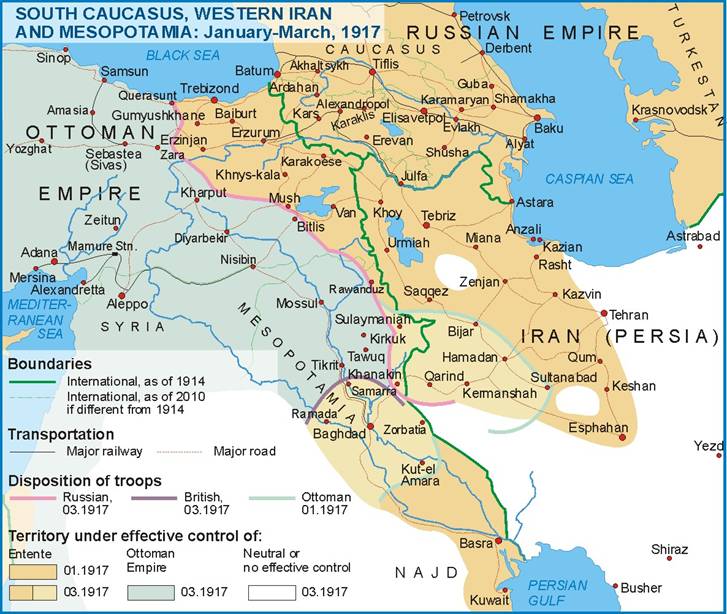
In May 1917, the first congress of
delegates of the Caucasian army met in Tbilisi. It was dominated by the
Mensheviks and the Social-Revolutionaries. There were only a few Bolsheviks
among the delegates, notably Korganov, later Commissar of War in the Baku
Commune, and the Georgian S. Kavtaradze. The Social-Revolutionaries and
Mensheviks professed, in public at least, to believe in the need to continue
the war to a victorious end, whereas the Bolshevik minority unsuccessfully
demanded peace at any price. Whatever the Georgians might have felt, the need
to continue the struggle to the bitter end was irresistibly pressed by the
Armenian Dashnaks and other representatives of the Armenian nation. Mortally
afraid of the Turks, the Armenians had been encouraged by the American
President Wilson to believe that an Allied victory would be followed by the
creation of an independent Greater Armenia carved from the debris of the
Turkish empire and stretching from the Mediterranean to the Caspian
Sea. The Armenians called for complete support of the Petrograd government and the prosecution of war to the
death. And so the war on the Caucasian front was allowed to drag on for many
months more.
Short
rations and Bolshevik broadsheets
As the year 1917 wore on, the situation of Russia's
Caucasian Command became increasingly unfavourable. The majority of the
half-million troops engaged against Turkey were not Georgians or Armenians,
but Russian peasants from the European provinces, whose only concern was to
finish fighting as soon as possible and return home to seize their share of
the estates of dispossessed landlords. Conditions at the front were extremely
harsh. At times, the men of the 4th Caucasian Rifle Division, whose chief of
staff was the Georgian General Kvinitadze, received only half a pound of
bread per day, and horses only one and a half pounds of barley. There was no
meat and no conserves, and the men were boiling soup from the flesh of
donkeys, cats and dogs. Bolshevik newspapers and broadsheets began to
circulate in the ranks, while democratic changes introduced into army
structure by the Provisional Government under pressure from the Workers' and
Soldiers' Soviets rapidly affected discipline and morale. In June 1917, the Russian
commander in the Caucasus, Yudenich,
resigned and was replaced by General Przhevalsky. This change did not improve
the military position. The standstill along the front continued, while there
was a further increase in incidents and disturbances in the rear echelons.
With the October Revolution, demobilization became spontaneous and
irresistible, even before Trotsky began the official negotiations that led to
the peace of Brest-Litovsk.
In the autumn of 1917, the food shortage in
Georgia and Transcaucasia generally became acute. Caucasia had long
depended for a large portion of her wheat and other grain supplies on South Russia. With the general anarchy prevailing in Russia,
these supplies were largely cut off. On 15 October, a special conference on
food supplies was convened in Tbilisi,
attended by the Russian commander on the Caucasian front, General
Przhevalsky. It was estimated that the requirements of the Caucasian Army
amounted to 24 million poods (1 pood = 36 lb.) of flour and 36
million poods of corn, oats and barley annually, while the needs of
the civilian population of Transcaucasia
amounted to another 51 million poods of grain-a total of 111 million poods.
The procurement of such quantities was out of the question. For the civilian
population of Tbilisi,
ten wagon-loads of wheat a day were required, whereas only four were
currently being delivered. A ship which arrived at Batumi
carrying corn from Russia
was commandeered by demobilized soldiers, who sailed back to Russia
in it without unloading the cargo. The bread ration in Georgia was cut still further,
while measures were taken to evacuate town dwellers to country districts.
Schools in Tbilisi
were shut down and the pupils sent off to rural areas. By such measures as
these, the population of the Georgian capital was quickly reduced by some
15,000.
The
Bolsheviks seize power
Early in November 1917, news was received
in Tbilisi of the successful Bolshevik
uprising in Petrograd and the fall of
Kerensky's Provisional Government. The reaction of the Georgian, Armenian and
Azerbaijani Soviets and executive committees was immediate and hostile. On 8
November 1917, the Regional Centre of Soviets of Workers', Soldiers' and
Peasants' Deputies met at Tbilisi together with the executive committees of the
Social-Revolutionary and Social-Democratic (Menshevik) parties and resolved
that the interests of the revolution demanded the liquidation of the
Bolshevik insurrection and the immediate convocation of the all-Russian
Constituent Assembly. A few days later, another meeting declared that the war
with Germany and Turkey
should go on and no separate peace be concluded.
The position of the Georgian
Social-Democrats at this juncture was somewhat paradoxical. In their dim,
dogmatic way, they were, no doubt, excellent patriots, though rather
indifferent nationalists, being wholeheartedly devoted to the fashionable
slogans of international brotherhood and workingclass solidarity. Since the
beginning of the century, they had been stumping the country proclaiming Georgia's destiny to help the workers and
peasants of the entire Russian Empire towards economic and political
fulfilment, and combating those who thought that Georgia's
national salvation lay in independence through separation from Russia.
With public speakers of the calibre of Irakli Tsereteli and Nikolai Chkheidze
prominent first in the Tsarist Dumas and then under Kerensky, the Georgian
Mensheviks exerted an influence in Russian affairs out of all proportion to
their numerical strength. The Russian political dog had sometimes been wagged
by its Georgian Menshevik tail. With the triumph of Lenin's Bolsheviks, the
Russian dog had cut itself adrift with a vengeance, while the Georgian tail
was left wagging furiously in a void. Far from rejoicing at their new-found
freedom, the Georgian Mensheviks quailed at the prospect before them. 'A
misfortune has befallen us,' Noe Zhordania lamented. 'The connection with Russia has been broken and Transcaucasia
has been left alone. We have to stand on our own feet and either help
ourselves or perish through anarchy.' 95
Instead of proclaiming Transcaucasia's
independence, as they could readily have done, and coming to terms
immediately with Turkey
and the Central Powers, the Caucasian politicians dallied and played for
time. On 24 November 1917, a conference of the Regional Centre of Soviets,
the Regional Soviet of the Caucasian Army, the Tbilisi City Council, the
Ozakom, the trades unions and other representative bodies met in Tbilisi and decided that since Transcaucasia could not
recognize the Bolshevik usurpation in Petrograd,
a local régime would have to be organized. Since this was regarded as merely
a temporary expedient, pending the suppression of the Bolshevik rebels, the
Georgians continued to make arrangements for the forthcoming elections to the
all-Russian Constituent Assembly. This much-heralded body, it was fondly
believed, would soon quell the unspeakable Bolsheviks and bring Russia
back to the paths of reason and order. In the event, the Constituent
Assembly, in which Lenin's followers were a minority, was forcibly dispersed
by Bolshevik troops after one sitting in January 1918--an event which marked
the deathknell of Russian parliamentary democracy.
The
Transcaucasian Commissariat
Meanwhile, the Transcaucasian Soviet and
party organizations had set up on 28 November 1917 a provisional government,
called the Transcaucasian Commissariat. It included three Georgians, three
Azerbaijanis, three Armenians and two Russians. The Georgian Menshevik Evgeni
Gegechkori was elected chairman, as well as being Commissar of Labour and
External Affairs. The other two Georgian commissars were Akaki Chkhenkeli
(Interior) and Aleksiev-Meskhiev(Education). While predominantly Menshevik in
character, the commissariat also included nominees of the Muslim Musavat
organization, the Armenian Dashnaks, and the SocialRevolutionaries. The
Bolsheviks were excluded. On the very next day, a detachment of Georgian Red
Guards, recruited from Menshevik workers and led by a former Bolshevik named
Valiko Jugheli, seized the Tbilisi
arsenal, held hitherto by a detachment of Russian soldiers with strong
Bolshevik leanings. Ordered by the Tbilisi Soviet to surrender the place, the
baffled soldiers gave in after a token resistance. In this way the Georgian
capital was preserved from the marauding hordes of Russian troops returning
home pell-mell from the Caucasian front. The capture of the arsenal was a
decisive setback to the Georgian Bolsheviks, and Lenin was extremely
displeased when the news reached him.
While shrinking still from any formal
declaration of independence from Russia, the Transcaucasian
Commissariat entered forthwith into negotiations with the Turks for an
armistice on the crumbling Caucasian front. A provisional agreement between
the Russian General Przhevalsky and the Turkish commander, Vehip Pasha, was
concluded at Erzinjan on 18 December 1917. However, Enver Pasha's Young Turk
government at Istanbul was well aware of the
heaven-sent chance which the Russian revolution offered for Turkey to recover Caucasian territories
wrested from her by Russia
over the preceding century, so that this move was mainly designed to gain
time pending further weakening of Russia's
military and political grip on Caucasia.
Meanwhile, the Russian Bolsheviks were busily negotiating a separate peace
with Germany
and Austro-Hungary at Brest-Litovsk, at which conference, however, the
Caucasian peoples were not directly represented.
The
Turkish menace
During the winter of 1917-18, the situation
in the Anatolian border areas around the Russo-Turkish front lines deteriorated
still further. Vehip Pasha protested repeatedly to the Russian commander and
the Transcaucasian government about alleged massacres of Turks and other
Muslims by vengeful Armenian guerilla bands. On 12 February 1918 the Turks
broke the truce and advanced against Erzinjan. Before the end of the month,
Erzinjan and Trebizond were once more in
Turkish hands. The Russian Army had by now virtually melted away. Against
Vehip's force of 50,000 men and 160 field guns, the Georgians could muster
only about 10,000 men, of indifferent quality and morale, while the small
Armenian national army, heroic but hopelessly outnumbered, was spread thinly
over a very wide area of difficult and exposed country. The nominal head of
these armies was the Russian general, Lebedinsky, but the real confidence of
the Transcaucasian government was given to the Georgian commander, General I.
Z. Odishelidze, a Knight of the Order of St. George, former Governor of
Samarkand, and late chief of staff of one of the Russian armies on the
European front. Erzurum
was defended by an Armenian garrison under the partisan leader Andronik. The
RussoCaucasian forces were hampered by thousands of panicstricken refugees,
Christian Armenians for the most part, fleeing from the implacable vengeance
of the advancing Turks. There was every prospect that hundreds of thousands
of the Turks and Tatars living in the Caucasus
would rise in support of their triumphant Muslim brethren. Andronik evacuated
Erzurum on 12 March 1918, while Batumi, Ispir, Kars
and Van were menaced by the Turkish spearheads.
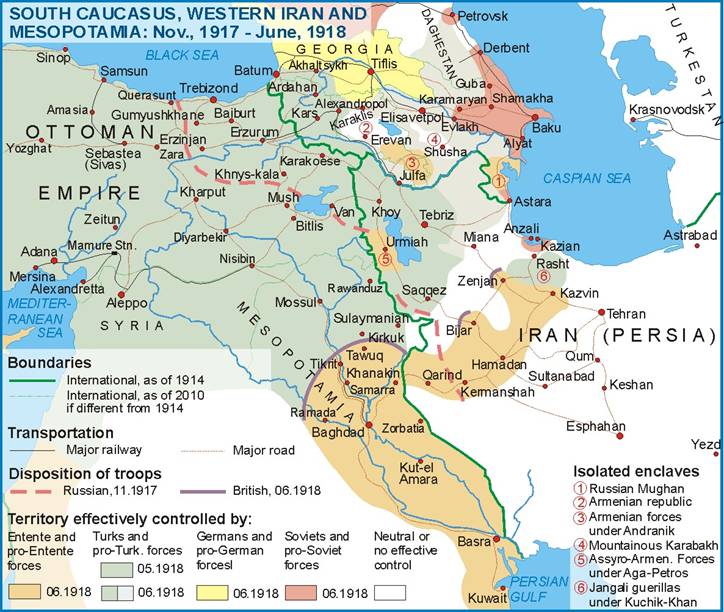
In the meantime, Trotsky had signed the
Treaty of BrestLitovsk, whereby the Bolsheviks agreed to exclude from Russian
territory the districts of Batumi, Ardahan and Kars, where the fate of the
population was to be decided by a free plebiscite. In prevailing conditions,
this meant abandoning the Armenian and Georgian Christian inhabitants to the
mercy of the Turks.
A peace conference between representatives
of Turkey and
Transcaucasia opened at Trebizond on 14
March 1918. Vehip Pasha immediately demanded the evacuation of all districts
abandoned by Russia
at Brest-Litovsk. The Transcaucasian delegates, led by the Georgian
politician Akaki Chkhenkeli, protested that they did not recognize
Brest-Litovsk and were not bound by its conditions. Prolonged parleys took
place until the Turks, flushed with victory, delivered an ultimatum demanding
the evacuation of the disputed districts not later than 10 April 1918.
Brest-Litovsk
repudiated
The Turkish ultimatum was received with the
greatest indignation in the Transcaucasian Diet or Seim. This new
parliamentary body, which assembled at Tbilisi
on 23 February 1918, was a local substitute for the short-lived Russian
Constituent Assembly in Petrograd which had
been so unceremoniously dispersed by Lenin's Bolsheviks. Nikolai Chkheidze
and Irakli Tsereteli, dethroned from their tribunes in the Petrograd Soviet
and Provisional Government, now reappeared in their native Georgia to raise the clarion call
of revolutionary democracy. A tug-of-war ensued between the Transcaucasian
delegation at the Trebizond peace conference and the government and Diet in Tbilisi. On 10 April
1918, Chkhenkeli declared himself willing to accept the Brest-Litovsk treaty
and conduct further negotiations based upon it. Simultaneously, Tbilisi was gripped by
patriotic and warlike frenzy. On 13 April 1918, Irakli Tsereteli declared in
the Diet: 'Turkish imperialism has issued an ultimatum to Transcaucasian
democracy to recognize the treaty of Brest-Litovsk. We know of no such
treaty. We know that in Brest-Litovsk the death sentence was passed upon
Revolutionary Russia, and that death sentence to our fatherland we will never
sign!' Tsereteli's speech was greeted with thunderous applause. The next day,
Evgeni Gegechkori, the Transcaucasian Premier, telegraphed Chkhenkeli and
told him to break off negotiations with the Turks and leave Trebizond.
That night, despite the manifest reluctance of the Muslim representatives,
the Transcaucasian Diet declared war on the Turks.
This bellicose act was a piece of somewhat
ridiculous panache. Divided against itself, Transcaucasia
had neither the means nor, in so far as the Muslim elements were concerned,
the will to resist. On 15 April 1918, it was announced in Istanbul
that the Turkish Army had entered Batumi.
Some of the forts had surrendered without firing a shot and the town and port
had been occupied without resistance. The Muslim Georgians of Lazistan and of
Atchara, of which Batumi is the main city, were helping the Turks, tearing up
railway lines, wrecking trains and conducting guerilla operations generally.
Having now seized most of the territories they coveted, the Turks renewed
their peace overtures. On 22 April 1918, Vehip Pasha telegraphed Chkhenkeli
and asked whether he was now prepared to resume peace talks. The
Transcaucasian Diet had no alternative but to accept the offer.
An
ephemeral federation
For the last six months, the Transcaucasian
Commissariat had clung to the illusion that Russia
would soon quell the Bolshevik usurpers and revert to the paths of true
democracy, in which case Transcaucasia would
be painlessly restored to the broad bosom of Russian Social-Democracy. While
refusing to recognize the surrender at Brest-Litovsk, these half-hearted
patriots delayed taking the only step which could preserve their country from
complete ruin--namely a declaration of complete independence from Russia,
combined with a real effort to enlist the support of interested foreign
powers against the Turkish peril. At the end of March 1918 the question of
Transcaucasian independence was discussed in the Diet, which voted
'categorically and irrevocably' against independence. On 22 April another
lengthy debate on this issue took place, as a result of which the majority of
the assembly adopted the motion 'that the Transcaucasian Seim decide to
proclaim Transcaucasia an independent
Democratic Federative Republic'. The formation of a cabinet was entrusted to
the Georgian Chkhenkeli.
On 26 April 1918, Chkhenkeli, who combined
the offices of Prime Minister and Foreign Secretary, published the names of
the members of his new Transcaucasian Ministry, which contained four
Georgians (including Chkhenkeli himself), five Armenians and four Azerbaijani
Muslims. The other Georgian ministers were Noe Ramishvili (Minister of the
Interior), G. Giorgadze (Minister of War) and Noe Khomeriki (Minister of
Agriculture). When presenting his cabinet to the Diet, Chkhenkeli made a
speech in which he outlined his government's programme, which featured the
writing of a constitution, the delineation of the new state's frontiers, the
liquidation of the war with Turkey, the combating of both counter-revolution
and anarchy, and finally, the carrying through of land reform. On 28 April
1918, the newly created Democratic Federative Republic of Transcaucasia was
recognized by the Ottoman Empire.
The Federative Republic,
born under such unfavourable auspices, lived but one brief month. Three days
after its formation, the Turks occupied the great fortress of Kars, from which
thousands of panic-stricken men and women streamed out, carrying their
children and their possessions on their backs. Those who were too old or too
sick to walk were left to the mercies of the Turk. Food shortages were
producing famine in many regions of Caucasia, notably in Armenia and Azerbaijan. Another disruptive
factor was the situation in the great oil port of Baku
on the Caspian, which was a Bolshevik stronghold within otherwise Menshevik
Transcaucasia. In December 1917, Lenin had appointed the Armenian Bolshevik
Stepan Shaumian as Commissar Extraordinary of the Caucasus.
Shaumian was chairman of the Baku Soviet, in which he was backed by the well
known Georgian Bolshevik Prokopi (Alesha) Japaridze. In March 1918, the Baku
Soviet was involved in open conflict with the Azerbaijani nationalist
organization, the Musavat. This led to inter-communal fighting between the
Baku Armenians and Tatars, lasting for several weeks, and resulting in
wholesale massacre of innocent victims. When the streets had been cleared of
thousands of dead bodies and the fires extinguished, the Bolsheviks emerged
as the strongest force in the city. On 25 April 1918, a local Council of
People's Commissars, modelled on the one in Moscow, was formed under Shaumian's
chairmanship. Spurning all allegiance to the Menshevik régime in Tbilisi, the Baku Bolsheviks nationalized the vast
oilfields around their city and placed them at the disposal of the Moscow government, from
which they derived constant moral support.
The resumed peace talks between Turkey and Transcaucasia opened at Batumi, now in Turkish
hands, on 11 May 1918. The Transcaucasian delegation, forty-five strong, was
headed by Premier Chkhenkeli, and also included the veteran Georgian
revolutionary and publicist Niko Nikoladze, and the jurist Zurab Avalishvili.
Vehip Pasha stated that the old peace conditions no longer applied, since the
Armenians and Georgians had responded to the earlier Turkish proposals by
armed resistance. Vehip now demanded the cession of the Georgian regions of
Akhaltsikhe and Akhalkalaki and the Armenian district of Aleksandropol by the
Turks of all Transcaucasian railways so long as the war against Great Britain
continued. In view of the impossibility of armed resistance, there seemed
nothing to prevent the Turks from establishing complete hegemony over the
Caucasian isthmus.
German
takes a hand
The Turks had reckoned without one very
important factor, namely the intervention of their ally Imperial Germany,
which at this time dominated the Ukraine
and the Crimea and had virtually turned the Black Sea
into a German lake. The Germans were in urgent need of the oil of Baku and had no desire to see the entire Middle East,
and perhaps Central Asia too, fall into the
hands of their ambitious Turkish friends. Thus it was that a strong and alert
German delegation also attended the Batumi
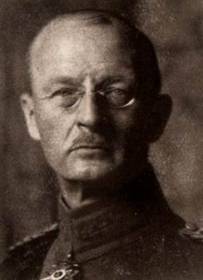
conference. Headed by the Bavarian general von Lossow, it also included Count
von der Schulenburg, a former German Consul in Tbilisi,
Arthur Leist, famous as a translator and scholar of Georgian literature, and
O. von Wesendonk, later Consul-General in Tbilisi and author of studies on Georgian
history and civilization. Von Lossow proffered his services as mediator
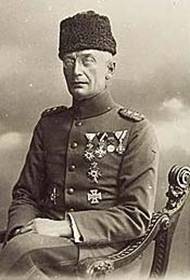
between the Turks and the Transcaucasians. He also sent to Tbilisi Colonel
Kress von Kressenstein, who entered into close touch with the Georgian
members of the Transcaucasian government and started collecting together a
special German task force from prisoners of war, peasants from the German
settlements around Tbilisi,
and any other German nationals whom he could assemble. Since the Georgians
and Armenians regarded the Germans as among the highest representatives of
European culture, science and technology, they were delighted at the sudden
prospect of this excellent barrier which would halt Turkey's onward advance. At
railway stations and other strategic points German helmets were soon to be
seen, which the Christian inhabitants thought vastly preferable to the
Turkish fez.
|
|
|
|
Otto
von Lossow
|
Friedrich
Freiherr Kress von Kressenstrin
|
|
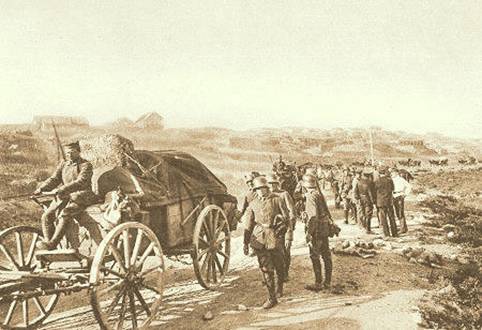
Germans
on their way to Tiflis
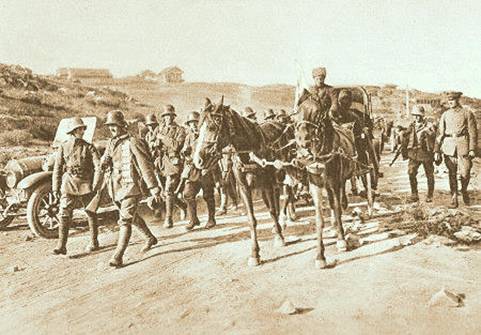
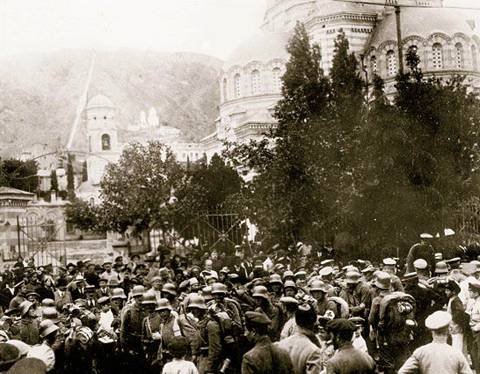
Germans in
Tbilisi
|
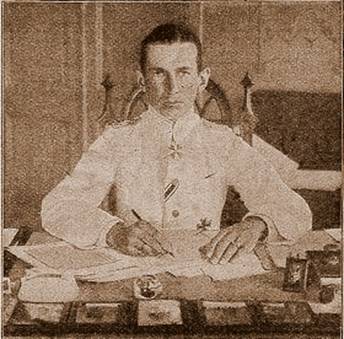
Captain Egon Krieger: Head of German military mission in Georgia
Birth
of the Georgian
Republic
There was no time to lose, if anything was to
be salvaged from the wreck of united Transcaucasia.
The Azerbaijani Muslims, who had nothing to lose by a complete Turkish
victory, were opposed to further resistance. The Armenians, for all their
heroism, were exhausted and incapable of organized action. Each of the
Caucasian nations had to look to its own corporate survival. As soon as this
became evident, Noe Zhordania, leader of the Georgian Social-Democrats and
President of the Georgian National Council in Tbilisi,
was summoned to Batumi.
There he concerted measures with the Georgian delegation at the peace
conference and then returned to Tbilisi with
the necessary authority to proclaim Georgia an independent republic
and to bring about the final dissolution of the Transcaucasian Diet. On 24
May 1918, von Lossow announced that owing to Turkish intransigence, his
efforts at mediation had failed, and that the German delegation would leave Batumi at once on the
S.S. Minna Horn. Two days later, the Transcaucasian delegation received a
Turkish ultimatum, demanding the acceptance of all Turkish proposals within
seventy-two hours, including the cession to Turkey of vast tracts of Georgian
territory. But the Turks had been outwitted. That same day, 26 May 1918,
Irakli Tsereteli in the Diet in Tbilisi had proclaimed Georgia a sovereign
country independent of the Transcaucasian Federative Republic, which was now
dissolved; Zhordania read a formal Act of Independence; and von Kressenstein
and von der Schulenburg appeared in person at the Tbilisi Town Hall, to announce
the establishment of a German protectorate over the newly born Georgian
republic.
The first Prime Minister of the Georgian Republic was Noe Ramishvili, while
Akaki Chkhenkeli received the portfolio of Foreign Affairs. These two new
ministers immediately hurried to the Black Sea port of Poti,
where von Lossow and his German colleagues were waiting impatiently on board
their steamer. A provisional agreement between Imperial Germany and the Georgian Republic was signed at Poti on 28 May
1918. this convention provided among other things for Germany to have free
and unrestricted use of Georgia's railway system and all ships found in
Georgian ports, for the occupation of strategic points by German troops, the
free circulation of German money in Georgia, the establishment of a
German-Georgian mining corporation, and the exchange of diplomatic and
consular representatives. Von Lossow also sent a secret letter to the
Georgian government, pledging his good offices towards securing international
recognition for the Georgian republic and safeguarding her territorial
integrity. Thereupon, von Lossow and his suite set off across the Black Sea
to Constanza, taking with them a Georgian delegation composed of Chkhenkeli,
Avalishvili and Nikoladze, who were sent on to Berlin to enter into formal
discussions with the Kaiser's government and the officials of the
Wilhelmstrasse. Lengthy negotiations between the Georgians and the German
Foreign Ministry ensued, only to be rendered abortive by the defeat of
Imperial Germany at the hands of the Allies in November 1918.
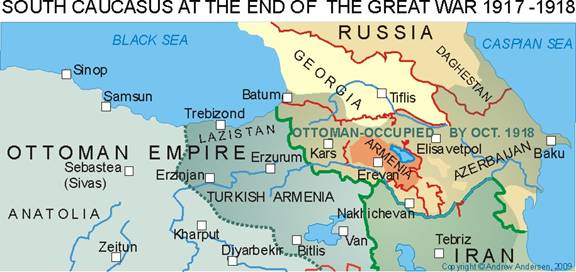
Back in Batumi,
a peace treaty between Turkey
and Georgia was signed on
4 June 1918, whereby Turkey
regained Batumi, Ardahan and Kars, as well as Akhaltsikhe and
Akhalkalaki. However, the main treaty of peace and friendship between Georgia and Turkey was never formally
ratified. True to their policy of playing off the Turks and Germans against
one another, the Georgian delegation in Berlin declared to the German Foreign
Ministry that 'inasmuch as Georgia, under direct pressure from Turkey, was
compelled to sign any agreement whatsoever with her alone, the obligations
incurred in such conditions must be considered null and void'. An attempt by
Turkish troops to take possession of certain border areas of Georgia allegedly ceded to Turkey by the treaty of 4 June
was repulsed by Georgian and German troops acting in concert, provoking a
regular crisis between the German and Turkish governments. On 20 June 1918, a
Georgian delegation headed by Evgeni Gegechkori arrived at Istanbul
to take part in a general conference to revise the treaties of Batumi. Before anything
had been settled, military defeat brought the Ottoman
Empire itself tumbling down in ruin. By the end of 1918, as we
shall see, German and Turkish hegemony over Caucasia
had melted away, to be replaced for a short season by the rather less popular
occupation of the victorious British.
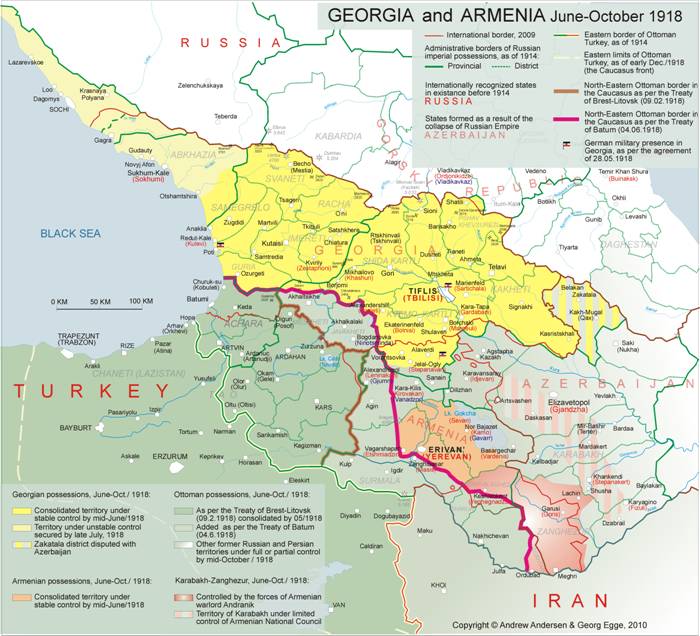
Click
on the map for better resolution
Click here to continue
___________________________________________________________________________________________________
92. F.
Kazemzadeh, The Struggle for Transcaucasia, 1917-1921, New York, Oxford
1951, p. 34.
93. Quoted
by Kazemzadeh, The Struggle for Transcaucasia,
p. 37.
94. N.
Zhordania, Reminiscences, p. 113.
95. Quoted
by Kazemzadeh, The Struggle for Transcaucasia,
p. 55.
|
|