|
Although
Poland-Lithuania escaped the ravages of the Thirty Years' War, which ended in
1648, the ensuing two decades subjected the country to one of its severest
trials. This colorful but ruinous interval, the stuff of legend and the popular
historical novels of Nobel laureate Henryk Sienkiewicz (1846-1916), became
known as the potop,
or deluge, for the magnitude of its hardships. The
emergency began with an uprising of
Ukrainian Cossacks that persisted in spite of
Despite the improbable survival of the
commonwealth in the face of the potop,
one of the most dramatic instances of the Poles' knack for prevailing in
adversity, the episode inflicted irremediable damage and contributed heavily
to the ultimate demise of the state. When Jan II Kaziemierz abdicated in
1668, the population of the commonwealth had been nearly halved by war and
disease. War had destroyed the economic base of the cities and raised a
religious fervor that ended Source: |
|||
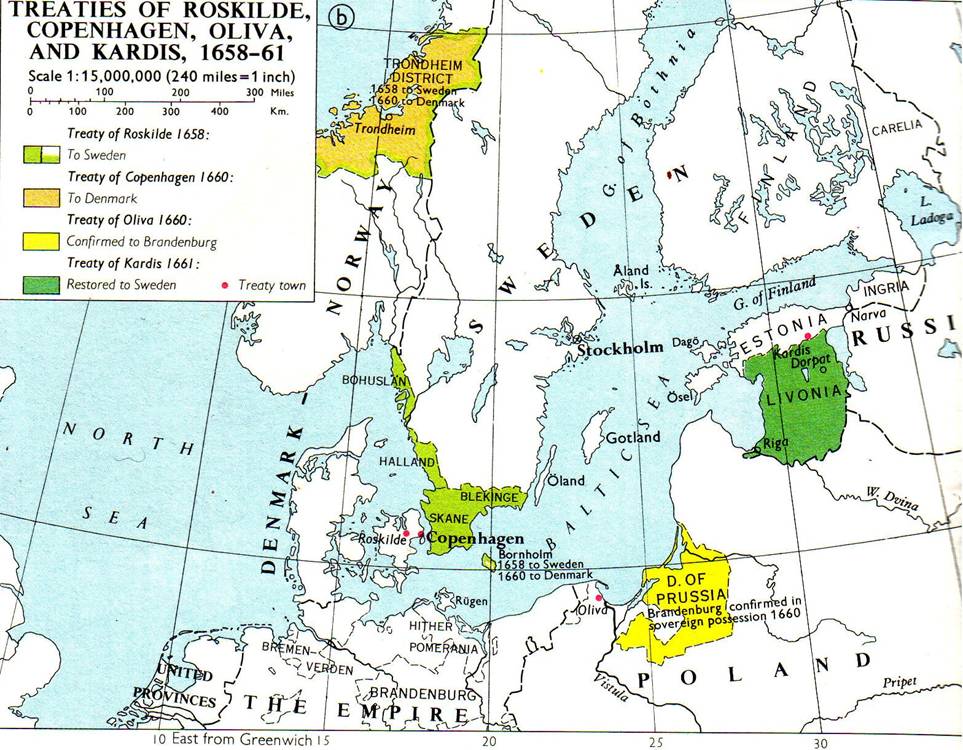
The Deluge, 1648-67
by Peter K. Gessner |
|||
|
A few
years before the Polish Rzeczpospolita or Commonwealth became inundated by
the Swedish Deluge, the thirty years war came to an end in |
|||
|
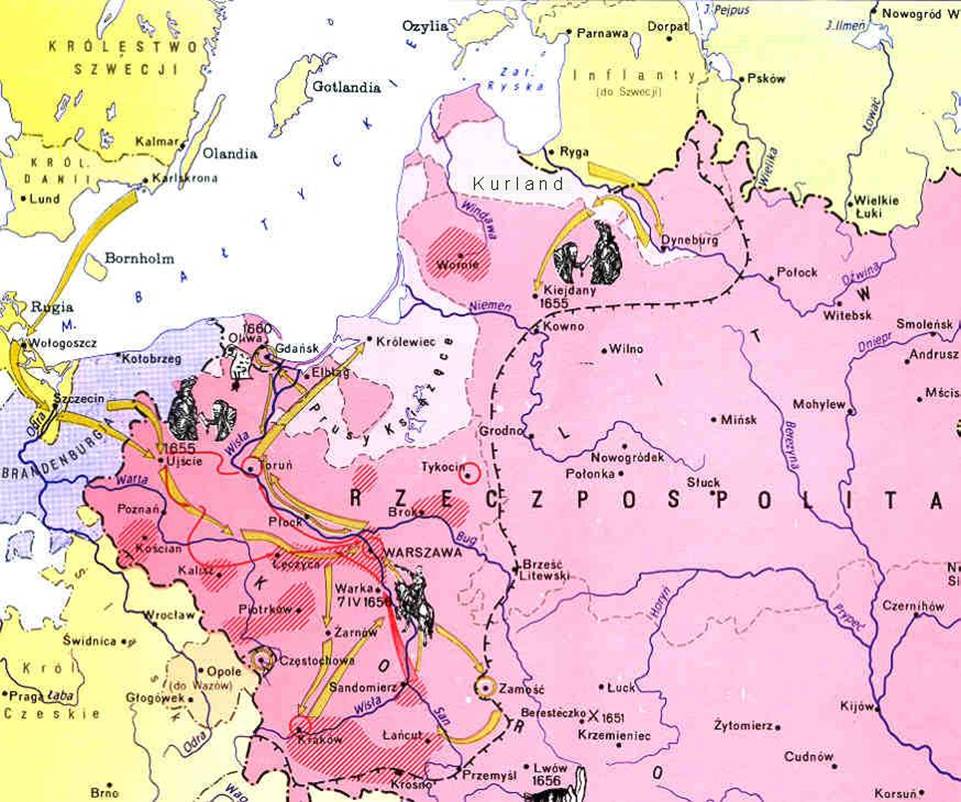
Already
in 1648, Two
columns of Swedish troops made their way across The
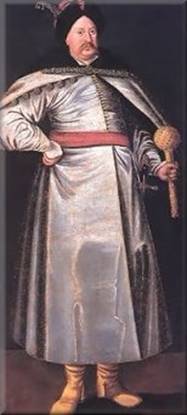
Polish King, Jan Kazimierz Vasa, escaped from Warsaw and via Krakow and then
Czorsztyn made it to Silesia, part of the Czech Kingdom, whence in November
1655 he addressed a writ to the nation in which he called upon "people
of every condition and station" to fight for freedom. The majority of
the population was quite prepared to accept Carl Gustav as King, but the
Swedes quickly proved not nearly as nice as they had promised to be, and
rapes and robberies of the possessions of the nobility were taking place. In From November 19
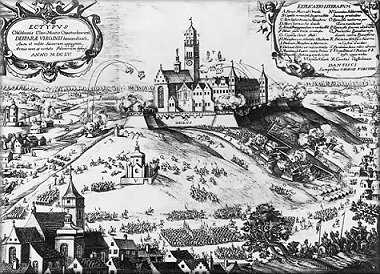
till December 25, 1655, the monastery of Pauline Fathers on Jasna Gora
resisted a Swedish siege. News of the impudent attack of the Swedes on the
monastery had an electrifyng effect. The invaders respected neither their own
promises, nor Polish religious feelings, and a national uprising ensued. In
Tyszowace, a confederation of Polish Hetmans - Mikołaj Potocki and
Stanislaw Lanckoronski with the Lithuanians of the Governor of Witebsk, Pawel
Sapiecha - came into being. The Uprising enveloped Greater and Lesser |
||
|
LEGEND: Yellow arrows - Swedish movement. Red arrows - Polish movement. Yellow circles - Swedish siege. Red circles - Polish siege. At the beginning of 1656, Jan
Kazimierz returned to |
|||
|
|
During the same year, Stefan
Czarniecki, a master of guerilla warfare, took command of the anti-Swedish
forces. Together with the Lithuanians, he encircled Carl Gustav in the fork
of the San and Towards the end of June, the Royal troops
regained |
||
At the beginning of 1657, the troops of the
Principality of Transylvania led by George Rakoczy entered
|
|
||
|
|
|||
BACK TO THE HISTORY OF POLAND
BACK TO
BALTIC HISTORY
BACK TO THE UKRAINIAN
HISTORY
VIDEO |
|||
|
Additional
information extracted from Wikipedia: (not necessarily reflecting the views of the administration of
this web resource) Before "The Deluge", the
Commonwealth was a Central European power; but during the wars
|
|||
|
|
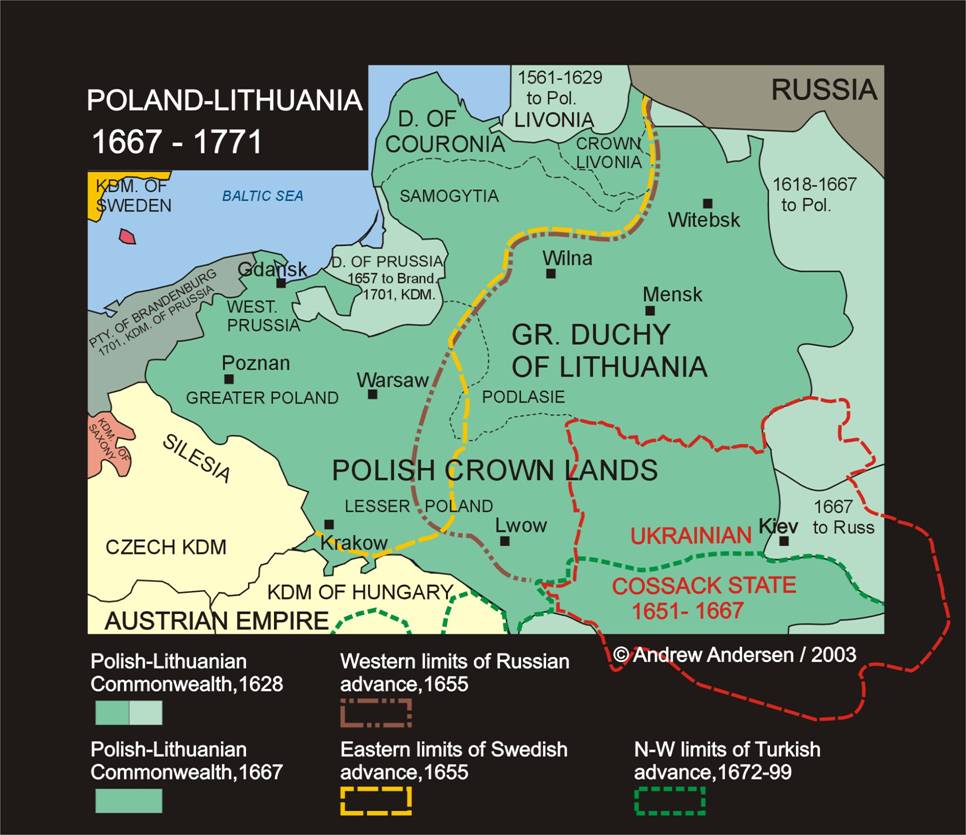
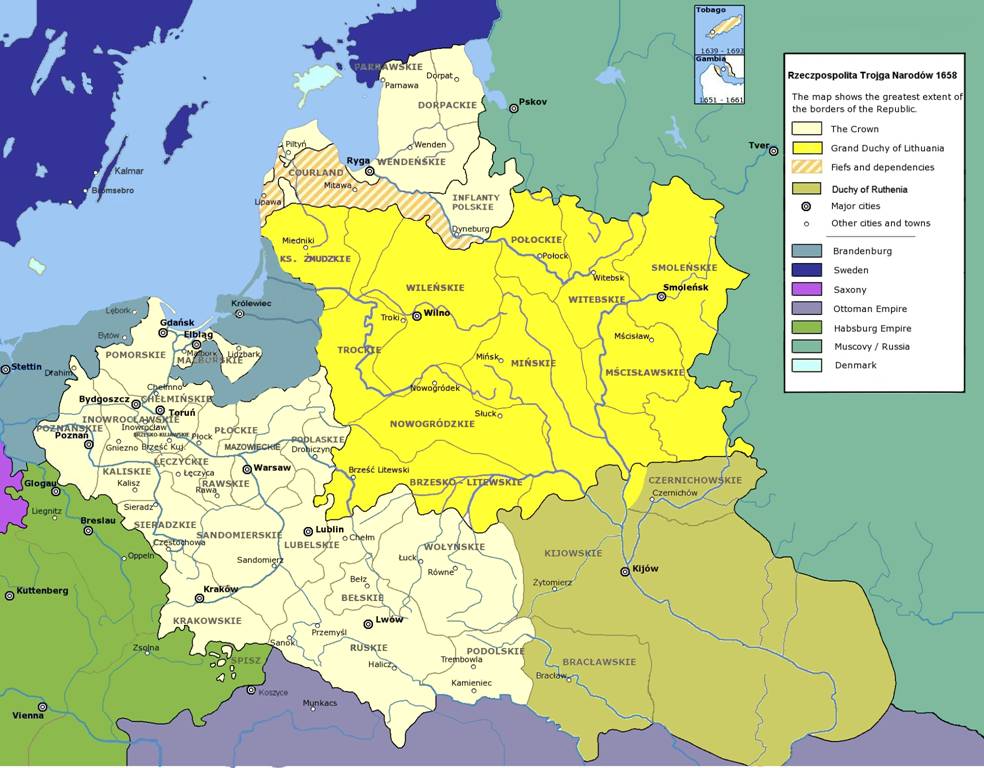
Arms and map (below) of
the Commonwealth, As per the Treaty of
Hadiach |
||