|
|
Interwar
|
Preface: DOMESTIC PROBLEMS AND FOREIGN POLICIES OF
INTERWAR EAST EUROPEAN STATES
These problems and
policies should be viewed within
(a) the context of the beliefs/perceptions of historians
today, and
(b) the realities of E.Europe at this time.
(a) Current western
beliefs/perceptions.
1 Under the impact of
the internecine ethnic/religious wars of the 1990s in
the lands of former
2. In this context, some contemporary western historians condemn
President Woodrow Wilson for his insistence on the principle of
self-determination in 1919. At the same time, these historians condemn the peace makers in
3. Finally,
some western historians view federalization as the best solution for East
Central European Danubian states in 1919-20, and thus
condemn its rejection when offered by Emperor Charles for Austria
and Michael Karolyi for Hungary in Nov-Dec. 1918,
also later rejections of similar projects.
(b) These views
may seem attractive but they are out of touch with East European realities of
the time and therefore unrealistic. To start with the last view :
1. The majority of
non- German/Austrian and non-Magyar peoples
rejected the federal solution in either
2.
Ethnic-national states were not created by Woodrow Wilson or the peace settlement
of 1919; nor were they an East European
aberration. This process was, in fact, the
continuation of the national unification movements that had already taken
place in Western Europe, especially in
3. Contrary to
conventional wisdom, most of the new borders of East European countries
were not fixed by western statesmen drawing maps in
4. Of course, it was impossible to establish borders satisfactory
to every ethnic nationality because of the inter-mixing of peoples in the past,
and esp. because of long foreign rule. The natural outcome of this state of
affairs in 1919 was that the nations which had opposed the Central Powers in
the war: the Poles, Czechs, Serbs, Romanians, who also had sufficient
armed forces at their disposal, were able to include territories with
significant minorities within their borders. The Poles were able to do this in the
east because of their victory over the Red Army.
Keeping the above
realities in mind, let us look at the East European States of the interwar
period.
General Characteristics and
Problems.
The interwar period
was short, lasting just over 20 years if we start in Jan .1919, or a few months
longer if the starting point is November 1918. However, this short period had
enormous significance for these countries because: (a) they could develop their
own politics, administration, economies,
education, and culture; (b) their very existence legitimized them in the eyes
of the world. After this period, they could not be obliterated either by Nazi
Germany or the Stalinist USSR.
Joseph Rothschild (d. Dec.1999) , an American political scientist and author of books on
Eastern Europe, wrote that even communist historians joined
"bourgeois" emigre scholars "in
valuing highly the sheer fact of interwar state-independence, and judging it to
be a historic advance over the area’s pre-World War I political status."
He also gave a balanced judgment on these countries' performance in the
interwar period:
Thus, despite major and avoidable failings (too little area-wide
solidarity, too much over-politicization of human relations, too little
strategic government intervention in the economy, too much petty government
interference with the society), thanks to the political performance of the
interwar era it is impossible today to conceive of East Central Europe without
its at least formally independent states. In retrospect, one must assign
greater responsibility for the catastrophes of 1939-41 to the malevolence,
indifference, or incompetence of the Great Powers than to the admittedly costly
mistakes of these states. *
*[Joseph Rotschild, East Central Europe
Between the Wars, Seattle, WA. 1974, and reprints, pp. 24-25; bold italics,
AMC].
We must bear in mind
that the interwar East European states faced enormous problems, most of which
could not be solved in twenty years, especially in view of the paucity of
foreign capital investment before the Great Depression struck in 1930, and
virtually none after that. Furthermore, they faced the growing threat of Nazi
Germany from 1935 onward.
Many problems of East European states were inherited
from the former empires, a fact acknowledged by the British historian Hugh
Seton-Watson, whose negative evaluation of interwar
*[Hugh Seton-Watson, Eastern
Europe between the Wars, 1918-1941, Preface to 3rd edition
revised, Harper Torchbooks, New York, 1967.].
Unfortunately, few
people bother to read prefaces, and this is a case in point.
In fact, the
problems were much more numerous than those listed by Rothschild. There
were 10 key problems:
(1).economic backwardness; (2). agrarian,
unmechanized economies; (3). overpopulation
on the land; (4).peasant poverty; (5).bad roads and insufficient railway track;
(6).lack of a middle class; (7). lack of adequate
numbers of trained bureaucrats; (8). widesrpread
illiteracy; (9). lack of experience, or restricted
experience with parliamentary politics and participation in any kind of
government; (10). lack of investment capital.
The exception
to all these problems was Czechoslovakia, where the western Czech
lands of Bohemia, Moravia and Silesia had a highly developed industry, a
prosperous agriculture, an excellent road and rail network, a highly literate
population, a numerous and well trained bureaucracy, experience in
parliamentary government and considerable capital resources. However, of the
other two constituent parts of the country,
Two other problems
which most E.European countries had in common were either
multi-ethnic/national populations or/and significant ethnic/national
minorities whose loyalties belonged to, or leaned toward neighboring
national states. In
This state of
affairs, though inevitable at the time, deepened the general feeling of insecurity.
Indeed, the discrimination against the constituent or so-called ruling
nationalities in Czechoslovakia (Slovaks and Rusyns),
Yugoslavia (non-Serbs), and the discrimination or oppression of national
minorities in most East European countries, stemmed primarily from fear that
constituent nationalities as well as minorities, could, and probably would
given the chance, undermine the sovereignty of the countries in which they
were resentful citizens, and lead to the reduction of their territory or even
their destruction. We must bear this insecurity in mind when we look at
minority policies in the interwar East European states.
The above fears were
intensified by the general, international insecurity in the 1930s, which made
territorial disputes more threatening than they would have been otherwise.
Thus, the states allied with France: Poland and Czechoslovakia,
feared
The largest
state in the region,Poland,
had two potential enemies:
Political systems.
The general trend of
East Central European political development was
from parliamentary democracy, including strong Socialist parties at the outset,
to various kinds of authoritarian government. But it should be
noted that while fascist parties or groups existed in each country, no
interwar East European state had a fascist party in power as was the case in
Germany, Italy, Spain and Portugal, while a totalitarian communist. system existed in the
Click on the map for
better resolution:
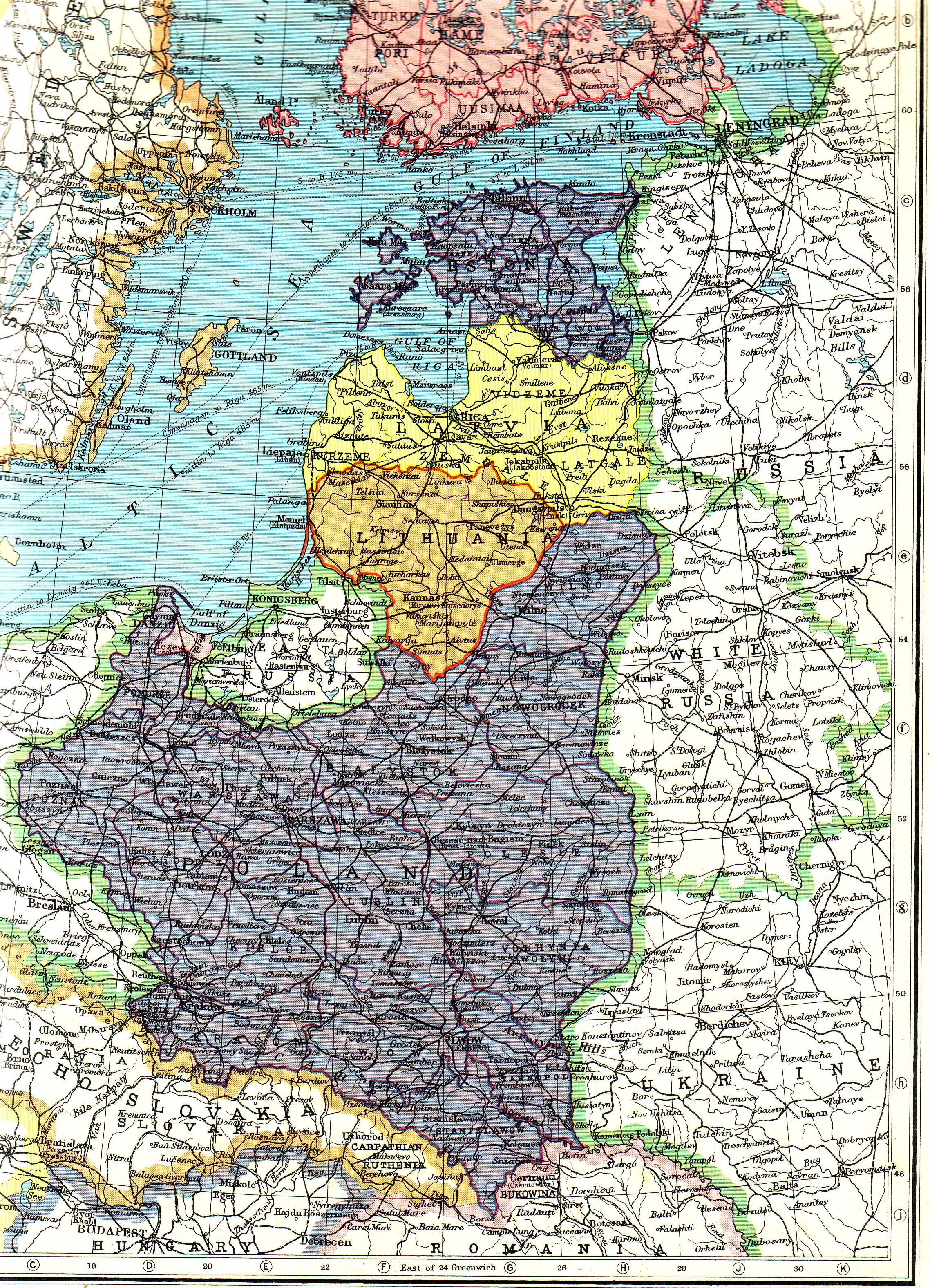
Interwar Poland.
(i) Politics.
Polish political life
was dominated in 1918-23 and 1926-35 by Jozef
Pilsudski (1867-1935), but he was bitterly opposed by his rival, Roman Dmowski (1864-1939), leader of the National Democratic movment. This was a right wing, Roman Catholic and anti-semitic movement supported by a significant part of the
Polish intelligentsia [educated people of gentry
descent, mostly in the civil and military service but also in the liberal
professions] and the growing middle class [business people, entrepreneurs].
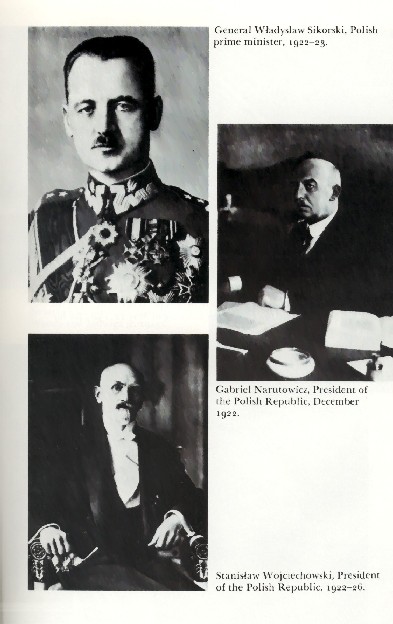
Pilsudski was "Head of State" until December 1922, when the Seym [Parliament] elected the first President, Gabriel Narutowicz (1865-1922) after
Pilsudski had declined the post because it had no power. Narutowicz,
an engineer and former minister, was supported by Pilsudski. His election was
bitterly resented by the National Democrats because he had won the presidency
in a Seym[parliament]
election with the votes of deputies representing the national minorities,
including the Jews who made up 10% of the whole population. Therefore, the N.
Democrats claimed that Narutowicz was not a Polish
President and incited the
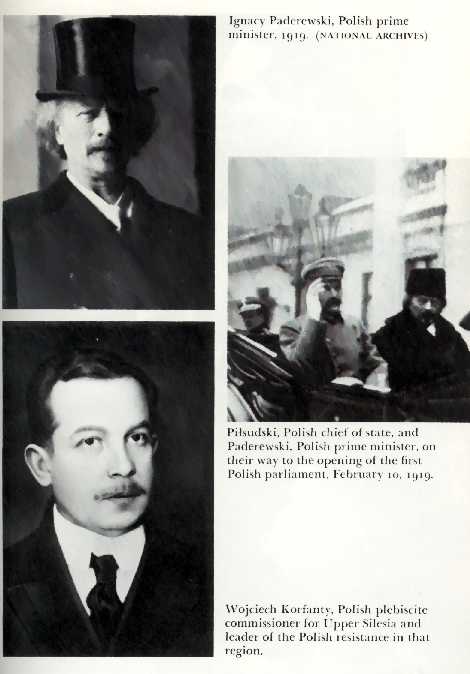
[Pictures from Richard M.Watt,
Bitter Glory, New York, 1974].
The Polish political
system, as it existed in 1921-26, was modeled on
The multi-party
system was the source of political instability because, unlike the French model
which included a professional bureaucracy unaffected by changes of power
(except for ministerial positions), in Poland most of the civil service jobs changed
hands with each new government, which distributed them as political patronage.
(As in most East European countries, the civil service employed most of the
country's Intelligentsia, or educated people). In 1923, a National
Democrat-Peasant Party coalition politicised military appointments, which Pilsudski protested by
resigning from all his positions in July of that year and going into
retirement. He distributed his marshal's pension to charities and lived from
his writings and lectures.
The years 1923-24
witnessed great economic- financial instability in
Recovery seemed in
the offing with the establishment of a new Polish currency, the zloty (meaning
golden), in 1924, but a year later
The situation was bad
for
In fact, these treaties of mutual assistance weakened the existing French
alliances with Poland and Czechoslovakia.. Pilsudski
was especially worried that
Pilsudski's Coup d'Etat, May
12, 1926.
Against the
background of this insecurity, in spring 1926 Prime Minister Wincenty Witos
(1874-1945), the leader of the right wing Peasant Party "Piast", entered into a coalition with the National
Democrats, and publicly dared Pilsudski to take power. Witos even threatened to establish a right-wing
dictatorship of the N.Dem. and
Peasant Parties, while the N.D. leader Roman Dmowski
was thinking of a dictatorship along Italian lines (Mussolini).
Pilsudski had the support of the Socialists and the Left-wing
Peasant Party in opposing a right wing dictatorship. He demanded that the
President dismiss the government and appoint a new one, and he threatened to
use military force to this end if necessary. On 12 May 1926, when he marched on
It should be noted
that Pilsudski’s action was not a classic military coup because he had the
support of Polish socialists and even the communists, who feared a right wing
coup. Indeed, except for the
|
|
|
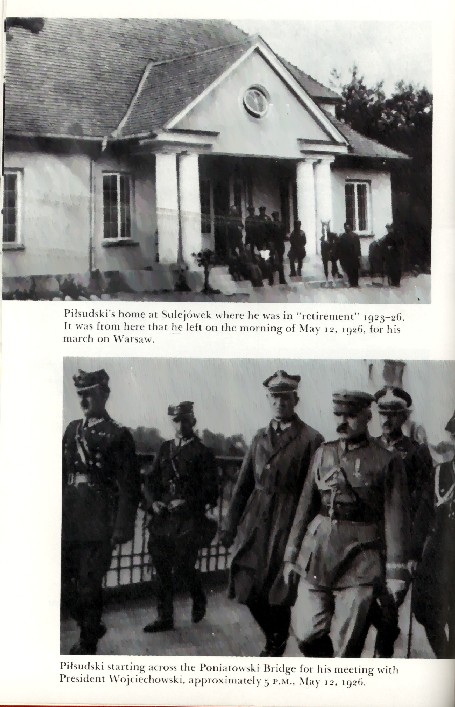
*[Pictures from Watt, Bitter Glory. For a detailed
Pilsudski denied that
he wanted to be a dictator, and said his goal was to bring the country back to
health. This was the origin of the name given to his political group: "Sanacja" (pron. Saanatsiiaa,
from the French assainir = to heal). His main
objective was to give the Presidency strong executive power. He managed to
expand presidential power with parliamentary support in 1926-27, but when
parliament opposed him, he appointed governments of "experts" which
issued decrees on the assumption that parliament would approve them. When
parliament resisted, tensions grew. Pilsudski was twice Prime Minister, but
devoted most of his attention to defense and foreign affairs. He was the
Inspector General of the Armed Forces and Minister of War from 1926 until his
death in May 1935.
In 1927 a pro-government
bloc was created, the" Bezpartyjny Blok Wspolpracy z Rzadem." (The
Non-Party Bloc of Cooperation with the Government, known by its acronym: BBWR.
In fact, it was created to balance the N.Dem. "Oboz Wielkiej Polski"
(Camp of Great Poland -OWP), created by Dmowski in
1926 as an umbrella organization for various right wing parties affiliated with
the N.Democrats.
Political tensions
worsened under the impact of the Great Depression which hit
The imprisonment and
trial of political opponents was a black mark for
In April 1935,
Pilsudski’s supporters used a trick to pass a new constitution. The
opposition deputies were not told when the vote would be taken and most were
absent. (Pilsudski expressed his disapproval of this trick). The "April
Constitution" gave very extensive powers to the president. (Some
historians compare Pilsudski with Charles De Gaulle, who obtained
extensive presidential powers in
Pilsudski’s
successors continued the political system
established by the April constitution. They controlled parliament and passed a
new electoral law (July 1935), which allowed the government party to hand pick
deputies to run for parliament. In reply, opposition parties boycotted the next
elections.
The post- Pilsudski
governments are sometimes called "the governments of colonels,"
but they were not military juntas in the Latin American style. They consisted
mostly of politicians who had served in Pilsudski’s Legions in WW I and held
the rank of colonel, though the vast majority were colonels in the reserve.
Their program was the same as Pilsudski’s: to make
In 1937, the BBWR was
dissolved and replaced by the "Oboz Zjednoczenia Narodowego"
(OZON = Camp of National Unity), led by Col. Adam Koc.
OZON made anti-semitic gestures to gain the National
Democrats’ support for the government. However, it did not go far enough for
the N. Democrats, for unlike Romania and Hungary, no anti-Jewish legislation
was ever passed in Poland, except for the prohibition of Jewish ritual
slaughter of animals (which continued anyway because Polish butchers
would have gone broke without Jewish purchase of beef). The restriction on
Jewish student enrollment called the "numerus clausus" or closed number, was
not sanctioned by law (see under minorities below). Nor was OZON effective in
building up popular support for the government. In fact, the Municipal
Elections of December 1938 returned many oppositionists. President Ignacy Moscicki
(1867-1946, pron: Eegnaatsy
Moshtseetskee, President 1926-39) promised electoral
reform, but it was not implemented because the government party did not want to
share power with the opposition..
The second most
important person in the state after the President was the Inspector General of
the Army, Marshal Edward Rydz-Smigly
(or Smigly- Rydz,
1886-1941, Marshal November 1936), but he was not a politician. However,
he did support the modernization of the Polish Army, which began in earnest
after Pilsudski's death.
The key foreign policy maker was Foreign Minister Jozef Beck (1894-1944,
For. Minister
1932-39), hand picked
for the position by Pilsudski. He had been a Pilsudski legionnaire in World War I, and served in
Military Intelligence, 1920. In the early 1920s he was Military Attache in
As Foreign Minsiter, Beck followed Pilsudski’s policy of maintaining
the alliance with
The National
Democrats, the Socialists, and both the left and right wing Peasant Parties
were in the opposition after 1928, and boycotted the elections held under the
electoral law of July 1935. Nevertheless, they retained and even gained
followers.
There was a small fascist group, the "Falanga."
that split off from the N. Democrats, It was led by Boleslaw Piasecki who admired Mussolini and was strongly anti-semitic. But this group was insignificant in Polish political
life. (Piasecki served Polish communist governments
after WW II).The majority of Pilsudskiites
successfully resisted the idea, advanced by a few of their number, of
establishing a dictatorship along fascist lines and Pilsudski never envisaged
it.
(ii)Interwar
Like most countries
of E. Europe,
(b) in the 1920s Gt.
Nevertheless, the Poles managed in just a few years to integrate the economies
of Russian, Austrian and Prussian Poland and to create a uniform legal system,
which was no mean achievement. Furthermore,
(1)
(2)
In 1939,
(3)
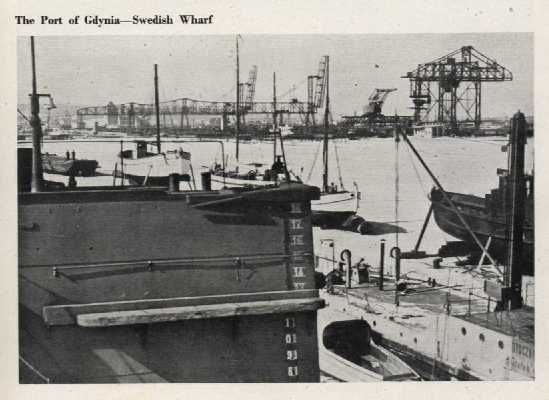
The city of
[ Many foreigners, mostly English and
German, were guests in our home, and I remember seeing father off at the
airport on some of his business trips. I also remember being taken by him to
visit an English merchant ship, which had a Chinese cook with a pigtail, and the new Polish ocean liners of the Gdynia-America
Line, which sailed regularly on the
[
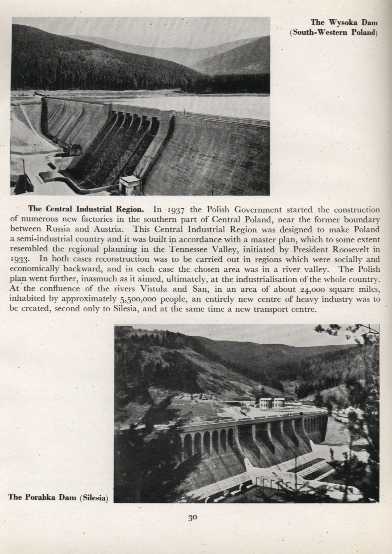
(2). The other great economic development of interwar
[
Land Reform.
In 1919, 35% of the
arable land in
The Great Depression, which hit Europe in
1930, lowered the price of agricultural goods while at the same time the rural
overpopulation could not be absorbed by
Education.
There was great
progress in this field due to free and compulsory education at the primary/
elementary and middle school levels, so tha tilliteracy was almost wiped out by 1939. There were 28,000
primary schools and 770 secondary schools, but only one High School was free of
charge. By 1939,
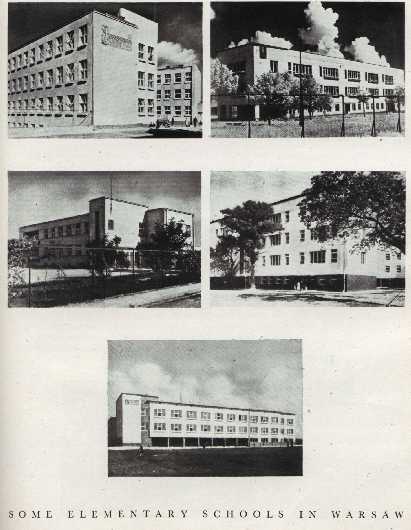
[
Social Services
These were very good in the towns. Workers paid a little
toward medical care while employers paid the rest. There was also government
subsidized housing for the workers. However, with the onset of the depression,
unemployment grew, as it did elsewhere in Europe and the
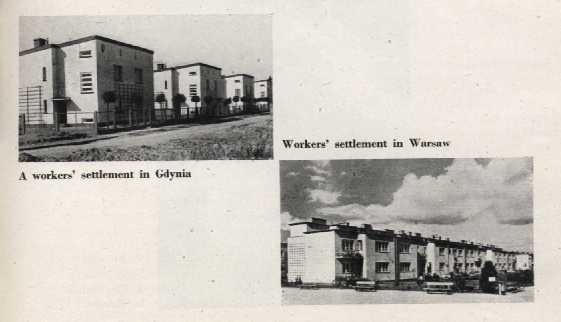
[
Women.
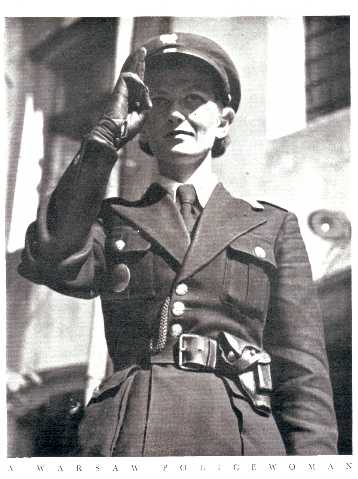
A few educated Polish
women had begun to go into other professions than school teaching before 1914.
In the interwar period, there were Polish women doctors and dentists, also
engineers and architects, but they were still a small minority compared to
men. There were some Polish policewomen, mainly directing traffic. There
was also voluntary paramilitary training for women. Women had the right
to vote since the rebirth of the Polish state in November 1918.
[
The Arts.
The interwar period
saw a great flourishing of art, literature and theater in
While only the
composer and musician Karol M. Szymanowski
(1882-1937) and the great pianist and composer Ignacy
Paderewski (1860-1941, Prime Minister, then Foreign Minister January
-November 1919), managed to attain world fame, there were many other great artists
and writers who are still recognized and admired by Poles today.*
*[For literature and
theater, see: Czeslaw Milosz, The History of
Polish Literature London, 1969, and reprints, chapter X, Independent
Poland. On the arts, see: Janina Hoskins, Visual
Arts in Poland. An Annotated Bibliography of Selected Holdings in the
Library of Congress, Library of Congress, Washington, 1993; the vast majority of the works listed here are
in Polish].
(iii) Minorities
As mentioned earlier,
national or ethnic minorities amounted to some 30% of the total population.
This was one of the problems faced by the Polish state, but it was not a major
problem, and was certainly less serious than that faced by the multinational
states of
According to
the last prewar census, held in 1931, the nationalities inhabiting
by mother tongue
|
|
|
|
|
In millions |
|
Polish |
21,993,400.....
....68.9% |
|
Ukrainian |
4,
442,000.*.13.9% |
|
Jewish |
2, 732,600*...... 8.6% |
|
Belorussian |
990,000......... 3.1% |
|
German |
741,000*...2.3% |
|
Russian |
139,000..........0.4% |
|
Lithuanian |
83,000..........0,3% |
|
Czech |
38,000...........0.1% |
|
"Local"(tutejsi)** |
707,000..........2,2%
|
|
Others |
11,000..........0.1%.
|
|
TOTAL |
31,916,000........100%
|
[*disputed figures; ** locals]
adjusted by religion
|
|
|
|
Polish |
20,644,000.........64.7
% |
|
Ukrainian |
5,114,000 ........ 16
.% |
|
Jewish |
3,114,000............9.8%
|
|
Belorussian |
1,954,000...........6.1%
|
|
German |
780,000............2.4%
|
|
Russian |
139.000............0.4%
|
|
Lithuanian |
83,000..............0.3%
|
|
Czech |
38,000...............
0.1% |
|
Local.(tutejsi)* |
- - |
|
Other |
11,000...............0.1%
|
|
Not
given |
39,000..............0.1%
|
For the official figures according to mother tongue. see the Concise Statistical Yearbook of
For the figures given in the second table, as adjusted by Professor Janusz Tomaszewski in his book
about the multinational
* Local (tutejsi) was declared mostly by people living in
The total population
of
The Germans
lived mostly in western
The Ukrainians
lived in former
Some west Ukrainians
had fought the Poles for an independent Ukrainian state with its capital in Lviv (P. Lwow) in 1918-19 and
lost, leaving bitter feelings on both sides. Some Ukrainian intellectuals
emigrated to Soviet Ukraine and participated in the cultural renaissance there
in the early 1920s, but most were later imprisoned or killed in Stalin's
crackdown on "nationalism" which began in 1926. Later, millions of
Ukrainians died in Stalin's man-made famine of 1930, which he used to break
Ukrainian peasant opposition to his collectivization of agriculture. Some
Ukrainian exiles lived in
The official leader
of Ukrainians in
The Ukrainians had many elementary and middle Ukr.
lang. schools, and developed a network of highly
prosperous cooperative shops selling agricultural produce. They had legal
political parties whose deputies were elected to the Polish parliament.
However, there was an
extreme nationalist organization, the OUN (Organization
of Ukrainian Nationalist), established in
In September 1930, the OUN launched organized attacks on Poles in East
Galicia with the aim of causing a mass Ukrainian uprising. They burned Polish
manor houses and villages. Pilsudski sent in the army which carried out a
brutal "pacification." The number of
Ukrainians killed was small, maybe 50, but Polish police mistreated the
population and destroyed Ukrainian property and libraries. This, of course,
increased Ukrainian resentment of Polish rule. Ukrainian
discontent and even resentment of Polish rule is understandable, but we
should bear in mind that the Ukrainians living in the
The Belorussians were divided between Roman Catholic, Uniate,
and Greek Orthodox, and did not have a strongly developed national identity.
However, grinding poverty lent appeal to communist propaganda, so the
Belorussian peasant party "Hromada," established
in 1925, cooperated with the Belorussian Communist Party, an affiliate of the
Polish Communist Party. Therefore, the Hromada was delegalized in 1927; its leaders were tried in
The Jews of
Most Polish Jews were
orthodox, that is, Hasidic Jews. Most were poor and worked in crafts and
retail trade. Some were money lenders in small towns and villages, mainly in
the central and eastern areas which had been former Russian Poland and the
southern areas which had been
Jews and Poles had
lived alongside each other for centuries, but in separate communities. Thus,
they lived together but apart. The Jews preserved their identity through their
religion, customs, and languages (Yiddish and Hebrew), but this obviously
differentiated them from the Poles, as well as Ukrainians, Belorussians,
and Russians.
Assimilated Jews made up some 5 % of the whole Jewish population of about
3,500,000 (1939), but they gave Poland many outstanding writers, poets,
lawyers, doctors, and scientists. Indeed, these assimilated Jews constituted
some 25% of the Polish intelligentsia as a whole. Those educated before
1918, dominated the legal and medical professions and this incited right-wing
government coalitions in 1923-26 to attempt passing legislation restricting the
intake of Jewish students of law and medicine to 10%, roughly equivalent to the
percentage of Jews in the total population. This was called the "numerus clausus" or closed
number. However, attempts to make this into law failed, so its application
depended on university administrations. Nevertheless, Jewish students were
generally not admitted to study medicine and law.
[Note: At this time, a 10% admission ceiling for Jewish students was the
unwritten rule at Harvard, and probably other Ivy League Universities as well].
N.Democratic students frequently attacked their
Jewish colleagues, or restricted them to back benches, but the extent to which
this was practiced depended on the university administration.
Quite a few members
of the assimilated Polish-Jewish Intelligentsia was politically
left-wing and sympathized with Communism or joined the Polish Communist
Party, whose visible leadership was preponderantly Jewish. This added fuel to
the N.Democratic brand of anti-semitism.
Finally, there were very few Jews in the Polish civil and foreign service, except for a few totally assimilated Polish
Jews. There was one general (Mond) of Jewish origin
in the army, but most Jewish officers - 10% of the officer corps - were in the
medical branch of the service.
It is worth noting
that the Jews of
*[For a photographic record of Jewish life in
After the Depression
hit, the Polish government sought to reduce the number of Jews in
*[See Laurence Weinbaum, A MARRIAGE OF
CONVENIENCE. The New Zionist Organization and the Polish Government, 1936-1939,
East European Monographs No. CCCLXIX (369), Boulder Co. and
The Polish government
tried to find areas of settlement for Polish Jews in French colonies,
especially
Conclusion.
The treatment of minorities in interwar
But despite the injustices, despite the terrorism by
the Organization of Ukrainian Nationalists (OUN) and the counter-terror
resorted to by the Polish State, despite the systematic Polonization
of the school system and conversion of Orthodox churches into Roman Catholic
ones under phony pretexts, despite numerus clausus and the exclusion of Jews from the professions
- despite all this and more, the material, spiritual, and political life of the
national minorities in interwar Poland was richer and more complex than ever
before or after.
In support of this claim, the author cites the
following statistics: in 1931, there were in Poland 920 Jewish non-periodical
publications, mainly in Yiddish,but 211 in Hebrew;
342 Ukrainian non-periodical publications, of which 264 appeared in the Lwow (L’viv) voevodship;
and 33 Belorussian non-periodical publications in the Wilno
(Vilnius) voevodship. Wilno
was the second most lively Jewish publishing center
after
*[Jan Gross, Revolution from Abroad. The Soviet Conquest of Poland’s Western Ukraine and Western Belorussia, Princeton, N.J., 1988, pp..6-7. Here, the
author also cites 1939 Ukrainian, Jewish and Belorussian publication figures
for the territories annexed by the
Originally
published at http://www.ku.edu/~eceurope/hist557/lect14a.htm
|
|
Anna M. Cienciala
B.A. Liverpool, 1952, M.A. McGill, 1955;
Ph.D. Indiana, 1962 20th century Polish, European, Soviet, and
American diplomacy 1919-1945. Born in the Free City of Danzig (Gdańsk, in Poland after WWII); she attended middle and high school in England; university studies in England, Canada, and U.S. (B.A. Liverpool, 1952, M.A. McGill, 1955; Ph.D. Indiana, 1962). She taught at the University of Ottawa and the University of Toronto before coming to the University of Kansas in 1965. More info |