|
Poland: The Struggle for Independence 1795-1864
By Anna M. Cienciala (Maps.: Andrew
Andersen)
VIDEO 
|
Overview.
The year 1864 marks a
great turning point in modern Polish history. The failure of the second great
revolt against Russia
within three decades ended what is known as the "Romantic" period of
insurrections, and led to rethinking political
strategies to regain independence. However, we should note that beginning
around 1892, a new revolutionary- insurrectionary trend appeared with the
founding of the Polish Socialist Party Abroad followed in 1893 by the
establishment of the Polish Socialist Party (Polish acronym PPS) in
Warsaw. One of its founders was Jozef
Pilsudski (1867-1935, pron. Peelsootskee),
who headed the party in Lithuania. The same period saw the founding of the conservative, Catholic, National
Democratic Movement led by Roman Dmowski
(1864-1939, pron. Demofskee). Both movements
began with the goal of regaining Polish independence but in 1906-16 the
National Democrats, who saw Poland's
greatest enemy in Germany,
followed a policy of cooperation with Russia,
while Pilsudski, who saw Russia
as the greatest enemy, lined up with the Central Powers against in her 1914-17.
Key Characteristics of the period
1795-1864.
A. The Struggle for Independence
- but note that between insurrections there were also attempts by the Polish
social elite to find a "modus vivendi,"
that is to get along with the foreign rulers of Poland.
B. Modern Polish national
consciousness began to develop in the period of revival and reform, 1772-91.
It inspired the authors of the 3 May 1791 Constitution and was manifested by
armed struggle in the Kosciuszko
Uprising of 1794, when peasant volunteers armed with scythes mounted
on long pikes fought Russian troops. National consciousness developed further
in the period of the Napoleonic Wars (1797-1815), then in the short lived Kingdom of Poland
(1815-30), and was greatly strengthened by the two great revolts against Russia of
1830-31 and 1863-64.
C. Until 1830, that is, in the period of the Duchy of Warsaw (1807-12)
and the Kingdom of Poland (Congress Poland, 1815-30), the social and
political elite was made up of nobles, seconded by army officers of gentry
(minor noble) origin. After the failure of the first revolt against Russia, 1830-31, political leadership passed to poets
and writers of the "Great Emigration," most of whom settled in France.
D. Poets and musicians played an especially important part in
developing national consciousness in the period 1831-63. The poet Adam
Mickiewicz (1798-1855, pron. Meestkyeveetch)
was the most important in this respect, though Zygmunt
Krasinski (1812-1858) and Juliusz
Slowacki (1809-1849) also contributed
greatly to this development. The composer and piano virtuoso Frederic Chopin(1810-1849,
pron. Shohpehn) expressed Polish yearning for
independence in his music.
E. The evolution of Democratic Ideas can be seen in the Polish
Democratic Society, which was established by Polish emigre
officers in France,
and especially in its program, published in 1839. The key ideas were the emancipation
of the Polish peasants - with compensation for the landlords - which
was combined with the belief that Poland would rise again as the result
of a coming "War of the Peoples" against the monarchies of
Europe, which would overthrow the Russian, Prussian, and Austrian monarchies
that ruled Polish lands.
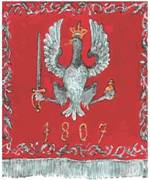
1. The Poles in
the Napoleonic Wars.
Polish nobles and
gentry were divided into two groups: (a) those with a Russian orientation, who
worked for the union of all Polish lands in an autonomous Kingdom within the
Russian Empire, with the Tsar as King of Poland, and (b) those who followed the French orientation, and put their hopes for
an independent Poland
in Napoleon.
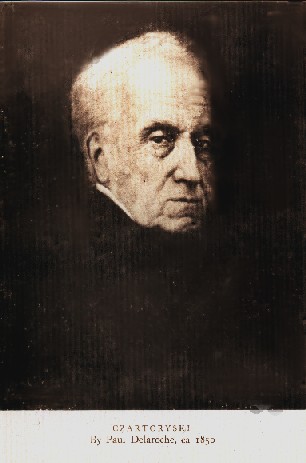
The most prominent leader of the Russian orientation was Prince
Adam Jerzy Czartoryski
(1770-1861, pron. Chartohryskee), a friend and
adviser of TsarAlexander I until 1815.
He fell in love with Alexander's wife, and their love affair had Alexander's
permission because his was an arranged, loveless marriage. However, after his
death, she was not allowed to marry him and he married late in life, when he
was in exile in Paris.
Czartoryski's political career reflected the
vicissitudes of Poland's
fate throughout his long life.
The most prominent
leaders of the French orientation were General Jan Henryk
Dabrowski (1755-1818, pron. Dohmbrofskee), and Prince Jozef
Antoni Poniatowski
(1763-1813, pron. Pohnyatofskee), nephew of King Stanislas Augustus Poniatowski. Dabrowski created the Polish Legions in Italy, 1797,
and they fought for Napoleon. His name figures in the Polish marching song
written at this time by Jozef Wybicki (1747-1822, pron. Vyhbeetskee),
and sung to the tune of a Polish mazurka, a folk dance of Mazovia.
(In the interwar period, 1919-39, it became the Polish
national anthem). Poniatowski was War Minister
and a general in the army of the Duchy of Warsaw, also a Marshal of France.
Prince Jozef Poniatowski at the Elster River,where he died.
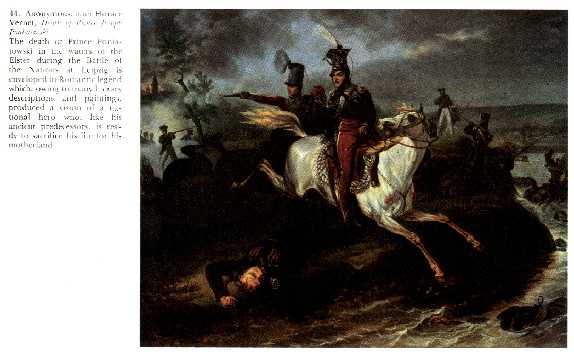
[from Topolski, Outline
History of Poland].
The French
orientation seemed to be winning until the defeat of Napoleon in Russia, 1812.
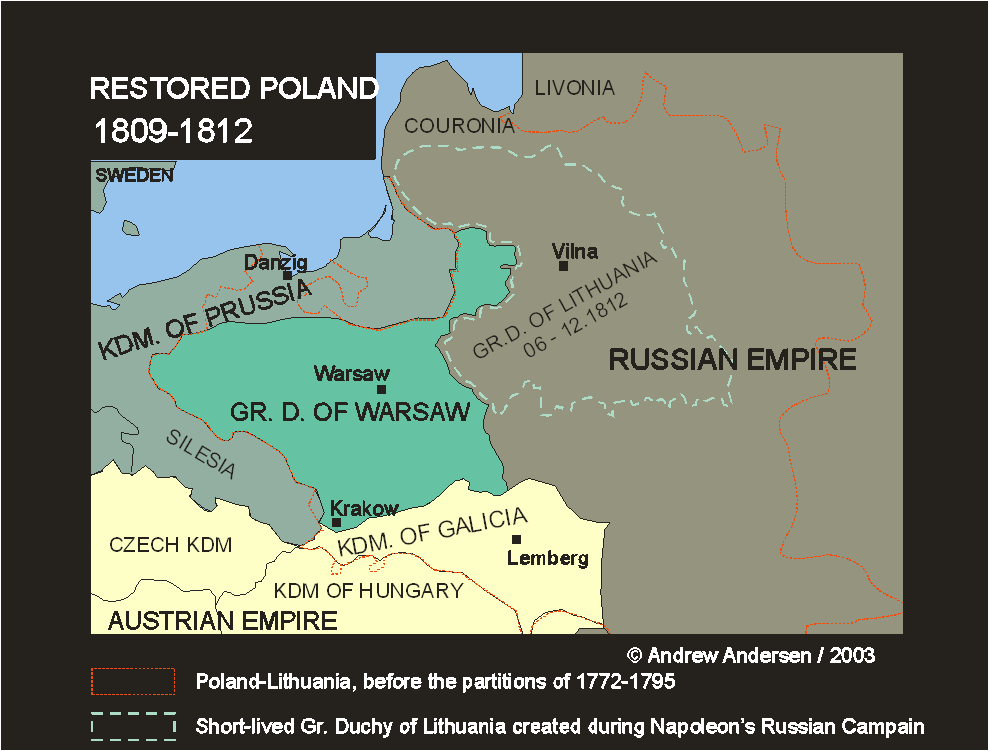
Meanwhile, the Duchy of Warsaw, created in 1807 and expanded to include
Austrian Poland in 1809, received the Napoleonic Code and was ruled by
the Frederick Augustus, the Elector of Saxony,
under French supervision. The Duchy of Warsaw was, in fact, treated pretty much
as a French colony - though a willing one - and was exploited economically by France.
THE YEAR 1812.
About a quarter of
Napoleon's "Grande Armee" of
some 600,000, which invaded Russia
in June 1812, was made up of Poles. A poetic image of this army's march through
Lithuania,
as seen by Polish nobles, is pictured in Adam Mickiewicz's great epic poem Pan
Tadeusz (Mr.Thaddeus).
Or the Last Foray into Lithuania, which illustrates Polish gentry life in Lithuania at
this time. (The Poles were the landowning class in most of the country).
Written by Mickiewicz and published in Parisian exile in the early 1830s, this
is a perennial favorite with Polish readers and has been translated into many
languages. (The best English translation is by Kenneth
Mackenzie, published by the Polish Cultural Foundation, London, 1964, with
later reprints).
The tale of Poles
fighting in Napoleon's army in Spain
and then retreating with the "Grande Armee"
from Russia
is told in Stefan Zeromski's novel Popioly (Ashes), which was made into a
wonderful film by Polish film director, Andrzej Wajda.
2. The
decisions of the Congress of Vienna,
1814-15, concerning Polish lands.
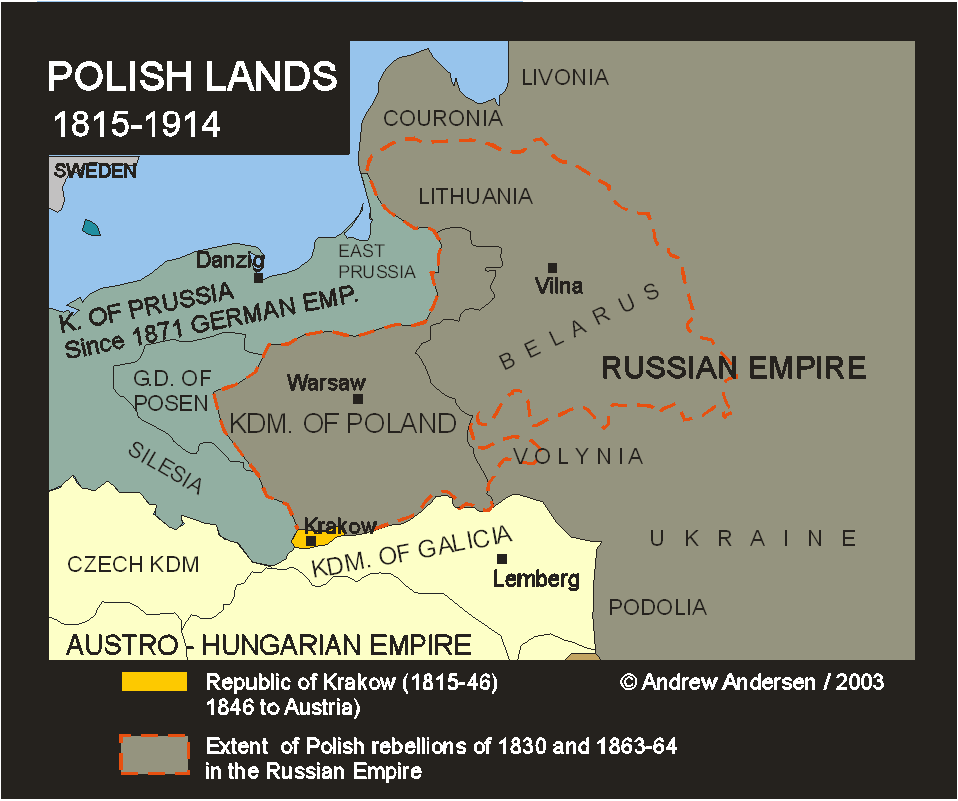
After Napoleon's
final defeat by British and Prussian armies at Waterloo,
Belgium, on June 18, 1815,
the victorious allies proceeded to implement the peace settlements they had
worked out at the Congress of Vienna,
Sept. 1814- June 8, 1815.
Tsar Alexander I of Russia
wanted to unite all Polish lands under the Russian crown - which was also the
goal of his adviser, Prince Adam Czartoryski.
However, Prussia and Austria refused
to give up their Polish acquisitions for compensation elsewhere. They were
supported in this by Gt.Britain and the newly
restored French monarchy - both of whom feared a too powerful Russia in Europe.
However, Austria and Prussia did agree to give up their shares from
the Third Partition to a Kingdom
of Poland united with Russia but
without its former eastern lands, which greatly disappointed Czartoryski and all those who had supported Russis against Napoleon. All three powers guaranteed the
rights of their Polish subjects to cultural development and economic unity.
Finally, Austria
agreed to set up The Republic of Cracow, which became a symbol of
Polish independence.
3. The Kingdom
of Poland (Congress Poland),
1815-1830/31.
Tsar Alexander I granted his new Kingdom a liberal constitution, which included a two
chamber legislature (Seym and Senate). The kingdom
also had its own administration and army. Alexander viewed the liberal
constitution as an experiment; if it worked, it might be extended to Russia.
Unfortunately for the Poles he appointed his brother, the Grand Duke
Constantine, as commander in chief of the Polish Army and the large Russian
force stationed in the Kingdom. He was married to a Polish lady, who sometimes
succeeded in tempering his brutal character. The pardoned, former Napoleonic
General Jozef Zajaczek was
appointed Viceroy, but without real power , which was
in the hands of Nikolai Novosiltsev, whom
Alexander II appointed to oversee Polish affairs.
There was some
important economic development at this time, especially in the textile
industry which had its center in Lodz
(pron: Woots). There
was also some significant educational development in the Kingdom. Furthermore,
Prince Adam Czartoryski, who was
curator of the educational region of Vilna
(P. Wilno, Lith. Vilnius) extended the Polish
educational reforms of the 1772-93 period to former eastern Poland, now Russia, where the noble class was
Polish. He was replaced by Novosiltsev in 1823, who
introduced a repressive policy, in line with Tsar Alexander's change of mind.
Alexander turned
conservative after the 1820-21 revolts in Europe, when he lent his moral and
diplomatic support to Austria.
In the Kingdom of
Poland, the imposition of
censorship led to the development of secret
societies among students and army officers. The students were attracted to
western liberal ideas, and Adam Mickiewicz became famous for his
"Ode to Youth," which was really an ode to freedom. Mickiewicz, a
member of the Philotmat society at the University of Wilno, was exiled to Russia, where
he made the acquaintance of Pushkin and other Russian literary figures. (He left for Western Europe in 1830). The officers resented
the brutal methods of their commander-in-chief and Viceroy of Poland, the Grand
Duke Constantine. They also resented their dim perspectives of
advancement in the army.
Alexander I died on December 1, 1825, at Taganrog,
on the Sea of Azov. There is some mystery
about his death, allegedly of the plague. His body was not buried with the
other Tsars and their families in St.Petersburg, and
rumors persisted that he had not died but became a hermit. Whatever the case
may be, he was succeeded by his brother Nicholas, who became Nicholas I (1796-1855,
ruled 1825-55). He put down a revolt against his coronation, led by
liberal-minded Russian nobles and known as the Decembrist Revolt. He
meted out ruthless punishment to the rebels.
Some Polish nobles
sympathized with the Decembrists and the Polish Senate refused to condemn as
traitors the nobles who had contacts with the Decembrists. Nicholas I,
who had expected condemnation, was furious.
3. Factors leading to the Polish Revolt against Russia,
1830-31.
a. Revolutions broke out all over Europe in 1830, beginning with the July
revolution in Paris
against King Charles X Bourbon, who was succeeded by King Louis
Philippe of the House of Orleans, known for his liberal views. In August,
the Belgians revolted against Dutch rule, and Belgian independence was won with
British diplomatic support. Revolts broke out in some of the German states,
toppling rulers. In Feb.1831, there were revolts in Modena
and Parma, with the goal of uniting Italy. There
were also revolts in the Papal States.
However, all were put down.
b. In Warsaw,
the cadet officers' conspiracy against the Grand Duke Constantine
was in danger of being discovered; by November, the secret police were on their
trail.
c. In November 1830, Tsar Nicholas I declared
he would march to help the Dutch King William against the Belgians, and
would include the Polish army in this expedition. This was the last straw for
the Polish cadets.
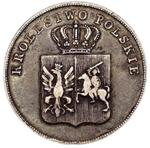
4. Revolt and Failure.
On Nov. 29, 1830, the cadets revolted in Warsaw and tried
to kill Constantine,
but he escaped. They people of Warsaw
rose up in support of the cadets. A new government was formed, with Prince
Adam J. Czartoryski at its head. He only
accepted leadership in hope of reaching a negotiated peace with Nicholas
I, but the Tsar demanded surrender so he was dethroned as King of Poland.
Though the Polish
army scored some victories, the Poles could not win because: (a). They were outnumbered 10-1 by the Russians, and (b). They
received no foreign support - as did the Greeks in their War of Independence
against the Turks. (c) Austria
and Prussia
gave support to the Russians.
One of the key battles of the 1830-31 revolution against Russia.
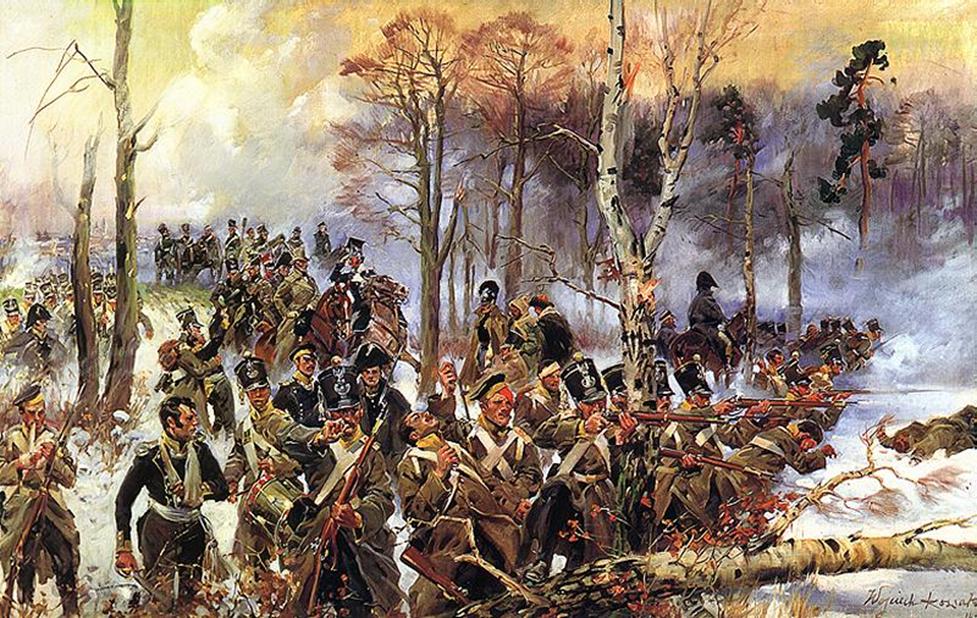
[from Topolski, History of
Poland].
Even so, the fighting lasted for over a year. Russian
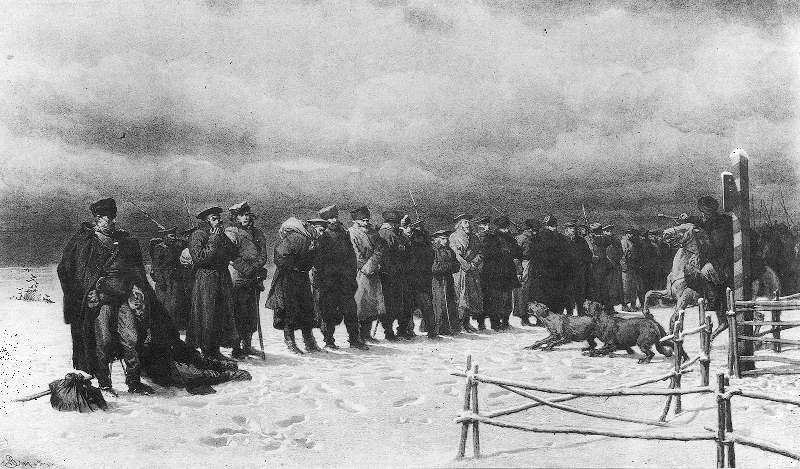
retribution was ruthless. Many insurrectionists were sentenced to hard
labor or service in the ranks of the Russian army. Hundreds of
Polish gentry families were deported to Siberia from former
eastern Poland,
being replaced by Russian landowners. The former Kingdom of Poland
was placed under military rule, headed by General Ivan F.Paskevich (1782-1856) who had defeated the Poles
and was made "Prince of Warsaw." At the same time, the Austrian and
Prussian governments repressed their Polish subjects too.
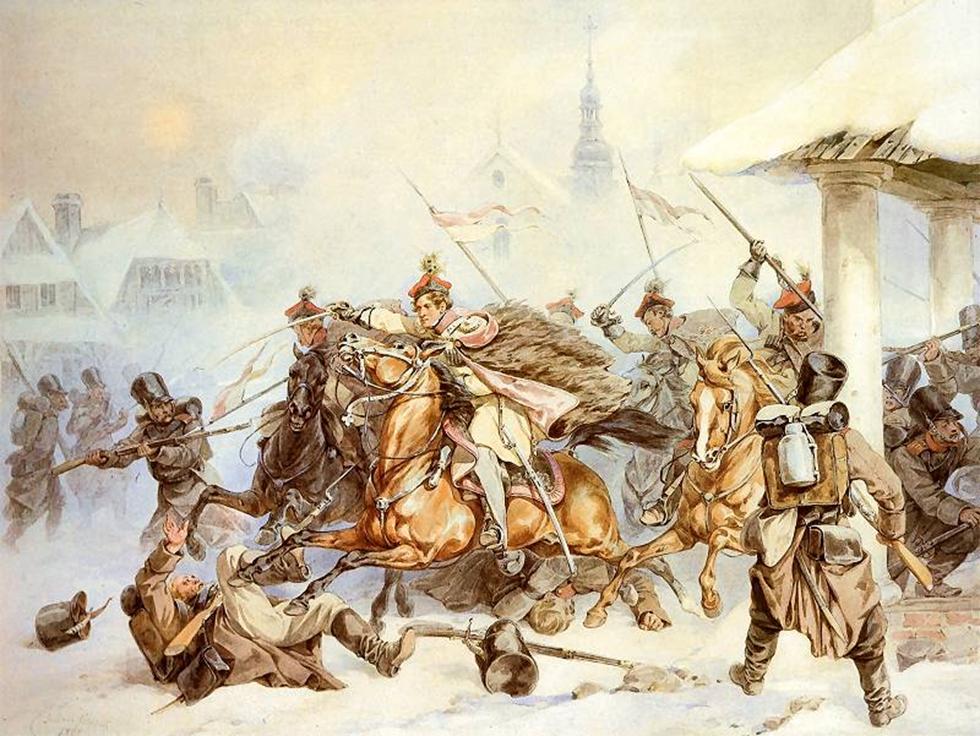
5. Importance of the 1830-31 Revolution.
(a) It increased Polish national consciousness because
Poles from Austrian and Prussian Poland had joined the revolt against Russia.
(b) Many in the
Polish elite saw the defeat as due more to mistakes in
military and political leadership than to Russian might. They came to
believe that if the Polish leaders had offered emancipation to the peasants,
this would have provided a mass army to defeat the Russians. Thus, Emancipation
came to be the program of a large group of Polish emigres.
(They overlooked the fact that emancipation in 1830-31 would
have ruined the gentry, who were the backbone of the revolution, and that even
a large Polish army could not have won without foreign support against the
vastly superior Russians, who also had the backing of Austria and Prussia).
6. The Great Emigration; the revolts of 1846 and
1848; the Crimean War, 1854-45.
An estimated 10,000 Poles, mostly nobles and gentry, preferred exile
Siberia or living under Russian rule in Poland. Most settled in France
and divided into two main political groups:
(a) Conservatives
led by Prince Adam J. Czartoryski, who
resided in the Hotel Lambert, Isle
St.Louis,
Paris (now the Bibliotheque Polonaise and museum). He
worked to secure French and British support to regain Polish independence,
hoping they would get involved in a war with Russia,
defeat the latter, and thus bring about an independent Poland. Czartoryski and his group also advocated conservative
agrarian reform, that is, commuting peasant labor dues
for money rents.
(b) The Polish
Democratic Society (PDS), mainly former officers, advocated the
abolition of serfdom, though with compensation for the landlords. They called
for the overthrow of monarchies in a "War of the Peoples," which
would bring Polish indepedence. One of the PDS
leaders was the historian Joachim Lelewel (1786-1861).
The PDS published their program in 1839; it is known as "The Poitiers Manifesto,"
because it was published in the city to which most former Polish officers were
relegated by the French government. (see Biskupski & Pula, Polish Democratic Thought, pp.
199-209).
The great emigration
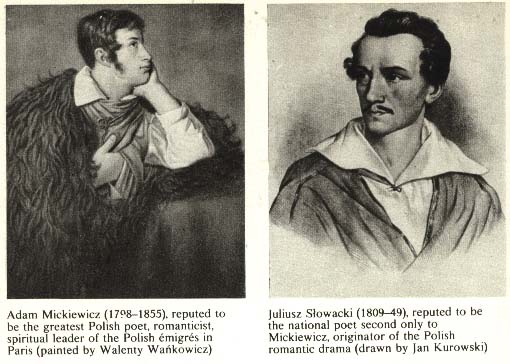
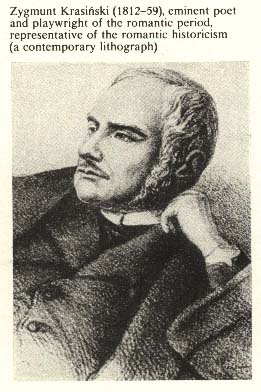
produced a great age of Polish literature. There were three great
Polish poets, who were also playwrights: Adam Mickiewicz (1798-1855); Zygmunt Krasinski
(1812-1859, pron. Krahseenskee) and Juliusz Slowacki
(1809-1849, pron. Swohvatskee). Mickiewicz's great
patriotic work was the play "Forefathers' Eve;" another was: "Konrad Wallenrod." But he is
best known for his epic poem: Pan Tadeusz,
(All these works are available in English). Poles love the other two poets as
well, but Mickiewicz became the national poet of Poland. His romantic view of Poland and the
struggle for Polish independence, deeply influenced several generations of
Poles, and with the spread of reading among workers and peasants the late 19th
century, it reached them as well. This was so even though his works were banned
in Russian and Prussian Poland, and allowed in Austrian Poland only after 1868.
(See: Charles Jelavich, The Habsburg Monarchy,
Polish Nationalism: Mickiewicz, pp.1-13)
The music of Frederic
Chopin (1810-1849) has also inspired generations of Poles and still does so
today. His father was French; came from Lorraine
to Poland
as a music teacher and married a Polish lady. Frederic was a child prodigy as a
pianist; he also collected folk tunes which he later used as themes in his
compositions, especially the Mazurkas. He lived in France from 1830 onward and had a
famous love affair with the French woman writer, Amandine Dudevant,
known by her pen name as Georges Sand (1804-1876). He died
of TB in Paris
at age 39. (There was a beautiful celebration in Paris on the
centenary of his death, summer 1949).
The great emigration was the artistic and political
heart of Poland until the
failure of the second revolt against Russia,
1863-64 and the Austrian grant of self-rule to Galicia,
Austrian Poland,
in 1868.
7. The Revolts of 1846 and 1848.
(A) 1846: In that
year, there was unrest all over Europe. A
series of bad harvests, and especially the potato blight, led to widespread
hunger, and to famine in European countries, not only in Ireland. At the
same time, people in many countries believed it was to time to rise up against
the monarchies and set up democratic republics.
In Poznan province (German: Posen) there was a
conspiracy, led by members of the PDS, to organize a national uprising to free Poland from
foreign rule. However, they were betrayed, arrested, and imprisoned in Berlin.
In the Republic of
Cracow (Polish: Krakow), a few democratic nobles tried to rouse the
peasants to rise up against Austria.
They began the insurrection in February 1846, gathering support from the more
enlightened peasants of the Cracow
region. However, most of the peasants of Austrian Poland (Galicia) were
undernourished because of bad harvests and hated their lords. Therefore, they
believed Austrian declarations that the good Emperor wanted to free them, while
their Polish lords opposed this. Furthermore, the Austrians offered money for
the heads of Polish nobles. This led to the "Galician Slaughter," in
which many nobles and their families were murdered by peasants. The revolt got
out of hand and the Austrians had to put it down. The Republic
of Cracow was abolished and
incorporated into Galicia.
(B) In 1848,
revolts broke out all over Europe. Again,
they started in Paris,
this time with the overthrow of King Louis Philippe in February of that year.
In March, a revolution broke out in Berlin and
the Italians revolted against Austrian rule, Also, there was a revolt in Vienna and a quiet revolution for home rule in Bohemia, while the
Hungarians also demanded home rule. When attacked, they fought for
independence, but lost. (For the Czechs, Slovaks and Hungarians, see lectures
6.7; for the Croats and Slovenes, and other Balkan peoples, see lectures 8, 9).
After the March
revolt in Berlin,
the Prussian Liberals feared Russian intervention, so they allowed the Poles
of Poznan to raise troops. However, Tsar Nicholas I did not move, so
the Prussian and other German Liberals, who met in the Frankfurt Parliament
to discuss what kind of united German state should be established, refused to
grant home rule to the Prussian Poles. A Prussian general and troops were sent
against them and defeated them.
Note that Mickiewicz
led a Polish Legion in defense of the short-lived Roman
Republic in Italy, but it was crushed.
Thus, the "War
of the Peoples" of 1848 failed to liberate the Poles and other peoples
of the Austrian Empire. However, in 1848 the word "Poland" became the shorthand for freedom
all over Europe.
The Crimean War, 1854-56.
This war broke out
when the Russian armies of Nicholas I invaded and occupied the Danubian Principalities of Moldavia and Walachia
of the Ottoman Empire. [They would soon
form the core of the new Romanian state].The British and French, who did not
want Russia to dominate or
destroy the Ottoman Empire, sent their fleets
to support it. When bilateral negotiations failed, war broke out between the
Russians and the Turks in October 1853. In January 1854, after the Russians
sunk some Turkish ships, British and French warships entered the Black Sea and
their troops - plus some from the Kingdom of Piedmont- Savoy - landed in the Crimea.
The Poles had great
hopes that France and Britain would crush Russia,
so Poland
would regain independence. Mickiewicz rushed to Turkey and tried to raise a
Polish-Jewish legion to serve in the Turkish army, but he died in Instanbul, probably of the plague, in 1855. Even without
his efforts, there were Polish units in the Turkish army, paid by Queen Victoria of England. (Their Turbans, adorned
with Polish eagles, can be see
today in the Polish Institute and Sikorski Musem, London).
Unfortunately for the
Poles, the Crimean War led to a stalemate, and the French Emperor Napoleon III
gave up plans for an armed landing on the coast of Lithuania. At the same time, France and Britain
supported Austria against Russia and had good relations with Prussia, so they were not willing to support an
independent Poland.
Nevertheless, the
fact that Russia
suffered defeat gave some hope to the Poles. They were also encouraged by the
death of Nicholas I in 1855, and by the fact that his successor Tsar
Alexander II began a policy of liberalization not only in Russia proper,
but also in Russian Poland. In 1861, he proclaimed the emancipation of the
peasants in Russia
- but not yet in Russian Poland.
8. Background to the Revolution of 1863-64 against Russia.
(A) Alexander II released many Polish exiles from Siberia.
Most returned to Poland,
many of them to Warsaw,
where they inspired young people with the desire for independence.
(B) In 1856,
Alexander allowed the establishment of the Warsaw Medical Academy and of
the School
of Fine Arts. In
1862, they were followed by the "Main School," which consisted
of the Medical Dept. (the reformed Medical
Academy), and departments
of physics-mathematics, law, and philology-history. This led many Polish
students to come from Russian universities, and they started conspiring for a
revolution.
(C) Count Andrzej Zamoyski (1800-1874,
pron. Zamoyskee), a great landowner, began annual
meetings of landowners to view and discuss agricultural innovations. These
meetings of the "Agricultural Association" turned into political
discussions on how to regain Polish independence and the former eastern
territories of Poland.
However, for the time being, the Agr.Assoc.
followed a policy of "organic work" modeled on
the activities of Poles in post- 1831 Prussian Poland, that is, working for
Polish education and prosperity within the legal limits set by foreign rulers.
However, the War
of Italian Liberation (Risorgimento) and the Austrian defeat there by
French armies (Solferino, 1859), was an
inspiration to Poles. A Polish military academy was set up in Cuneo, Italy.
There was also
ferment in Russian Poland. In late Feb. 1861, there were patriotic
demonstrations in Warsaw and in Wilno (Vilnius), Lithuania.
Russian troops fired on the demonstrators in Warsaw and killed five. The Poles were
outraged, and so was western opinion.
A great Polish
magnate, Alexander Wielopolski (1803-1877,
pron. Wyehlohpohlskee), now came forward with a
moderate program of extending Polish rights in cooperation with the Russian
government. This was accepted by Tsar Alexander II, but Wielopolski
alienated Polish opinion by dissolving Zamoyski's Agr.Assoc. Then, on 8 April 1862, Russian troops fired on a
peaceful demonstration in Warsaw,
killing a hundred people. These two steps turned Polish opinion against Wielopolski and his moderate program.
In summer 1862, the
Tsar's brother, the Grand Duke Constantine, arrived in Warsaw
as the Russian Viceroy for Poland.
It looked as if Tsar Alexander II was trying to repeat the experiment with the Kingdom of Poland. 1815-30. However, three young
Poles tried assassinate the Viceroy. The attempt failed and Wielopolski
had them hanged, which made them martyrs for the Polish cause.
In the meanwhile,
students and others were conspiring to organize a revolt against Russia. They
were called Reds because their program was radical for the time and red
was the color of revolution. The key points of the Red program were:
(a) Revolution in Poland linked to an expected revolution in Russia - where
emancipation had disappointed the peasants, leading to numerous peasant risings
which were expected to lead to revolution.
(b) Abolition of
serfdom in Russian Poland, without compensation for the landlords - who were compensated
in Russia.
(c) Poland would offer the non-Polish peoples of the
former Polish-Lithuanian Commonwealth, that is, Ukrainians, Belorussians,
and Lithuanians, a choice of either union or federation with Poland.
[See: K.Olszer, For Your Freedom and Ours, From the
Manifesto of the National Government of 1863, pp. 73-75.
Note that the Polish
Reds agreed on this program with the exiled Russian revolutionary writer Alexander
Herzen (1812-1870, pron. Hehrtsen),
publisher of the paper Kolokol (The Bell) in London.
The paper was smuggled into Russia,
where it was very widely read by the Russian intelligentsia (educated people).
However, Herzen's support of the Polish revolution
was seen as unpatriotic and alienated his Russian readers.
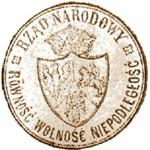
9. REVOLUTION, 1863-64.
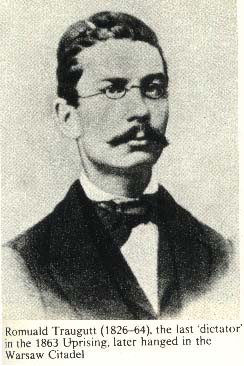
Although the Reds did not plan to revolt until there
was a large scale peasant revolt in Russia - where revolts were
spreading because of peasant dissatisfaction with the terms of their
emancipation - they were forced to act when Wielopolski
ordered selective conscription into the Russian Army in Jan. 1863. He did this
to remove the key conspirators and thus avert a revolt. Therefore, the Reds
published their Manifesto and began the revolt on Jan.22, 1863. (See the
Manifesto in K.Olszer, For Your Freedom and Ours).
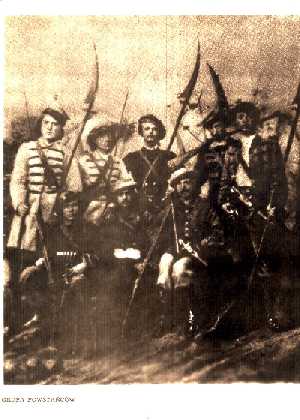
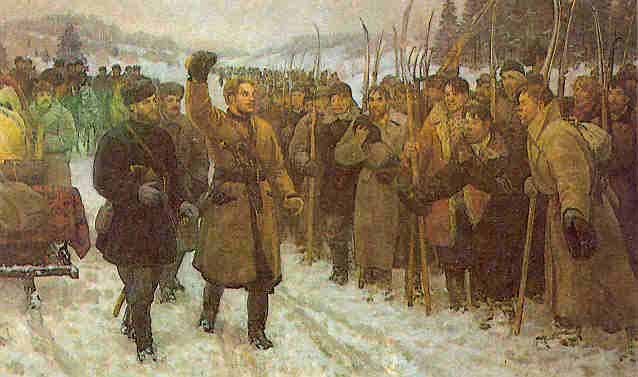
Byelorussian rebels fighting in support of Poland
under K. Kalinowski and Z. Sierakowski
Why the Revolution failed:
(A) There was no widespread peasant revolt in Russia;
(B) There was no help from abroad. The conservative
rebels had counted on help from Napoleon III of France, but he dared not move
because of Prussia and Britain
were opposed.
(C) Prussia - Bismarck - concluded an agreement with Russia to intern any Polish soldiers who crossed
into Prussia.
Historians often denigrate the typical weapon of the Polish peasantry in
1830-31 and 1863-64 - the pike-mounted scythe. However, in the days before
rapidly reloading rifles and artillery guns, a mass of peasants armed with
their pike-scythes could overwhelm a line of infantry or an artillery post. However,
even tens of thousands of peasants armed with this weapon could not prevail
against well trained Russian armies which outnumbered the Poles 10-1 in
1830-31, and even more in 1863-64, when there was no regular Polish army as in
1830-31.
Despite defeat,
Polish national consciousness was strengthened by two factors; (i) Poles came to fight from other parts of Poland; (ii)
the Polish peasants heard of the Reds' Manifesto; therefore, they did not feel
loyalty to Tsar Alexander II when he emancipated them.
The Aftermath.
There was severe
Russian repression, with executions and confiscation of landed estates owned by
participants in the revolt. [One of them was the author's great grandfather on
her mother's side, who escaped to Austrian Poland]. Furthermore, some 50,000
Polish gentry families were deported from former
eastern Poland to Siberia, to be replaced by Russians. There was also russification of the administration, law courts, and
education in both former eastern Poland and former Congress or
Russian Poland. The former Main School in Warsaw
became a Russian university in 1869.
Polish Reaction.
After the failure of
two revolts against Russia
within 34 years, the Polish intelligentsia turned away from armed struggle as
the means of regianing independence. In Russian
Poland, they adopted Positivism, which was really a form of "OrganicWork," that is, work for education and
prosperity. In particular, they worked to educate the peasants. Many young
students and teachers did this secretly, for it was illegal. Indeed, only
Russian schools were allowed and private education was forbidden.
Positivism prevailed
until about 1891, the centenary of the May 3 Constitution, which led to student
demonstrations in Warsaw,
brutally put down by Cossack troops. Nevertheless, with the establishment of
the Polish Socialist Party Abroad in 1892 and
then the Polish Socialist Party (PPS)in Warsaw in 1893, young people began to
conspire again to regain Polish independence.
----------------------------------
Brief Bibliography
Piotr S. Wandycz, The Lands of Partitioned Poland, 1795-1918, Seattle, WA., 1974
and reprints. (Pt. I covers
the period 1795-1830; Pt. II, 1830-1864; Pt. III, 1864-1890; Pt. IV.
1890-1918).
Norman Davies, God's Playground. A History of Poland, New York, 1982.
For works on special topics, see Bibliography: Select
English Language Works on the History of Eastern Europe,
Part I.
Originally
published at http://www.ku.edu/~eceurope/hist557/lect5b.htm
|

|
Anna M. Cienciala
Professor Emerita / The University of Kansas
hanka@ku.edu
B.A. Liverpool, 1952, M.A. McGill, 1955;
Ph.D. Indiana, 1962
20th century Polish, European, Soviet, and
American diplomacy 1919-1945.
Born in the Free City of Danzig (Gdańsk, in Poland after WWII); she attended middle
and high school in England; university studies in England, Canada, and U.S. (B.A.
Liverpool, 1952, M.A. McGill, 1955; Ph.D. Indiana, 1962). She taught at the
University of Ottawa and the University of Toronto before coming to the
University of Kansas in 1965. More info
|
BACK
TO POLISH HISTORY