THE CAUCASUS


Click on the globe  to locate the area

GLOBE


The Caucasus, an Alberta-size area including Southern districts of Russian Federation as well as three new nations - Georgia, Armenia and Azerbaijan - has been to a great extent isolated from the rest of the world during 70 years of communist rule and its policy of "the Iron Curtain". Most archival materials and other sources of historical information about the Caucasus were unavailable during this time, both for foreign and domestic research. In the USSR and to a great extent in the Russian empire (before 1917), mostly for ideological reasons, researchers were unable to study the history of annexed lands, especially if those lands had a much longer history than Russia itself. The Caucasus with its history coming back at least to the 9th century B.C. was not an exception. At the same time many Western researchers tended to underestimate the area regarding it as a remote and thus less important Russian province.


Due to the above facts the Caucasus still remains relatively unknown to the West. Finding reference literature is still a problem and it is still very hard for western diplomats, businessmen and ordinary citizens to understand the conflicts and problems of the area, to help resolve them and to make a more or less reliable prognosis for future development.


However the Caucasus seems to be a very interesting area of the world. Being a frontier of West and East it has a long and dramatic history. Its mountains and valleys gave birth to many important historical figures, among them philosopher Averroes and marshal Joachim Murat (hyp.), field-marshal Peter Bagration and dictator Joseph Stalin, Jurij Andropov and Mikhail Gorbachev. Peoples of the Caucasus made a valuable deposit into human culture having created numerous masterpieces of art, architecture, literature and film. Rich mineral and natural resources make the Caucasus a prospective area for international business.      


 SEE ALSO:


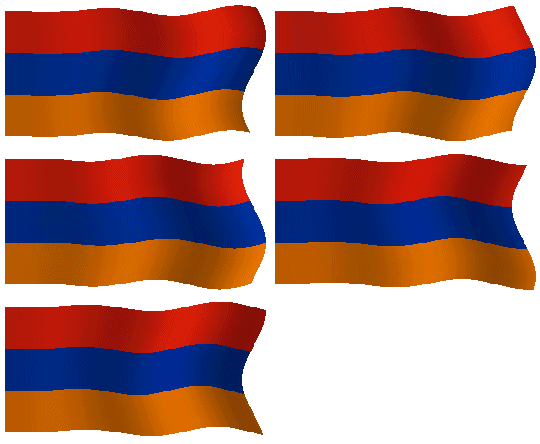
Drapeau animé d'Arménie par Pascal Gross

ARMENIA


ARMENIA: POLITIICAL STRUCTURE


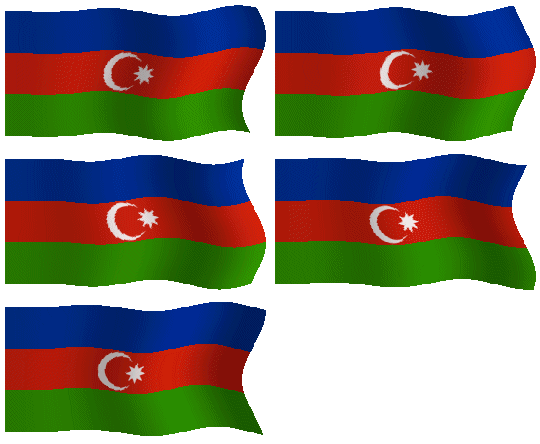
Drapeau animé d'Azerbaïdjan par Pascal Gross

AZERBAIJAN


AZERBAIJAN: POLITIICAL STRUCTURE

 
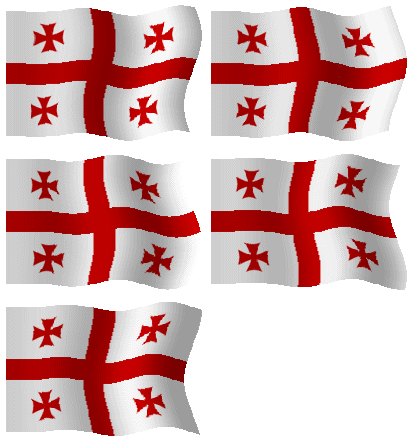
Drapeau animé de Géorgie par Pascal Gross
GEORGIA


GEORGIA: POLITIICAL STRUCTURE


WAR IN ABKHAZIA


WAR IN CHECHNYA


OSSETIAN DISPUTES


Visit YETT

(Young Experts’ Think Tank)

for related articles


HISTORICAL ARMS

OF THE CAUCASUS IN RUSSIAN EMPIRE


MEDIA RACK:

INTERESTING ARTICLES

FROM VARIOUS NEWSPAPERS

& MAGAZINES


JUST TO HAVE SOME FUN:

POLITICAL HUMOR


SHORT HISTORY OF THE AREA:


We are sorry, this page is still under construction

However, you can read selected sections below


THE CAUCASUS: MEDIEVAL HISTORY

(Section 1:     387 - 1080 AD)


THE CAUCASUS:  MODERN HISTORY

( Section 1:     1446 - 1555 )

( Section 4:     1878 - 1916 )

( Section 5:     1917 - 1918 )

( Section 6:     1919 - 1920 )


And you should DEFINITELY look through other pages of the Atlas 

that will tell you about the history of the countrieis and territories of the area among them 

ARMENIA, GEORGIA, CHECHNYA, ABKHAZIA as well as of the

 PONTIC GREEKS & THE EMPIRE OF TREBIZOND


RECOMMENDED BOOKS:


Bremmer, Jan, & Taras, Ray,            New States, New Politics: Building the Post-Soviet Nations,

Cambridge University Press, 1997


Oliker, Olga,                                     Russia’s Chechen Wars 1994-2000: Lessons from Urban Combat,

                                                       Rand Publishers, 2001


Suny, Ronald Grigor,                        The Revenge of the Past:

                                                       Nationalism, Revolution & the Collapse of the Soviet Union,              

                                                       Stanford University Press, 1993


Transcaucasia, Nationalism & Social Change: Essays in the History of Georgia, Armenia and Azerbaijan

          The University of Michigan Press, 1999


The Black Book of Communism                    Harward University Press       2000


SUGGESTED ADDITIONAL READING:


Allen, W.E.D.: A History of the Georgian People [1932]


Armenian Assembly of America: The Karabakh Crisis: Historical/Political Background. [1988]


Curtis, G.E.: Armenia, Azerbaijan and Georgia: Country Studies. [1995]


Daskhuranci, M.: A Hiistory of the Caucasian Albanians. [1961]


Denikin, A.: The Russian Turmoil. [1924]


Geiger, B.: Peoples and Languages of the Caucasus. [1959]


Iosseliani, P.: The Concise History of Georgian Church. [1883]


Kazemzadeh, F.: The Struggle for Transcaucasia: 1917-1921. [1951]


Lang, D.M.: The Last Days of the Georgian Monarchy, 1658-1832. [1957]


     : A Modern History of Georgia. [1962]


Maclean, F.: The Caucasus: The End of All the Earth. [1976]


Minorsky, V.: A History of Sharvan and Daruband. [1958]


Nersessian, S.: Armenia and the Byzantine Empire. [1947]


Panico, C.: Conflicts in the Caucasus: Russia's War in Chechnya. [1995]


Toumanoff, C.: Studies in Christian Caucasian History. [1963]