|
|
|
Soviet-Georgian War and Sovietization
of La guerre soviéto-géorgienne
et la soviétisation de la Géorgie
(février-mars 1921) By
Andrew Andersen and George Partskhaladze Photographs: private archive of Levan Urushadze |
|
|
|
Introduction In the year 1918, Initially, the Georgian elites were
reluctant to separate from
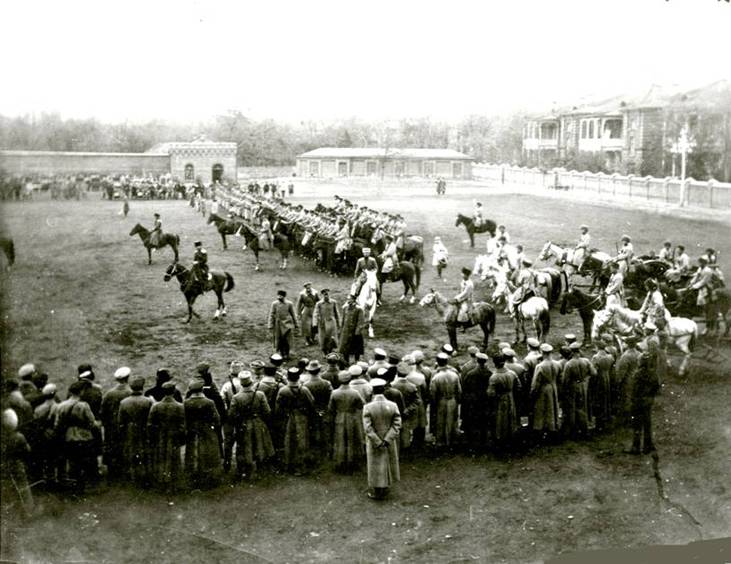
Military parade in Tbilisi, January/1921 During the three years of independence,
Georgia’s moderate socialist leadership were rather successful in the
establishment of a democracy-track society with universal suffrage,
democratically-elected legislature, freedom of speech and tolerance to both
right- and left-wing opposition[2].
However, the development of democratic processes in the First Republic faced
a number of challenges that included involvement in military conflicts with
Turkey, Armenia, as well as “the Reds” and “the Whites” of Southern Russia,
economic blockade by Western powers, delay of international recognition until
early 1920, internal conflicts with some ethnic minorities and subversive
activities of local Bolsheviks encouraged by Moscow and following orders from
the Kremlin[3]. By the end of February, 1920, an alliance
was formed between the Kemalist government of
Beginning
of the War In February 1921, the Soviet Red Army
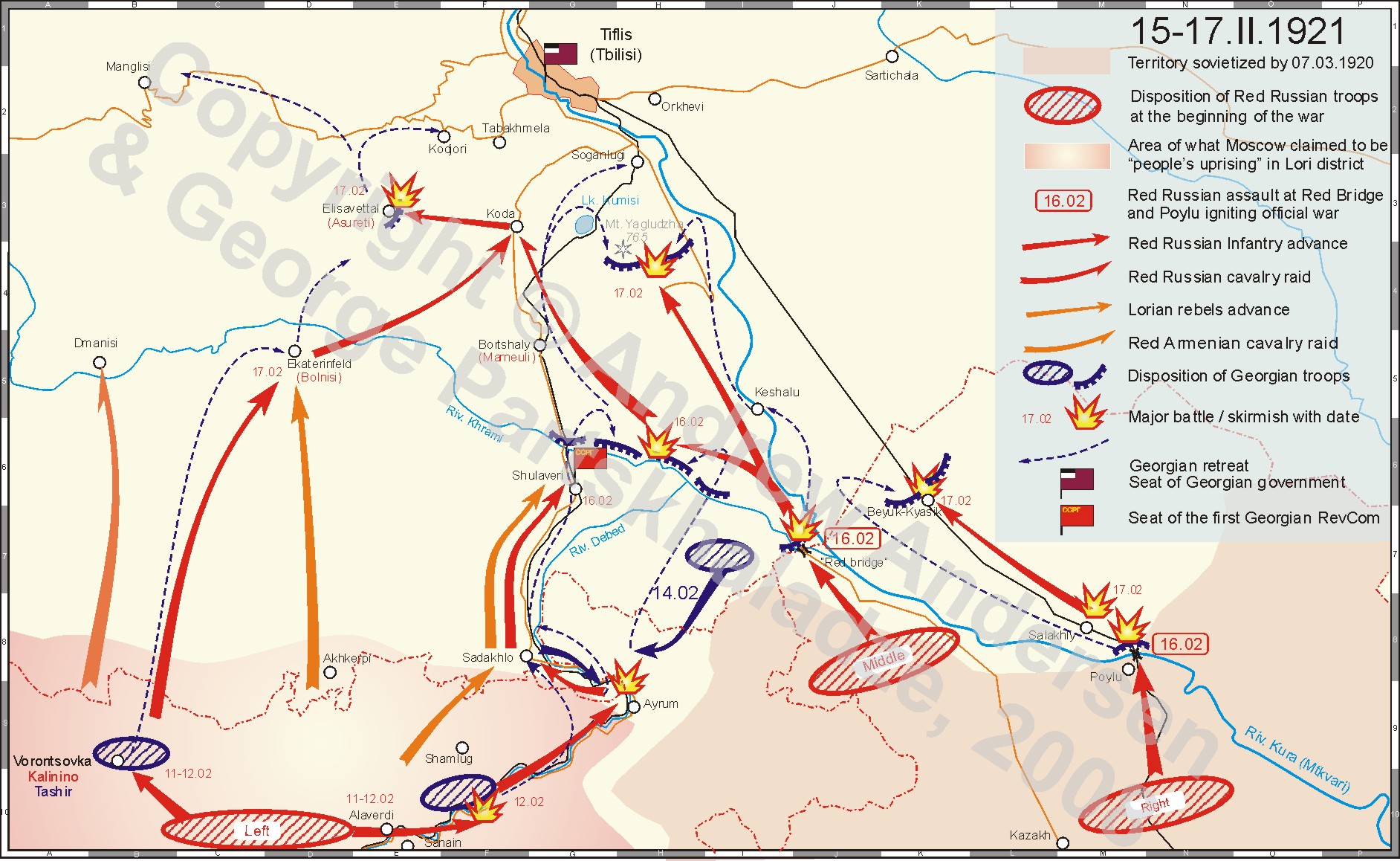
invaded The massive assault on On February 11, 1921, Soviet Russian and
Soviet Armenian troops percolated into Georgian-controlled Borchalo and with
some support of the local population hit Georgian garrisons in Sanaini and
Vorontsovka (Tashir). Caught by surprise and heavily decimated, Georgian
units retreated north- and westwards. During the next 68 hours they got
limited reinforcement (one battalion only) and made an abortive attempt to
regain control over the lost territory. After the failure of their counterattack,
the Georgians fell back further north of the line Ayrum – Sadakhlo (Sanaini
group) and towards Ekaterinenfeld (Vorontsovka group).
Click on the map to get high resolution image On February 16 the Soviet troops including
the regiments of 96th, 60th and 20th Rifle
Brigades of Russia’s 11th Red Army, Soviet Armenian Mounted
Brigade and several detachments of local Bolshevik sympathizers entered the
village of Shulaveri some 25 km to the north-west of Armenian border and the
so-called “Revolutionary Committee of Georgia” consisting of Red commanders
and local Bolsheviks was formed in the village. The same day, it declared
itself to be the only legitimate government of
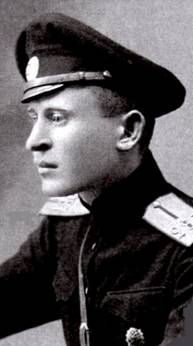
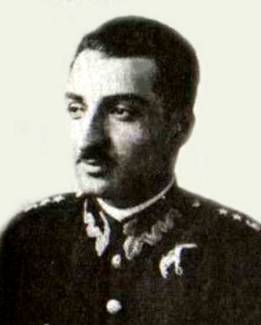
Georgian officers David Sarjveladze
and Akaki Skhirtladze
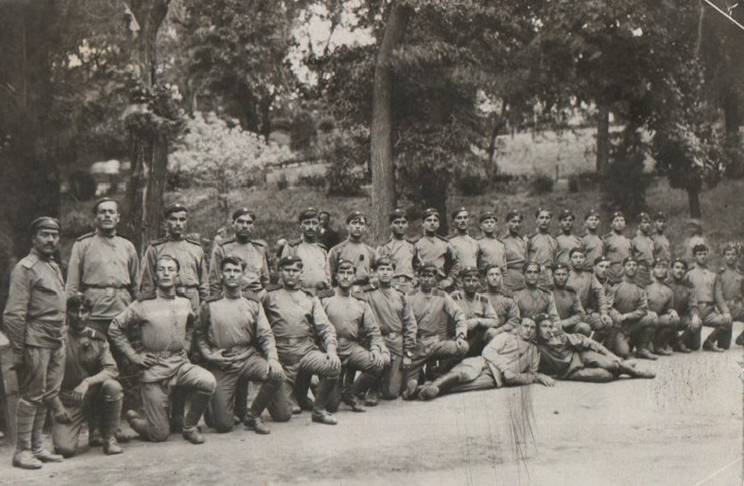
Georgian soldiers At the same time, Soviet Russia’s 98th
Rifle Brigade with Tersky Mounted Division was preparing to attack Soviet
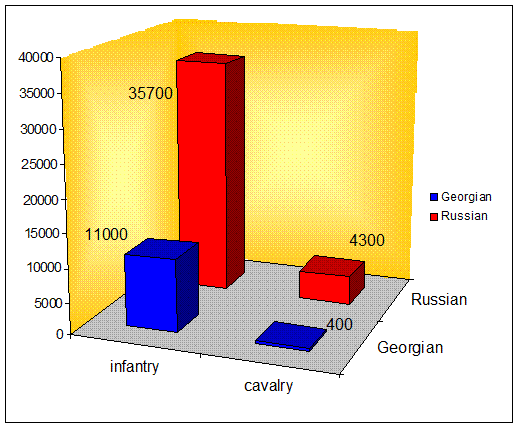
To contain the above invading force, Georgia could put
forward some 11 000 men of the 1st and 2nd Rifle Divisions, a
Mountain Artillery Division, 1st Sukhumi Border Regiment, 2nd
Border Regiment and a dozen battalions of People’s Guard the latter being
civilian militia lacking proper training, command and discipline. Georgian
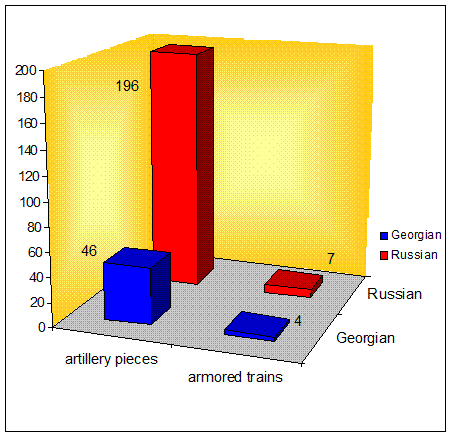
defense forces had 46 pieces of artillery, several hundred machine guns
(exact number unknown), 4 armored trains, several tanks and armored cars
(exact numbers unknown) and almost no cavalry (only 400 mounted troops) that
could prove quite useful in the mountainous landscape of the country.
Georgians also had several modern airplanes that were of much better quality
than those in possession of the Red Army. However, due to the absence of
proper oil and spare parts that the government refused to purchase, Georgian
pilots were incapable of taking full advantage of their technical superiority[5].
Click here to continue |
|
|