|
|
The Livonian War By Kara
Broughton Maps:
Andras Bereznay
Westemanns Atlas zur Weltgeschichte, Berlin, 1953 |
||
|
The ruin of Livonia in the late 1500's was due to a barter of control
for the six countries involved in The Livonian Wars (Lithuania, Russia,
Poland, Germany, Denmark, and Sweden). Livonia was unstable with ongoing
tension between the Order of Livonian Knights and the church. The surrounding
countries used this to their advantage, because Livonia was an important
middle party for trade to them. Although the countries were considered as the
players, the rulers of those countries became the stars of the wars. Their
petty disputes were the destruction of a land that was vulnerable and trying
to figure out how to continue
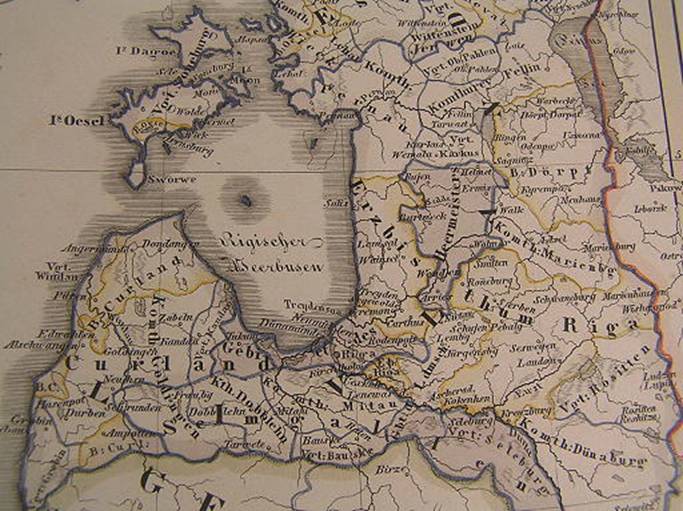
The Livonian
Confederation encompassed a large area bordering Muscovy in the east,
Lithuania and Prussia in the south, the Baltic Sea in the west, and the Gulf of
Finland in the north. It was divided into three areas being Estonia in the
north, Livonia in the middle (also the largest portion of land), and Kurland
in the southwest. The ruling forces
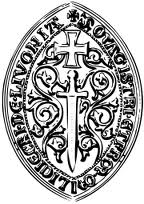
of the Livonian Confederation were: The Order of the Livonian Knights, who
had once been based on Roman Catholic ideas and became secularized in 1562,
the Archbishopric of Riga, the Bishoprics of Dorpat,
Oesel-Wiek, Reval, and
the Hansa towns (the most important being Riga, Reval, and Dorpat). Both the
Master of the Livonian Order and the Archbishop of Riga were looked to for
alliance and direction by representatives of the Livonian Confederation (with
an exception of Dorpat). After the disputes in the
early 16th century between both parties, they decided they needed to abstain
from further division of the Livonian Confederation due to the fear of attack
from Muscovy. |
|
||
|
|
|
||
|
AUDIO
FILES The
Rocky Relationship of Ivan IV & Sigismund Agustus
Tension grew
between Muscovy and Lithuania in the late 15th century. The Muscovites fought
westward continuously trying to expand while the Lithuanians tried to defend
themselves and lost land. With each loss, the Lithuanians signed a peace
treaty, breaking it when they built up, ready to fight back. This vicious
cycle continued for about 50 years before the beginning of what is marked as
the Livonian Wars. (Zur Vorgeschichte
227) Muscovy only kept peace with Lithuania because they had power struggles
to the south and east they wanted to have under control before beginning
another big battle. Lithuania kept peace while trying to obtain allies help attack Muscovy in order to regain control of their
lands (mainly Smolensk).
The disruption in
Muscovy’s relations with Livonia started in 1554, shortly before the
Muscovites attacked Livonia. Different opinions have been formed as to why
Ivan the Terrible invaded Livonia and Sigismund Augustus did not. Erik Tiberg and Johannes Renner believe Ivan IV attacked
because he was not being paid current and back taxes that the Livonians defaulted on. Oscar Halecki
says it is because Heinrich von Galen, who was master of a part of the
Livonian Order in 1554, signed a treaty with Ivan IV stating that they would
not enter into a treaty with Lithuania for 15 years. Although three years
later his successor, Wilhelm von Fürstenberg, made
an agreement with Sigismund Augustus because he was on bad terms with the
Archbishop of Riga and the King of Poland. While Walther Kirchner shows that
due to the disintegration of the Livonian Order, Russia felt the need to
attack before other countries took the land and cut them off to the western
world. My thought is that the effect of the treaty and the access to more
trade worked together as reasons he wanted control over Livonia; while he
used the taxes to show he had power over them and as an excuse to attack when
they were unable to pay him. Attack
of “The Terrible” On January 22,
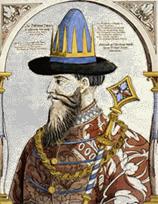
1558, Ivan IV’s armies (also known as Ivan the Terrible) attacked Marienburg and within days took over Narva
and Dorpat. Prior to the attack on Dorpat the master wrote to the Bishop of Dorpat offering assistance to the inevitable war, but the
bishop refused because he was afraid the Order would attack Dorpat and he would rather be defeated by an enemy than a
friend. After the attack the Master of the Teutonic Order, Fürstenberg, sent for help from Emperor Ferdinand of
Germany. Unfortunately, the Empire did not have money to help support the
Order and Fürstenberg was forced to look elsewhere
for help.
A Landtag (a meeting of the leaders of Livonia) met on the
third Sunday of Lent to try and figure out how they would defend themselves
against the Muscovites. At the meeting they decided they would be unable to
defend themselves and to try to obtain an armistice while offering a tribute
from special taxes (including Dorpat) to the grand
duke. While the Bishop of Dorpat decided he would
secretly submit his diocese to Ivan IV as long as they would be free in their
religious practices. The offer from the Bishop of Dorpat
was heard by the grand duke before the proposal from the embassy and so he
declined the money believing that eventually all of Livonia would submit to
him (49). Later Christoffer Lustfer,
who had delivered the message of submission to the grand duke, was captured
and confessed everything then hung himself while in prison.
Obtaining
"Help" from Christian III and Frederick II Denmark was next in
their quest for help. In June 1558, the landtag
convened once again to discuss the war. "It was decided, since the enemy
was capturing one castle after another, pillaging and devastating the
country, and since the forces of the Order along with those of the archbishop
and the diocese were powerless to oppose this, that help would have to be
sought from other rulers and mighty lords" (Renner 61). They decided to
look toward Denmark and sent an embassy to request this decision. Some other
people contacted Sweden due to their connection between Estonia and Finland.
In the beginning of August ambassadors arrived in Denmark and asked for King
Christian III's help in place of surrendering their land to him and he
refused it. Later a leader of Dünaburg described
their situation and asked Christian III for aid and support and he gave the
country some money. Then in December, a Danish delegation was sent by the
king to Muscovy to negotiate peace between Muscovy and Livonia. This failed
and the Danish delegation went home to find out that Christian III had died
and his son Frederick II was their new king. Frederick II had
little experience and different ideas of dealing with Livonia. Johann the
Bishop of Oesel sold his see (the bishopric) to
Frederick II in April 1559. King Frederick II obtained Oesel,
which also included Kurland, for his brother Magnus. The two brothers made a
treaty where Magnus gave up his inheritance to Holstein in favor of the
bishopric of Oesel and on September 26, 1559 the
transfer was made. Moritz Wrangel, the Bishop of Reval, saw the advantage of Johann and quickly resigned
his office to Magnus also. Soon after this happened Master Gotthard Kettler decided to make Magnus an ally and met him at Pernau in August. Then along with Archbishop Wilhelm von
Brandenburg of Riga and his Coadjutor Christoph of
Mecklenburg, Kettler gave to Magnus the portions of
Livonia, which he had taken possession of, but they refused to give him any
more land. Magnus was upset he
had been tricked out of his inheritance of Holstein. After Sweden took Reval, Frederick II made a treaty with Erik XIV of Sweden
in August 1561. The brothers were in great disagreement and Frederick II
negotiated a treaty with Ivan IV on August 7, 1562 in order to help his
brother obtain more land and stall further Swedish advance. Erik XIV did not
like this and The Northern War between Lübeck,
Denmark, Poland, and Sweden broke out. While only losing land and trade,
Frederick II and Magnus were not faring well. But in 1569 Erik XIV became
insane and his brother John III took his place. After all parties had been
financially drained, Frederick II let his ally, King Sigismund Augustus of Poland, know that he was ready for peace. On December 15,
1570, the Stettin peace treaty was concluded. In 1578 Magnus
retired to Poland and his brother all but gave up the land in Livonia.
Frederick II had trouble continuing the fight against Muscovy unlike Sweden
and Poland. He came to an agreement with John III in 1580 giving him the
titles in Livonia. After Magnus died in 1583, Poland invaded his territories
in Kurland and Frederick II decided to sell his rights of inheritance. Except
for the island of Oesel, Denmark was out of the
Baltic by 1585.
Due to the
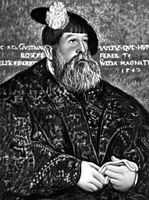
opposition by some of the Order and in wanting to remain neutral, Gustavus refused any appeals Kettler
made to him or his sons, Erik and John. But in the spring of 1560, Gustavus decided to become active and offered money and
mediation in the war between Muscovy and Livonia. Although by that time Kettler no longer wanted Sweden's help and insisted that
their offers came too late, afraid that they would lose help from Poland.
Emperor Ferdinand of Germany once again asked for Gustavus's
help and Poland also began direct negotiations with Gustavus,
but nothing resulted because on September 29, 1560, Gustavus
I Vasa died. Once Erik XIV
became king he took quick actions to get involved in the war. He negotiated a
continued peace with Muscovy and spoke to the burghers of Reval.
He offered them goods to submit to him as well as threatening them. By June
6, 1561 they submitted to him contrary to the persuasions of Kettler to the burghers. The king's brother
John married the Polish princess Catherine. Wanting to obtain his own land in
Livonia, he loaned Poland money and then claimed the castles they had pawned
as his own instead of using them to pressure Poland. After John returned to
Finland, Erik XIV forbade him to deal with any foreign countries without his
consent. Shortly after that Erik XIV started acting quickly lost any allies
he was about to obtain, either from Magnus or the Bishop of Riga. John III ascended
to the throne of Sweden and due to his friendship with Poland he began a
policy against Muscovy. He would try to obtain more land in Livonia and
exercise strength over Denmark. In 1575 after Muscovy attacked Danish claims
in Livonia, Frederick II dropped out of the competition as well as the
Emperor of Germany. After this John III held off on his pursuit for more land
due to Muscovy obtaining lands that Sweden controlled. He used the next two
years of truce to get in a better position. In 1578, he resumed
the fight for not only Livonia, but also everywhere due to an understanding
he made with Poland. While Ivan IV concentrating on fighting Poland, John III
took the chance to take over Narva, ending the
rivalry between the ports of Swedish Reval and
Muscovite Narva. On August 5, 1583, Sweden and
Muscovy signed a treaty.
Kettler had wanted the
help of Poland and was able to work a draft of a treaty to represent the
Livonian Confederation in subjecting to Poland. After the treaty of Vilna was
signed both sides saw no advantage to it. In the spring of 1560 the king
tried to get stipulations made to the treaty for to obtain more occupation in
Livonia. The Livonian Confederation resisted further occupation due to the
failed defense taking place. The reason for this is that Sigismund Augustus
never really meant to help with the war because of his fear of Ivan IV. In
December 1568, the Union of Lublin was signed. The Livonian Confederation
along with the Lithuanian nobility and estates unified with Poland. Poland
suffered greatly in the Northern War and was ready to make peace with Sweden.
Warfare
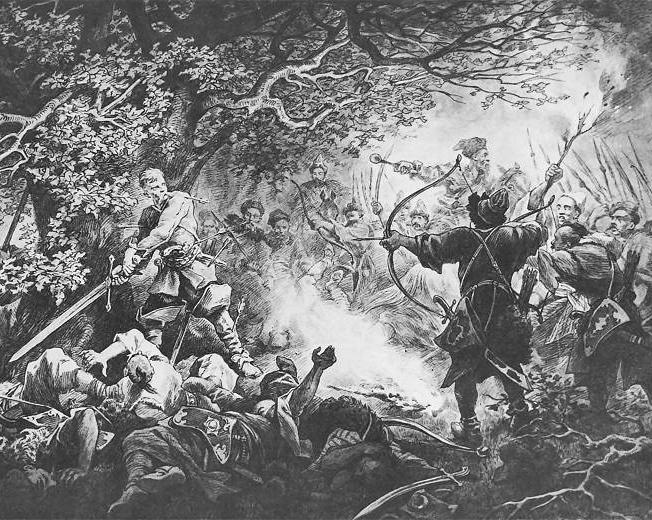
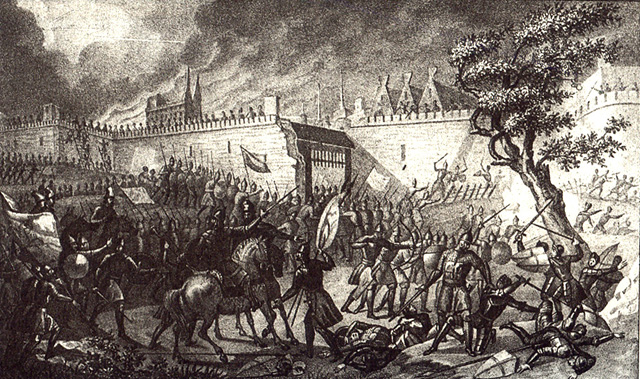
to Remember Burning castles,
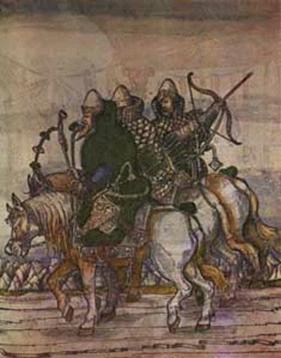
cities and fortresses is mostly how the wars were fought. The envoys would
travel on horses, with peasants walking and taking the brunt of the attack.
When they were able to get close enough or even sometimes after the attack,
they would go through and slay people. Sometimes they would give the
defenders a chance to surrender and as they walked out the Muscovites would
rob the Germans. They used many
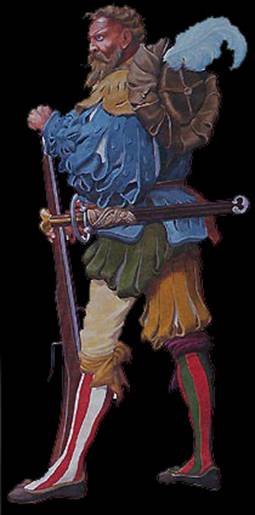
different kinds of weapons. They had arquebusiers,
which is described as a gun with a hook on the bottom that can be placed on a
support. Stone cannon balls were described as being shot as high as one's
knee (Renner 50). Swivel guns, culverins (a slender
cannon), hand guns, and target guns were also used. There was much
propaganda put out by the German nobles describing the harm of the Muscovites
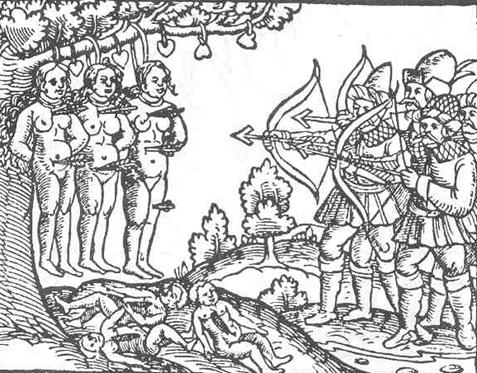
and which gave Ivan IV his nickname of "Ivan the Terrible". This
picture of Ladies hanging from a tree with children dead below shows the
Muscovites doing this and is described in German, which most peasants could
not read. It describes the terrible, cruel, fear inspiring and unheard of
news of the Muscovites. That perpetrating on the captures and prisoners are
men, young women, and children on a daily basis are being harmed. This shows
the Muscovites as a great danger and that this is a warning to all Christians
as to what is happening. This piece of propaganda was done to show that
Muscovites were barbaric and how much they should be feared. |
|
||
|
|
|
|
|
|
|
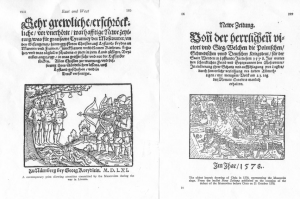
The next picture
presented by the Narva Newspaper describes a
victory. The victory in which the Polish, Swedish, and German warriors for Narva in 1578 maintained and won the fight against the
tyrant of the Muscovites in conquering them and driving them out. The special
granting of God with few people on the 21st day of that month did this. These
pictures and warnings were the propaganda that was used to help form people's
ideas of negativity against the enemy. The pictures were used not just to
form an imprint in one's mind as to the harm that the Muscovites caused, but
also for the peasants who could not read. Post-War
Livonia The
"winners" of the Livonian Wars were both Sweden and Poland. Only
they could not sustain the peace that they concluded with. Only a few years
later they began another war know as the Swedish-Polish War. Although the
area know as the Livonian Confederation has come to
its ruin, the area where it once was will continue to be in and out of
disruption for many years to come.
Bibliography Frost, Robert I. The Northern Wars: War, State, and Society in
Northeastern Europe, 1558-1721. New York: Addison Wesley Longman Inc.
2000. This book was best
used for its mention of propaganda. Both of the maps of the Livonian
Confederation as well as the pictures of propaganda were taken from this
book. There is also good detail as to the peasants and a lot of information
on Ivan IV "The Terrible". He uses this as a tool to discuss
details that are unusual and useful information, giving a different insight
into the people involved in the Livonian Wars, mainly that of the Order and
peasants. Halecki, Oscar. Borderlands
of Western Civilization: A History of East Central Europe. http://historicaltextarchive.com/halecki/11.htm (9 June 2002) New York: Ronald. 1952. The article offers
a good overall view of the mid- to late 16th century. He discusses the
political outlook through the relationships of the rulers. This is the only
on-line article I was able to find that gave good, useful information about
the Livonian Wars and all of the players involved. It is an on-line copy of a
book that was written in 1952. Kirby, David. Northern
Europe in the Early Modern Period: The Baltic World 1492-1772. New York:
Longman. 1990. Pages 418 & 419. This was used for
the picture of the Baltic in 1500. Using this picture is helpful in
understanding where all of the countries are that participated in the
Livonian Wars. Kirchner, Walther. The
Rise of the Baltic Question. Newark: University of Delaware Press. 1954. The question that
Kirchner wants to reflect is "the influence which this area exercised
upon the development of the surrounding great powers" (2). He gives
backgrounds for every political figure involved in the making and ending of
the wars. He gives a good description to who and what the Livonian
Confederation was as well as their disputes and why they were susceptible to
ruin. Then he takes each country involved and gives the reason for their
specific influence and involvement or lack of involvement into the war. There
were so many factors and petty disputes that each country had with each other
and within their own country that they brought to fighting for the areas that
were once know as the Livonian Confederation. This
is best used to know the political strategies and behind the scenes accounts
of relationships of the people in charge of the wars. Renner, Johannes. Johannes
Renner's Livonian History 1556-1561. Translated by Jerry C. Smith and
William Urban with J. Ward Jones. Lewiston: The Edwin Mellen
Press. 1997. Renner took these
notes on the Livonian Wars from the pre-war activities through to the first
few years of the wars. He was first a secretary to the advocate of Jerwen and then to the castellan of Pernau.
Although he wrote a second addition to his account after Balthasar
Russow published his chronicle in 1578 and used
some of Russow's more detailed section for the
years prior to 1556. This book gives very detailed accounts to attacks on
almost every castle or fort in the area in the beginning of the wars. This is
best used for accounts of warfare, and for a description of the areas of the
Livonian Confederation. Tiberg, Erik. Zur Vorgeschichte des
Livländischen Krieges:
Die Beziehungen zwischen Moskau und Litauen 1549-1562.
Motala: Borgströms Tryckeri AB. 1984. The book is written
in German, but has a summary in English. It goes into great detail about the
relations between Russia and Lithuania, prior to the war through the
beginning of the war. Tiberg goes into grave
details as to the petty disputes of the two leaders Sigismund Augustus and
Ivan IV. Mostly described is the resistance of Lithuania to give into Muscovy
and by not recognizing the Ivan IV (grand duke) as Tsar. I was able to
maintain all of my information on the two countries through this 18 page
summary. Urban, William.
"The Origin of the Livonian War". The Lithuanian Quarterly.
29, no. 3 (1983): 11-25 Urban's article is based on comparing other articles on the Livonian Wars. He
discusses the different thoughts on why it began, who Ivan IV was and why he
was able to go so far in his attacks with no one helping the Livonian Confederation.
He discusses Ivan IV's other conquests that made him wait to begin the war
that he so badly wanted. He uses discussions from Tiberg's
article as well as Kirchner and Halecki to discuss
these various aspects in order to give a discussion in English on the
Livonian Wars.
|
|
|
|
Originally
published at http://depts.washington.edu/baltic/papers/ |
|||




.