|
|
Poland: Revolution and Rebirth
By Mieczyslaw Kasprzyk
Maps: Andrew Andersen
|
Napoleonic Poland;
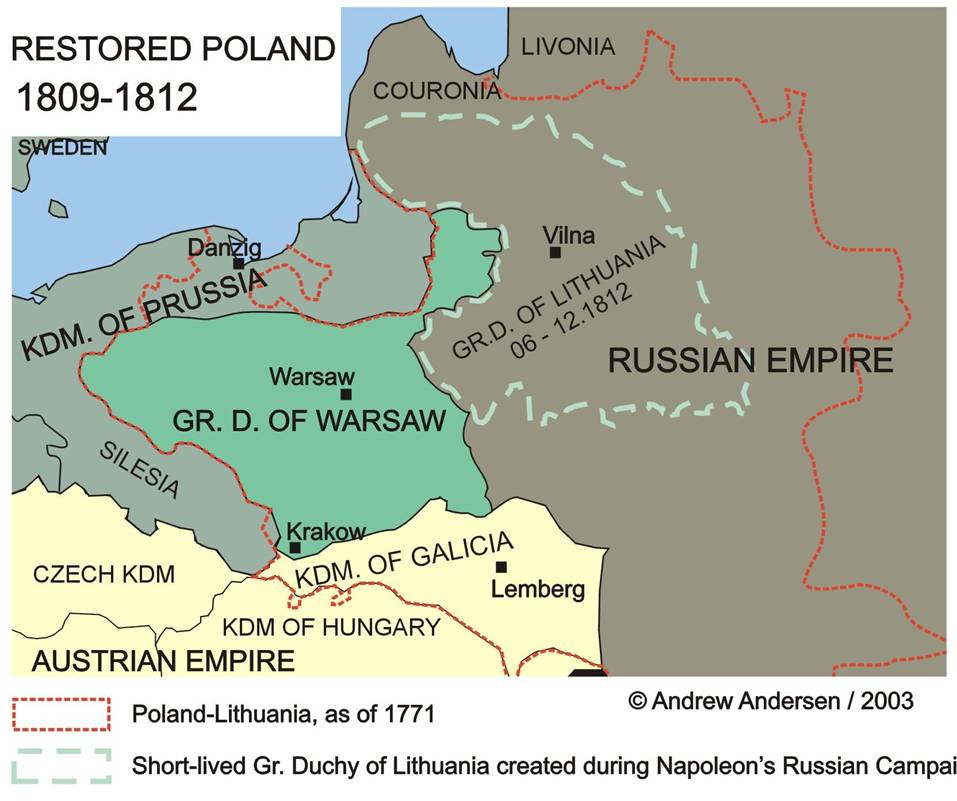
The Duchy of Warsaw
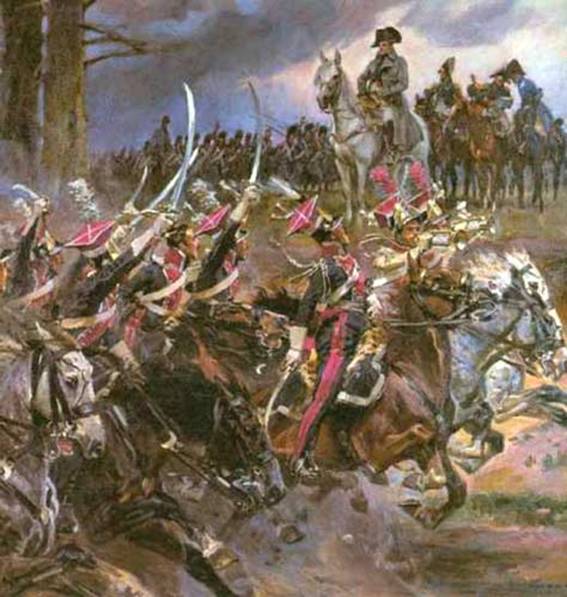
The Poles felt that one way of restoring independence
was to fight for Napoleon Bonaparte. In 1791 Dabrowski
organised two legions to fight the Austrians in
Lombardy and, later, for the French in the Iberian
Peninsula.
Kniaziewicz organised the Polish Danube
Legion to fight against the Germans in 1799.
Napoleon
used the Polish Legions in all his campaigns; against Russia, Austria
and Prussia, in Egypt, in the West Indies (Santo
Domingo), and in Spain
(where they fought the British and inspired the formation of the English
lancers equipped with Polish-style uniforms and weapons). Some of the Poles
became very disillusioned with Bonaparte, realising
that they were being manipulated.
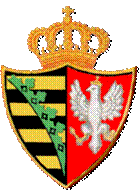
Later, in
1806, the French armies defeated the Prussians at Jena
and entered Posen (Poznan)
led by the Poles under Dabrowski. A year later
Napoleon and the Tzar, Alexander, met at Tilsit and agreed to set up a Polish State made up of the
lands the Prussians had taken in the second partition. This was the Duchy of
Warsaw. Napoleon used the Duchy as a pawn in his political game and in 1812
called upon the Lithuanians to rebel as an excuse to attack Russia. The
Poles, flocking to his standard in the hope of resurrecting the Commonwealth,
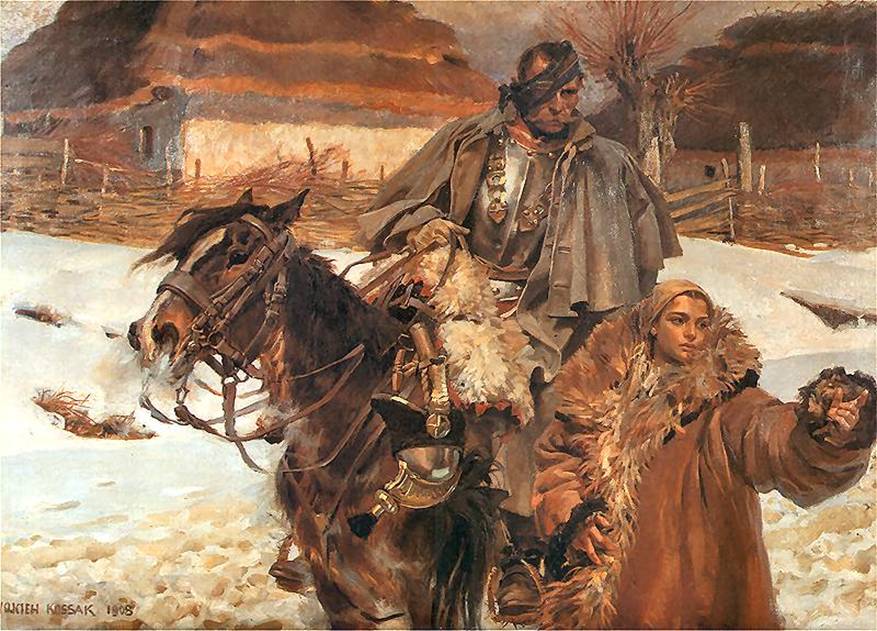
formed the largest non-French contingent, 98,000 men. Polish Lancers were the
first to cross the Niemen into Russia, the first to enter Moscow, played a
crucial part in the battle of Borodino and, under Poniatowski,
covered the disastrous French retreat, being the last out of Russia; 72,000
never returned.
Despite
the cynical way that Napoleon treated the Poles they remained loyal to him and,
when he went into exile on Elba the only
guards that Napoleon was allowed were Polish Lancers.
The "Congress Kingdom"
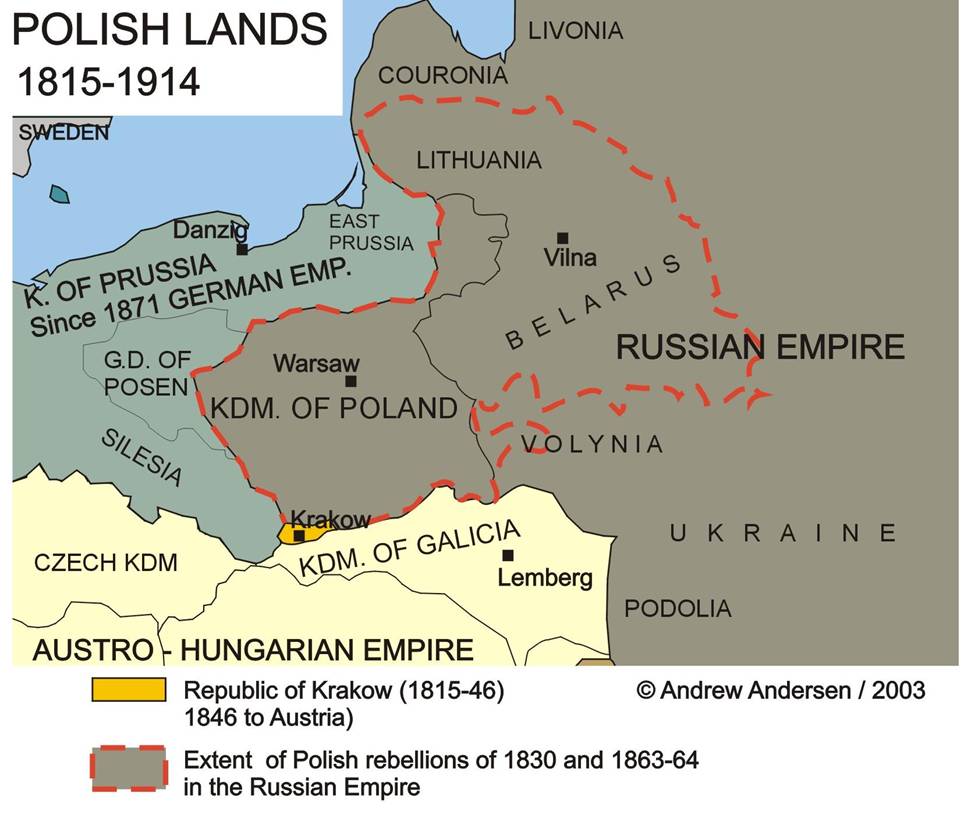
In 1815 at the Congress of Vienna the Duchy was
partitioned and a large part went to Russia. In Austria and Prussia
there was repression of all Polish attempts to maintain the national culture,
but in Russia, fortunately,
the Tzar, Alexander I, was a liberal ruler who agreed
to the setting up of a semi-autonomous "Congress Kingdom"
with its own parliament and constitution. This became a time of peace and
economic recovery. In 1817 the University
of Warsaw was founded.
But the accession of Tzar Nicholas I to the throne in
1825 saw the establishment of a more repressive regime.
In 1830,
after the revolution in France
and unrest in Holland,
Nicholas decided to intervene and suppress the move towards democracy in the
West. He intended to use the Polish Army as an advanced force but instead
propelled the Polish patriots into action. On the night of November 29th the
cadets of the Warsaw
Military College
launched an insurrection. The Poles fought bravely against heavy odds in former
Polish territories around Wilno, Volhynia
and the borders of Austria
and Prussia.
The insurrection spread to Lithuania
where it was led by a woman, Emilia Plater. For a
while victory actually lay in their grasp but indecision on the part of the
Polish leaders led to defeat. Warsaw was taken
in September 1831, followed by terrible persecution; over 25,000 prisoners were
sent to Siberia with their families and the Constitution of the "Congress Kingdom" was suspended.
The 1830
Revolution inspired the work of two great Poles living in exile; Chopin, the
composer, and Mickiewicz, the poet.
The "Great Emigration"
The failure of the Insurrection forced thousands of
Poles to flee to the West; Paris
became the spiritual capital. Many of these exiles contributed greatly to
Polish and European culture. Joachim Lelewel became Poland's
greatest historian, Chopin her greatest composer, and Mickiewicz, Slowacki, Krasinski and Norwid among her greatest poets. Adam Czartoryski
set up court at the Hotel Lambert, in Paris,
which played an important part in keeping the Polish question alive in European
politics.
"For Your Freedom and Ours"
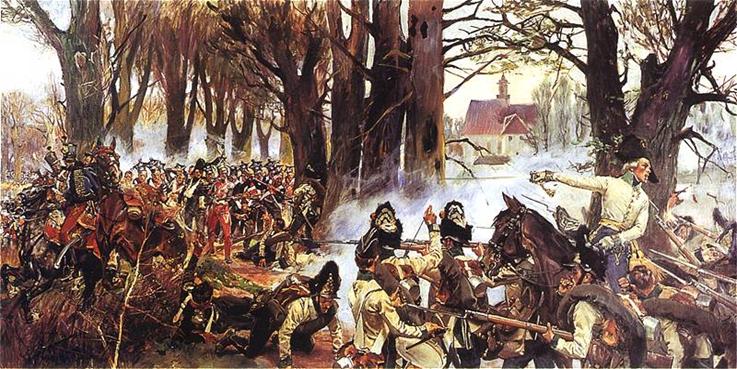
The insurrection in the semi-independent City of Krakow in 1846 was doomed
from the start. The insurrectionists had hoped to gain the support of the local
peasantry (recalling the victory at Raclawice) but
the peasants, having never benefited from the liberal ideals proposed by the intelligensia, used the insurrection as an excuse to rid
themselves of their landlords; it was the last "jacquerie"
(or peasants' uprising) in European history. The insurrectionist forces were
defeated by a combination of Austrian and peasant forces at the battle of Gdow and the insurrection was put down with great brutality
by the Austrians, resulting in the abolition of the Commonwealth of Krakow.
In 1848
"the Springtime of Nations" (a revolutionary movement towards greater
democracy in much of Europe) saw large-scale contributions by the Poles; in
Italy, Mickiewicz organised a small legion to fight
for Italian independence from Austria, whilst in Hungary, Generals Dembinski and Bem led 3,000 Poles
in the Hungarian Revolution against Austria. There were also unsuccessful
uprisings in Poznan (Posen), against the
Prussians, and in Eastern Galicia, against the
Austrians.
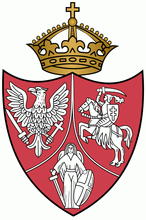
Starting
in 1863, the "January Uprising" against the Russians lasted for more
than a year and a half. A Provisional government was established and more than
1,200 skirmishes were fought, mostly in the deep forests under the command of Romuald Traugutt. Italian help
came from the "Garibaldi Legion" led by Colonel Francesco Nullo. In 1864 Traugutt and four
other members of the Provisional government were captured in Warsaw and publicly executed.
The
Uprising was finally put down in 1865, and the Kingdom of Poland
was abolished and a severe policy of persecution and "Russification"
established. The University
of Warsaw and all schools
were closed down, use of the Polish language was forbidden in most public
places and the Catholic Church was persecuted. The Kingdom
of Poland became known as the "Vistula Province".
In the
Prussian occupied zone the aim was to totally destroy the Polish language and culture;
from 1872 German became compulsory in all schools and it was a crime to be
caught speaking in Polish. There was a systematic attempt to uproot Polish
Peasants from their land. A special permit was needed to rebuild any farm
buildings damaged or destroyed by fire or flood, but none were ever granted to
Poles. One peasant, Wojciech Drzumala,
challenged this law by living in a converted wagon.
In
Austrian Poland, Galicia,
conditions were different. After 1868 the Poles had a degree of
self-government, the Polish language was kept as the official language and the
Universities of Krakow and Lwow were allowed to
function. As a result this area witnessed a splendid revival of Polish culture,
including the works of the painter Jan Matejko, and
the writers Kraszewski, Prus
and Sienkiewicz.
All three
powers kept Poland
economically weak in this period of technological progress. Despite this the
Poles managed to make some progress; the textile industry began to flourish in Lodz (the "Polish
Manchester") and coal-mining developed rapidly. In Prussian Poland,
despite ruthless oppression, the Poles concentrated on light industry and
agriculture (and before long Poznan became the
chief source of food for the whole of Germany). In Silesia, under German rule since 1742, the
development of mining and heavy industry made her a chief industrial centre and
thus the Prussian attempt to exterminate all traces of Polish language and
culture was at its most ruthless, yet they survived.
Despite
its abolition by Kosciuszko in 1794 the partitioning powers restored serfdom.
It was not abolished in Prussia
until 1823, in Austria until
1848 and in Russia
until 1861 (but not in her "Polish" territories).
In 1905
the Russo-Japanese War saw a series of humiliating defeats for the Russians and
civil unrest in Russia.
In Poland
there was a wave of strikes and demonstrations demanding civil rights. Polish
pupils went on strike, walking out of Russian schools and a private organisation, the "Polska Macierz Szkolna"
("Polish Education Society"), was set up under the patronage of the
great novelist, Henryk Sienkiewicz.
Then, in
1906, Jozef Pilsudski, a founder-member of the Polish
Socialist Party (PPS), began to set up a number of paramilitary organisations which attacked Tzarist
officials and carried out raids on post offices, tax-offices and mail-trains.
In Galicia the Austrian
authorities turned a blind eye to the setting up of a number of
"sporting" clubs, followed by a Riflemen's Union.
In 1912, Pilsudski reorganised these on military
lines and by 1914 had nearly 12,000 men under arms.
PART II See also: “The Rebirth of Poland” by Anna M. Cienciala
The First World War: 1914-1918
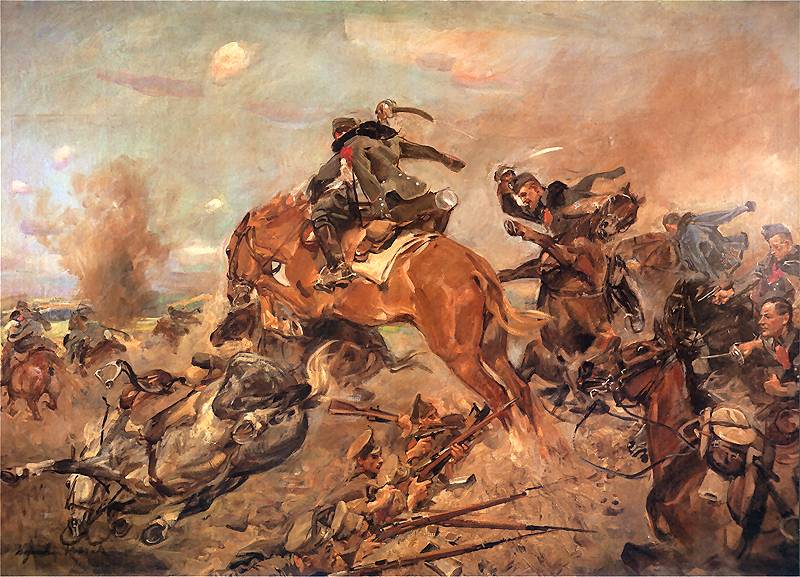
On the outbreak of war the Poles found themselves
conscripted into the armies of Germany,
Austria and Russia,
and forced to fight each other in a war that was not theirs. Although many
Poles sympathised with France
and Britain
they found it hard to fight with them on the Russian side. They also had little
sympathy with the Germans. Pilsudski considered Russia
as the greater enemy and formed Polish Legions to fight for Austria but
independently. Other Galician Poles went to fight against the Italians when
they entered the war in 1915, thus preventing any clash of conscience.
Almost
all the fighting on the Eastern Front took place on Polish soil.
On the
collapse of the Tzarist regime in Russia in 1917, the main purpose for fighting
alongside the Central Powers, Germany
and Austria, disappeared. They had made many promises of setting up an
independent Poland
but had proved to be very slow in carrying these promises out. When Pilsudski's
Legions were required to swear allegiance to Germany they refused and Pilsudski
was imprisoned. In 1918 when, at Brest Litovsk, the
Central Powers signed a peace treaty with Russia, which was detrimental to
Poland, the Second Brigade under General Haller revolted and marched into the
Ukraine where they joined other Polish forces already formed there and fought
against the Germans, eventually being surrounded and defeated.
At the
outbreak of the revolution in Russia Polish army units had joined together to
form the First Polish Corps under General Jozef Dowbor Munsnicki and tried to
reach Poland
but were disarmed by the Germans. Escapees and volunteers reorganised
themselves into a new army at Murmansk in the
Arctic and fought alongside the British on the shores of the Whits Sea
and beside the French at Odessa, as well as in
the Far East at Siberia. Later they managed to
reach Poland.
Roman Dmowski, founder of the right-wing Nationalist League, had
foreseen that Germany was
the real enemy and gone to France
where the "Bayonne Legion" was already fighting alongside the French
Army. He and Paderewski formed a Polish Army which consisted of volunteers from
the United States, Canada and Brazil together with Poles who had
been conscripted into the German and Austrian armies and had become POWs. This
Army became known as "Haller's Army" after its commander who had
escaped from Russia to France.
Rebirth: 1918-1922
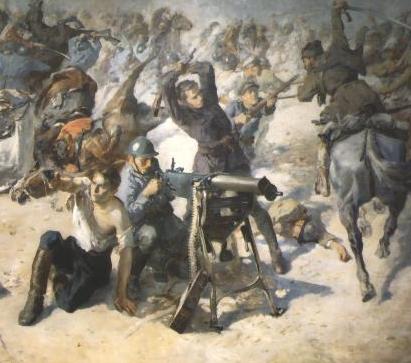
All sides, from Tzar
Nicholas of Russia to President Wilson (in his Fourteen Points) had promised
the restoration of Poland yet in the end the Poles regained independence
through their own actions when, first Russia, and then the Central Powers
collapsed as a result of the War.
In 1918,
on the 11th November, Pilsudski, having been released by the Germans,
proclaimed Polish Independence
and Became Head of State and Commander-in-Chief, with Paderewski as Prime
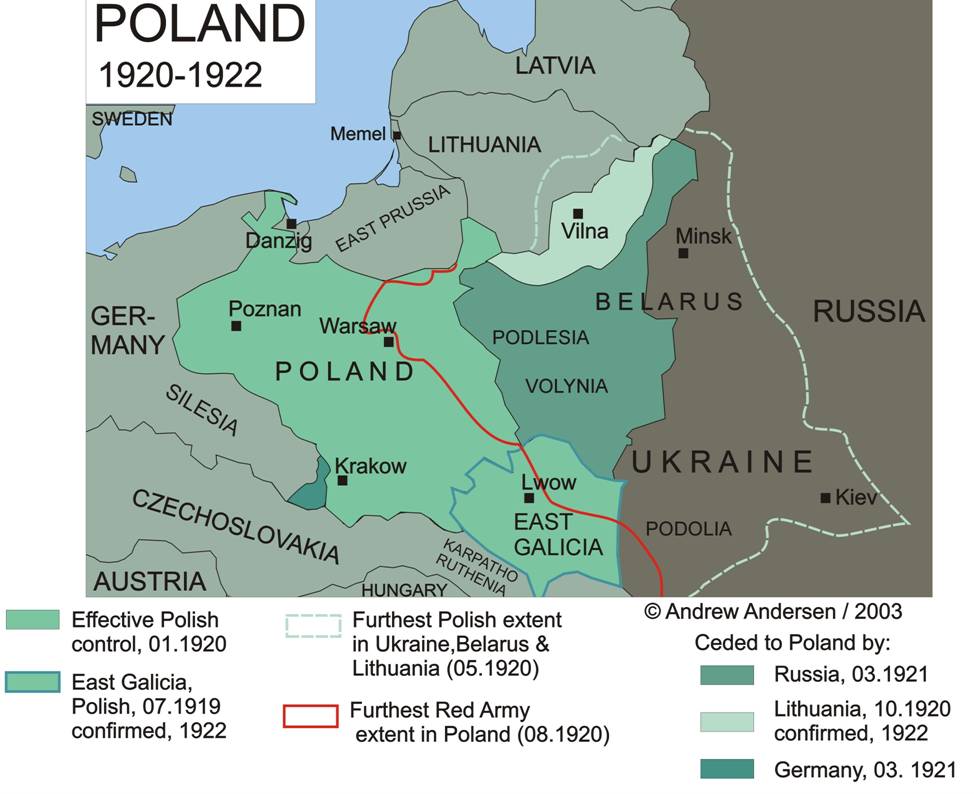
Minister. An uprising liberated Poznan and,
shortly after, Pomerania (which gave access to
the Baltic).
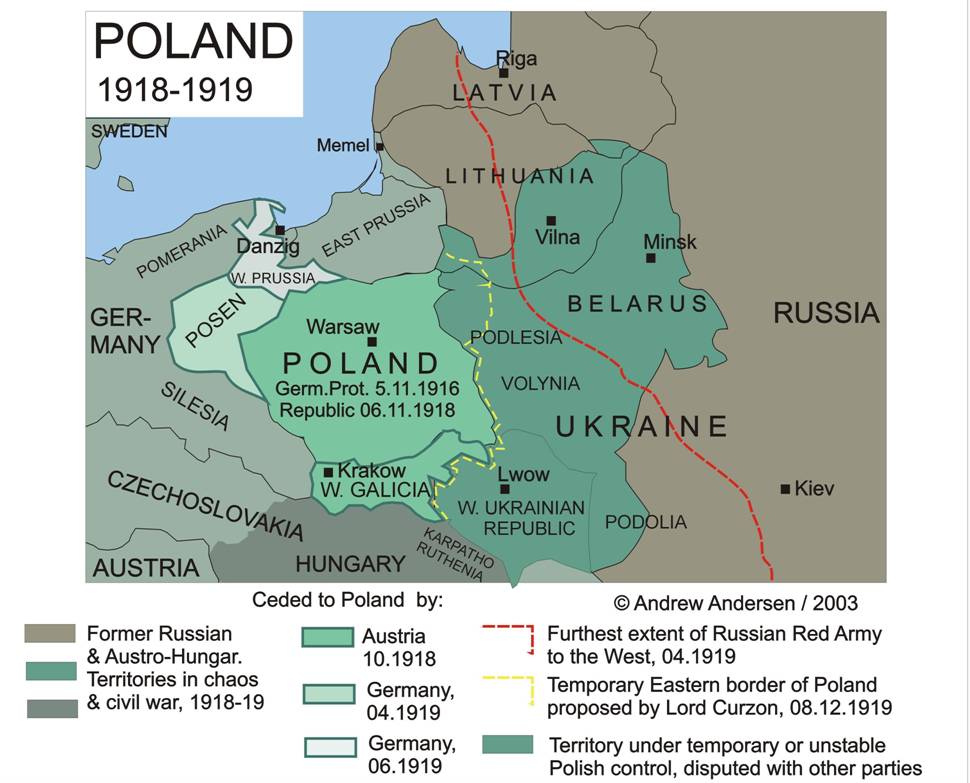
In the
chaos that followed the collapse of the Powers new states had arisen; Lithuania, Czechoslovakia
and the Ukrainian
Republic. All these
states laid claims on territory occupied by Poles.
The Poles
liberated Wilno from the Lithuanians in 1919,
reoccupied the area around Cieszyn (which had been
invaded by the Czechs) and annexed the Western Ukraine when the Ukrainian Republic,
which had been supported by Poland,
collapsed under attack from Soviet forces.
The Red
Army, having crushed all counter-revolutionary forces inside Russia, now turned its attention on Poland.
By August 1920 they were at the gates of Warsaw.
On August 15th the Polish Army under Pilsudski, Haller and Sikorski
fought the Battle of Warsaw (the "Miracle on the Vistula"), routed
the Red Army and saved a weakened Europe from
Soviet conquest. An Armistice was signed at Riga
in October, followed by a Peace Treaty in March 1921 which determined and
secured Poland's
eastern frontiers.
In 1922
part of Upper Silesia was awarded to Poland
by a Geneva Convention following three uprisings by the Polish population who
had been handed over to Germany
at the Peace Treaty of Versailles.
The Second
Republic: 1921-1939
On March 17th, 1921, a modern, democratic constitution
was voted in. The task that lay ahead was difficult; the country was ruined
economically and, after a hundred and twenty years of foreign rule, there was
no tradition of civil service.
Marshal
Pilsudski resigned from office in 1922, and the newly-elected President,
Gabriel Narutowicz, took office only to be
assassinated a week later.
Seeing
that the government lacked power because of party strife, Pilsudski took
control by a coup d'etat in 1926 and established the Sanacja regime intended to clean-up ("sanitise") political life. By 1930 this had become a
virtual dictatorship.
Despite
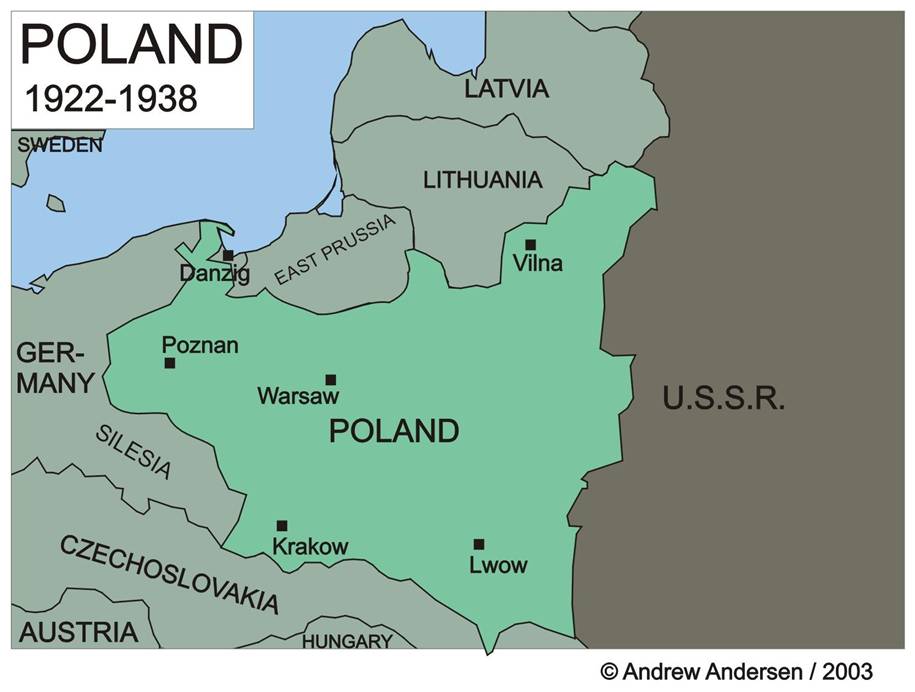
all her problems Poland
was able to rebuild her economy; by 1939 she was the
8th largest steel producer in the world and had developed her mining, textiles
and chemical industries. Poland had been awarded limited access to the sea by
the Peace of Versailles (the "Polish Corridor") but her chief port,
Gdansk (Danzig) was made a free city (put under Polish protection) and so, in
1924, a new port, Gdynia, was built which, by 1938, became the busiest port in
the Baltic.
There
were continual disputes with the Germans because access to the sea had split Germany into two and because they wanted Danzig under their control. There problems increased when
Adolf Hitler took power in Germany.
In 1939,
under constant threat from Germany,
Poland entered into a full
military alliance with Britain
and France
In August,
Germany and Russia signed a secret agreement concerning the
future of Poland.
Originally published at http://www.kasprzyk.demon.co.uk/www/HistoryPolska.html
BACK TO POLISH HISTORY
SEE ALSO RELATED BIOGRAPHIES