The Establishment of the
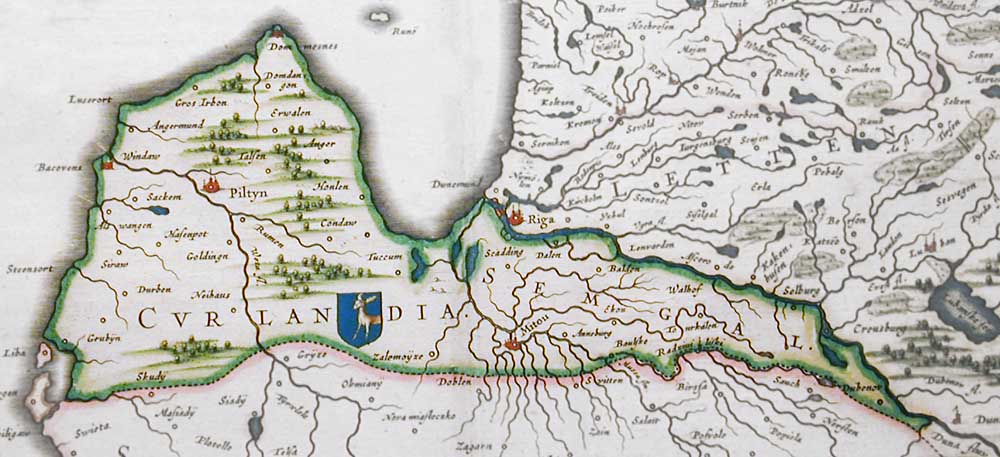
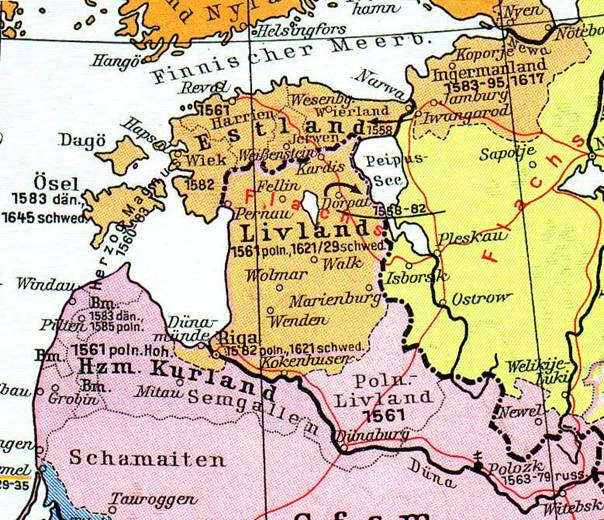
Duchy of The territories that comprised the Livonian Confederation in the Baltic region
were militarily weak and losing appeal.
Territory expansion became the new buzzword. The Swedes, Russians, and Poles saw the
weak
The nobles of Northern Livonia asked
protection from the Swedes and the nobles of the South asked protection from
the Poles. The Master of the Livonian
Order, Livonian nobility in the South, the Archbishop of Riga, swore loyalty
to Sigismund, King of Poland in 1561.
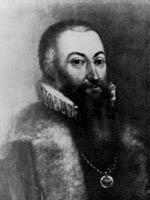
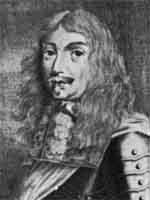
Gotthard Kettler, the Grand Master of the
Livonian Order, was now the Duke of Courland-Semigallia
district and a vassal of the King. In
return, he agreed to secularize all the German noble landowners and provide a
military force in war. He owned a
third of the district of Courland-Semigallian and
he was given autonomy and hereditary rights that lasted for nearly two and a
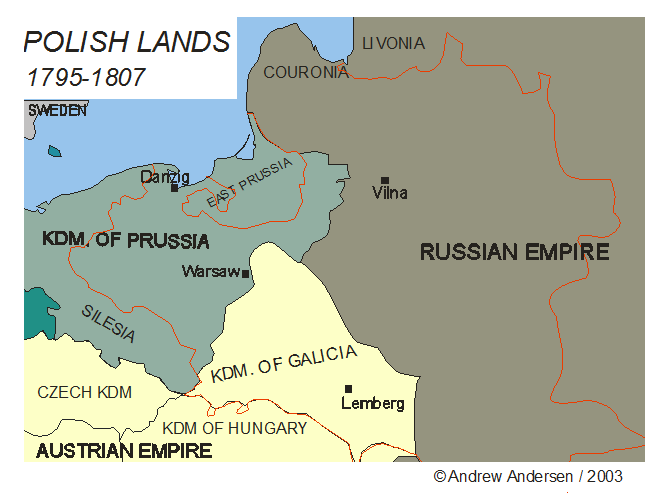
half centuries, until the final incorporation into the Russian Empire in
1795. Click here for the list of the Dukes of Courland
Duke Gotthard Kettler
obtained from the King of Poland the Pacta
Subjections. This written document
signed by Duke Gotthard established the boundaries of the duchy, religious
rights, confirmed all privileges of Courland nobles, right to free commerce,
the right to coin money and Poland to recognize all the laws of
Courland. Following the war, he sought
to rebuild the duchy that had been destroyed.
In order to enlist the unsupportive nobles, he had to provide them
with certain privileges, which initiated the Privilegium
Gotthardinum.
Under the laws provided for by Duke Gotthard, nobles had the right to
engage in commerce, distill spirits, brew beer, hunt, fish, run taverns,
etc., forbid the nobles from taxes and other obligations. In case of war they were to provide horses
and men. Also rights were given to the
nobles to have squires preside as judges on their private manors and
non-noble inhabitants. The nobles were
given rights to the land along with the right of enserfment. Of 359 fiefs in The Religious Awakening: Lutheranism, Calvinism, Orthodox and Brethren
religion was also being challenged by the status quo of Catholicism and
Protestantism in all the regions. King
Sigismund Augustus of
Wars: Duke Gotthard Kettler
died on May 17, 1577 succeeded by his two sons. Trying to be fair to both of them, he
divided the Duchy between them.
Friedrich will rule Semigallia and Wilhelm
to rule
The local nobles wasted little time bringing
complaints to the King about the brothers that eventually resulted in his
intervention. Wilhelm was eventually
stripped of his ducal rights and heredity rights after a commission was
appointed to reside over the murder of some local nobles, who were acting for
the King. They were summoned in the
middle of night and murdered. Gotthard
and Magnus von Norde, who in 1615 traveled under
the service of the King, had verbally abused the dukes in public. Duke Friedrich had no children, which
spelled doom for their Kettlers rule. Duke Friedrich appealed the King's
decision, but the King's position wouldn’t change. Many other leaders wrote letters to the
Polish King to persuade him to appeal his earlier conviction. Duke Wilhelm moved to
Duke Jacob Kettler
was a very determined individual. In
1634, he joined the Polish army during the Polish-Russian War. He was well educated by Western
standard. He became very interested in
Mercantilism. He learned that the
peasants for the past several centuries were well known for their skills as
daring sailors. His goal was to
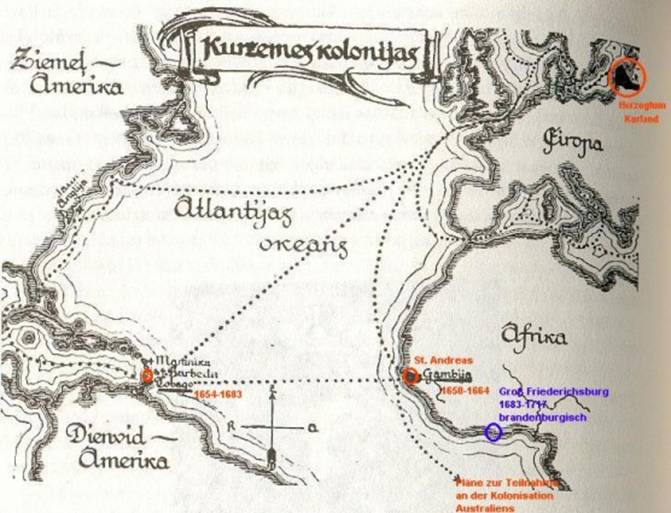
improve the treatment of his serfs and beyond. In 1639, Duke Jacob began to rule over Though a small country, he competed in the
shipping and trade industry, alongside Duke Jacob founded his first colony in 1642
in Tobago Island, Caribbean and built a fort and set out colonizing the
land. Becoming very wealthy and a
renowned among the larger European countries, he realized that in order to
have a steady economy, there must be a middle class.[7][7]
But home trouble was brewing. Click on the below map or on the flag
The Polish-Lithuania-Swedish
War: Following the invasion of Muscovy into The Northern War: Duke Friedrich Casimir
tried to revive his father’s shipping business. He served as duke from 1682 to1698. Towards the end of the century, his
interest wavered and he had to give up the colonies and the prestige. The landed nobility used this opportunity
to strength their control over the serfs.
Duke Friedrich Wilhelm in 1998, because of his youth, his mother
Elizabeth Sofia and his father’s brother Ferdinand acted as regents. Lacking such leadership, Courland and Peter I never gave up on capturing the The Male-Line of the Kettler ends: From 1721-1737, the last Kettler,
Duke Ferdinand emerges. At this point,
the duchy and Poland-Lithuania is fairly weak. When Duke Ferdinand dies childless, his
widow Anna the Tsar Ivan V daughter, persuaded the Tsar to allow Ernst Johann
Biron to be the new duke. Russian domination of
Courland-Semigallia was secured. Russification of Courlandic affairs ended with Duke Peter tenure. The duke was in constant conflict with the
local nobles, those who, however weakly supported Duke Ernst rule; those who
thought Courland’s Annexation to In 1763 King Stanislas
Poniatowski of Poland-Lithuania was undergoing a
civil war between pro and anti-Russian factions. Catherine the Tsarist of Russia agreed with
Frederick II of The Moravian Brethren Movement entered the
Baltic lands. The nobility saw it as a
good thing and thought it would make peasant more obedient. This movement was stopped. However in 1770, the censorship was lifted.
The piestic spirit had already become deeply
embedded in the folk memory of the Latvian peasant. This new religion in the Baltic lands
ideology was thought to be a good thing.[11][11]
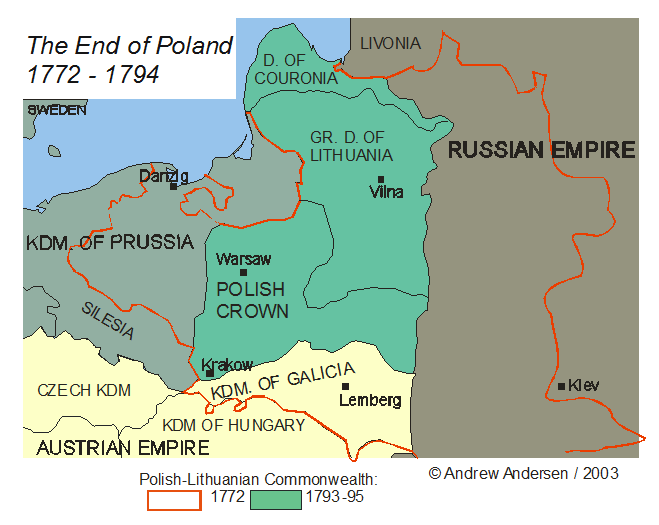
Opponents of the King of Poland and Patriotic party who formed the
confederation of Targowica and the insurrection led
by General Tadeusz Kosciuszko in 1794 was the final
assault of a revolutional uprising that was going
to be tolerated on Catherine’s doorstep.
Russian and Prussian military intervention put an end to the revolt
and Poland-Lithuania.[12][12] Duke Peter and the Courlandic
nobles, at the end of the third partition, were ready to pledge their loyalty
to Catherine the Great of Russia. Tsarine Catherine bought the estates of Duke Peter and
the end of a 233 years existence of Courland and the extension of the Russian
boarders to the
[13][1] The Reign of Duke James in [14][2] http://www.poloniatoday.com/history6.htm [15][3] The Enchiridion of Erasmus,
Erasmus [16][4] The Latvians Plakans [17][5] The Reign of Duke James in [18][6] The Ancient Couronians
in Africa, [19][7] Senie kurzemnieki Amerika un [20][8] http://historicaltextarchive.com/austria/chap25.htm [21][9] http://www.geocities.com/Athens/Olympus/5539/courland/courland.html [22][10] http://www.utb.boras.se/uk/se/projekt/history/articles/decline/decline2.htm [23][11] The Latvians, Plakans [24][12] http://www.campus.northpark.edu/history/WebChron/EastEurope/2PartPoland.html>
Anderson,
Edgar. The Ancient Couronians in DK: DK,
1970. The summary page emphasizes in
detail the duke Jacobson of Courland (1642-81) reign during Courland
expansion into West Africa, the Anderson, Edgar. Senie kurzemnieki Amerika un Duchy of Courland was one
of the first European countries to play a role in the Berkis,
Alexander V. The reign of duke James in Berkins, author, was born and educated in
Plakans
Andrejs. TheLatvians. Stanford: The history of the Latvians and Erasmus. The
Enchiridion of Erasmus. Translated by Raymond Himelick. University Press, 1963. “Reawakening”
of the religious spirit for those who have the Enchiridion. This book was Erasmus ideal of the
Scripture should be easy to read and understandable by anyone. The first published in 1503 when he was
about thirty-five years of age. He
attended St. Lebwin’s T. R. Jasinski-Herbert, “Polonia
Today,” A brief History of May 24, 2001, <http://www.poloniatoday.com/historyix.htm
> (01 June 2001).
This
site is dedicated towards Polish causes across the globe. The site has several links that emphasizes
history, current events, advertisement, and online news. My material evaluated came from its history
link that provided several brief chapters of Polish History.
Encyclopaedia Britannica, 11th
ed., s.v “The Cossacks.” <
http://historicaltextarchive.com/austria/chap25.htm> The reformation in chapter 25
details the Sweden-Polish War and the Treaty of Olvia. This site provides a brief history
of H. Spaugh, “A Short Introduction to the History, Custom
and Practices of the <http://www.everydaycounselor.com/archive/sh/shistory.htm>
John
Hus a Roman Catholic Priest became disenfranchise with the corruption of the
Catholic Church. He started to speak
out against the Catholic Church and was called before the Council of
Constance to recant his words. He
refused and was bound and burned to death at the stake. Emerged were the new Moravians such as
Martin Luther with the spreading of the Protestant Reformation.
M.
Dziedzic, “Russian and Eastern Europe Chronology,” The
Second Partition of http://www.campus.northpark.edu/history/WebChron/EastEurope/2PartPoland.html>
(01
June 2001) This
web site is part of the History Department of North Park University. The site contains the research of
students. You can find brief history ob the Balkans,
M.
Bjorkman and L. Hult,
“The Decline of the Great Power” n.d., http://www.utb.boras.se/uk/se/projekt/history/articles/decline/decline2.htm
(01 June 2001
There
are two authors who speak very simple about the subject. The color background of the article and
links are easy to read. The authors
give a brief history of several battles by
G. Eisters, "Duchy of
<http://www.geocities.com/Athens/Olympus/5539/courland/courland.html>
(06 May 2001) This site provides a history and a
graphic display of historical Baltic and a very brief history of the Duchy of
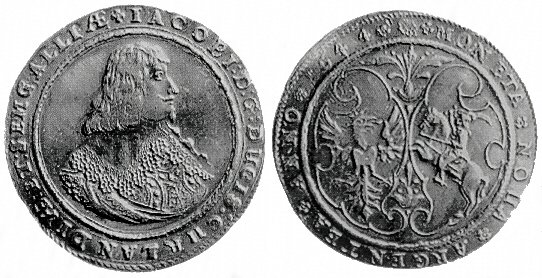
Courland. The sight shows a list of
the rare coins used during the period.
The author is a collector a rare coins. She doesn’t exactly say which
Baltic country she’s from, however I suspect Originally
published at http://depts.washington.edu/baltic/papers/
|